
Please briefly explain why you feel this question should be reported.

Please briefly explain why you feel this answer should be reported.

Please briefly explain why you feel this user should be reported.

Sign InSign Up

AccountingQA

AccountingQA Logo AccountingQA Logo

AccountingQA Navigation

  • Home
  • Ask Questions
  • Write Answers
  • Explore
  • FAQs
Search
Ask A Question

Mobile menu

Close
Ask a Question
  • Home
  • Questions
    • Most Visited
    • Most Active
    • Trending
    • Recent
  • Follow
    • Categories
    • Users
    • Tags
  • Write an Answer
  • Badges & Points
  • Request New Category
  • Send a Suggestion
  • Search Your Accounting Question..

  • Recent Questions
  • Most Answered
  • Answers
  • Most Visited
  • Most Voted
  • No Answers

AccountingQA Latest Questions

A_Team
A_Team
In: 1. Financial Accounting > Subsidiary Books

why cash book is called journalised ledger?

  • 1 Answer
  • 0 Followers
Answer
  1. Vijay Curious M.Com
    Added an answer on August 22, 2021 at 7:28 am

    Cash Book is called a journalized ledger because it is considered to be both a journal as well as a ledger. As you know Cash Book is a subsidiary book. But like a journal, the transactions in the Cash Book are recorded in it for the first time from the source documents/vouchers. Hence it is considerRead more

    Cash Book is called a journalized ledger because it is considered to be both a journal as well as a ledger.

    As you know Cash Book is a subsidiary book. But like a journal, the transactions in the Cash Book are recorded in it for the first time from the source documents/vouchers. Hence it is considered to be a journal for all cash transactions.

    Cash Book can also be viewed as a Cash A/c because all transactions involving cash are recorded in it. It provides a summary of cash transactions. Hence it is considered to be a ledger account for cash transactions.

    Since Cash Book is both a journal and ledger, you can very well call it a ‘journalized ledger’.

    See less
    • 0
    • Share
      Share
      • Share on Facebook
      • Share on Twitter
      • Share on LinkedIn
      • Share on WhatsApp
Astha
AsthaLeader
In: 1. Financial Accounting > Accounting Terms & Basics

What is the difference between personal accounts, real accounts and nominal accounts?

  • 1 Answer
  • 0 Followers
Answer
  1. Simerpreet Helpful CMA Inter qualified
    Added an answer on August 18, 2021 at 2:59 pm
    This answer was edited.

    Personal Accounts: The accounts of persons, firms, companies, etc. are personal accounts. There is a further classification to personal accounts- Accounts of Natural Persons: The transactions relating to individual human beings fall under this category. For Example, accounts of Joseph, Richard, MorrRead more

    Personal Accounts: The accounts of persons, firms, companies, etc. are personal accounts. There is a further classification to personal accounts-

    • Accounts of Natural Persons: The transactions relating to individual human beings fall under this category. For Example, accounts of Joseph, Richard, Morris, etc.
    • Accounts of Artificial Persons: The transactions relating to firms, organizations, companies, institutions, associations, etc. fall under this category. For Example, Oil India Ltd, Symbiosis college, Assam Tea company, etc.
    • Representative Personal Accounts: The transactions relating to certain person or a group of persons, although the name of the concerned person or persons are not mentioned in the account head, such types of accounts come under this head. Such type of accounts generally include outstanding accounts or prepaid accounts. For Example, accounts like wages outstanding, outstanding salary, commission received in advance, salary prepaid, etc.

    Note: When any Prefix or Suffix is used before/ after any nominal account head, such account is classified as Representative personal account under traditional approach.

    For Example, Salary A/c is a nominal account whereas salary outstanding A/c is a personal account as the word outstanding is being used as a prefix to Salary A/c.

    The Accounting rule for Personal Account is –

    Debit the Receiver of the benefit.

    Credit the Giver of the benefit.

    Real Account: The transactions relating to tangible things i.e. the things that can be seen, touched and physically exchanged and the intangible things that cannot be seen, touched but the presence can be felt comes under this category. For Example, tangible things like Cash, goods, building, machinery, etc. and intangible things like goodwill, patent, trademarks, etc.

    The Accounting rule for Real Account is –

    Debit what comes in.

    Credit what goes out.

    Nominal Accounts: The transactions relating to losses, expenses, incomes and gains comes under this category. For Example, Rent paid, wages paid, commission received, interest paid/ received, etc.

    The Accounting rule for Nominal Account is –

    Debit Expenses and Losses.

    Credit Gains and Incomes.

    Some Common Examples under the three heads are
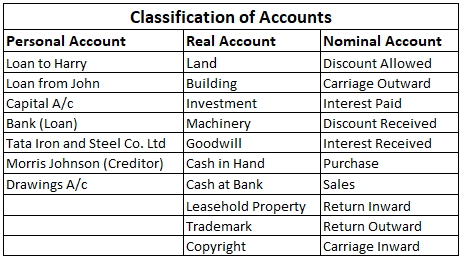
    See less
    • 0
    • Share
      Share
      • Share on Facebook
      • Share on Twitter
      • Share on LinkedIn
      • Share on WhatsApp
Naina@123
Naina@123
In: 1. Financial Accounting > Miscellaneous

What is the difference between cash discount & trade discount?

  • 1 Answer
  • 0 Followers
Answer
  1. prashant06 B.com, CMA pursuing
    Added an answer on August 18, 2021 at 4:41 pm

    A cash discount is a discount allowed to customers when they make payments for the items they purchased. This type of discount is generally based on time. The early the payment is made by the debtors, the more discount they earn. To be more precise cash discount is given to simulate or encourage earRead more

    A cash discount is a discount allowed to customers when they make payments for the items they purchased. This type of discount is generally based on time. The early the payment is made by the debtors, the more discount they earn. To be more precise cash discount is given to simulate or encourage early payment by the debtors.

    Trade discount is a discount allowed by traders on the list price of the goods to the customer at specified rate. Unlike cash discount, trade discount is based on number of sale i.e, more the sale more the discount earned. This is mainly given on bulk orders by the customers.

    To understand trade discount and cash discount let me give you simple example

    Mr. X purchased goods from Mr. Y of list price Rs 10,000. Mr. Y allowed a 10% discount to Mr.X on the list price for purchasing goods in bulk quantity. Further, he was provided with cash discount of Rs 500 for making an immediate payment. Therefore the entry for the above transaction in the books of Mr. X would be

    Purchase A/c                                                        ……Dr 9,000
               To Cash A/c 8,500
               To Discount received 500
    (Being goods purchased from Mr. Y worth Rs. 10,000@ 10% trade discount and cash discount of Rs. 500)
    See less
    • 0
    • Share
      Share
      • Share on Facebook
      • Share on Twitter
      • Share on LinkedIn
      • Share on WhatsApp
Manvi
Manvi
In: 1. Financial Accounting > Accounting Terms & Basics

What is the difference between discount received and discount allowed?

  • 1 Answer
  • 0 Followers
Answer
  1. Karan B.com and Pursuing ACCA
    Added an answer on August 18, 2021 at 4:13 pm
    This answer was edited.

    Discount received is the reduction in the price of the goods and services which is received by the buyer from the seller. It is an income for the buyer and is credited to the discount received account and credited to the seller/supplier’s account. Journal entry for discount received as per modern ruRead more

    Discount received is the reduction in the price of the goods and services which is received by the buyer from the seller. It is an income for the buyer and is credited to the discount received account and credited to the seller/supplier’s account.

    Journal entry for discount received as per modern rules:

    Creditor’s A/c Debit Decrease in liability
            To Cash A/c Credit Decrease in asset
            To Discount Received A/c Credit Increase in income
    (Being goods purchased and discount received)

    Discount allowed is the reduction in the price of the goods which is granted by the seller to the buyer on prompt payment of their account. It is an expense for the seller and is debited to the discount allowed account and credited to the buyer’s account.

    Journal entry for discount allowed as per modern rules:

    Cash A/c Debit Increase in asset
    Discount Allowed A/c Debit Increase in expense
        To Debtor’s A/c Credit Decrease in asset
    (Being goods sold and discount allowed)

    For example, A Ltd. offers a 10% discount to the customers who settle their debts within two weeks. Mr.B a customer purchased goods worth Rs.20,000.

    According to modern rules, A Ltd will record this sale as:

    Particulars Amt Amt
    Cash A/c                                    Dr. 8,000
    Discount Allowed A/c             Dr. 2,000
                To Mr.B’s A/c 10,000


    Mr.B will record this purchase as:

    Particulars Amt Amt
    A Ltd A/c                                    Dr. 10,000
       To Cash A/c 8,000
       To Discount Received A/c 2,000

    For a business, the discount received is an income, and the discount allowed is an expense. In the above example, A Ltd has granted a discount and B is the receiver of the discount. Hence, for A Ltd discount allowed is an expense and for B discount received is an income.

    See less
    • 0
    • Share
      Share
      • Share on Facebook
      • Share on Twitter
      • Share on LinkedIn
      • Share on WhatsApp
Vijay
VijayCurious
In: 1. Financial Accounting > Miscellaneous

What are outstanding expenses?

  • 1 Answer
  • 0 Followers
Answer
  1. Radha M.Com, NET
    Added an answer on August 17, 2021 at 4:51 pm
    This answer was edited.

    Outstanding expenses are those expenses that have been incurred during the accounting period but are yet to be paid. Basically, any expense which has become due for payment but is not paid will be called an outstanding expense. Outstanding expenses are treated as a liability as the business is yet tRead more

    Outstanding expenses are those expenses that have been incurred during the accounting period but are yet to be paid. Basically, any expense which has become due for payment but is not paid will be called an outstanding expense.

    Outstanding expenses are treated as a liability as the business is yet to make payment against them. Examples of outstanding expenses include outstanding rent, salary, wages, etc.

    At the end of the accounting year, outstanding expenses have to be accounted for in the book of accounts so that the financial statements reflect the accurate profit/loss of the business.

    Journal entry for recording outstanding expenses:

    Expense A/c Debit
       To Outstanding Expenses A/c Credit
    (Being expenses outstanding at the end of the year)

    The concerned expense A/c is debited as there is an increase in expenses. Outstanding expenses are a liability, hence they are credited.

    Let me give you a simple example,

    Max, a sole proprietor pays 1,00,000 as salary for his employees at the end of every month. Due to the Covid-19 lockdown, he could not pay his employees’ salaries for March month. So the salary for March (1,00,000) will be treated as an outstanding expense. The following entry is made to record outstanding salaries for the year.

    Salary A/c   1,00,000
       To Outstanding Salaries A/c   1,00,000
    (Being salaries outstanding at the end of the year)

    At the end of the year, outstanding salary will be adjusted in the P&L A/c and it will be shown as a Current Liability in the Balance Sheet.

    See less
    • 0
    • Share
      Share
      • Share on Facebook
      • Share on Twitter
      • Share on LinkedIn
      • Share on WhatsApp
Astha
AsthaLeader
In: 1. Financial Accounting > Miscellaneous

What is outstanding income?

  • 1 Answer
  • 0 Followers
Answer
  1. Simerpreet Helpful CMA Inter qualified
    Added an answer on August 17, 2021 at 3:32 pm

    Outstanding Income is the income that is due and is being earned but not yet received. The person/ firm has the legal rights to receive that part of the income which it has earned. Outstanding Income is an Asset Account for the business/ the person. According to the modern approach, for Asset AccounRead more

    Outstanding Income is the income that is due and is being earned but not yet received. The person/ firm has the legal rights to receive that part of the income which it has earned.

    Outstanding Income is an Asset Account for the business/ the person.

    According to the modern approach, for Asset Account:

    • When there is an increase in the Asset, it is Debited.
    • When there is a decrease in Asset, it is Credited.

    So the journal entry  will be-


    For Example, Mr. Rashid works as a laborer in a factory and he earns wages @Rs 500/day.

    So by the end of the week, he receives a payment of Rs 3000 of Rs 3500 i.e. he receives payment of 6 days instead of 7 days. So here Rs 500 would be an outstanding income of Mr. Rashid as he has earned that income but has not received it yet.

    Journal Entry –


    Another example, Yes Bank gave a loan of Rs 10,00,000 to company Ford @ 10% as interest payable monthly. The interest for one month i.e. Rs 1,00,000 has not been received by Yes Bank which is being due. So it will be outstanding income for Yes Bank since it is due but not yet received.

    Journal entry-


    Accounting Treatment for Outstanding Income-

    • Treatment in Income Statement

    The Outstanding Income is shown on the credit side of the income statement as the income is earned for the current year but not yet received.

    • Treatment in Balance Sheet

    Outstanding Income is an Asset for the business and hence shown on the Assets side of the balance sheet.


    See less
    • 0
    • Share
      Share
      • Share on Facebook
      • Share on Twitter
      • Share on LinkedIn
      • Share on WhatsApp
Simerpreet
SimerpreetHelpful
In: 1. Financial Accounting > Journal Entries

What is the Journal Entry for Closing Stock?

  • 1 Answer
  • 0 Followers
Answer
  1. Radha M.Com, NET
    Added an answer on August 4, 2021 at 4:17 pm
    This answer was edited.

    The journal entry for the closing stock is passed at the year-end as closing stock is the inventory held by a business at the end of its accounting period. However, the entry for recording closing stock depends on how it is treated in the books of accounts. The two types of the accounting treatmentRead more

    The journal entry for the closing stock is passed at the year-end as closing stock is the inventory held by a business at the end of its accounting period. However, the entry for recording closing stock depends on how it is treated in the books of accounts.

    The two types of the accounting treatment of closing stock are as follows:

    • Closing stock is not shown in the Trial Balance.
    • Closing stock is shown in the Trial Balance.


    Closing stock is not shown in the Trial Balance:

    As per this treatment, the closing stock is not shown in the Trial Balance because it is already a part of the purchases of the business. Showing it in the Trial Balance would lead to a double effect. This will not give us accurate profit/loss at the end of the year.

    The closing stock is transferred to Trading A/c by passing a closing entry.

    Closing stock is an asset. It is debited because there is an increase in the assets. Trading A/c is credited because of the Matching concept as the value of the closing stock is adjusted against the cost of goods sold.

    At the end of the year, it is shown on the Asset side of the Balance Sheet, under the head Current Assets and sub-head Inventory.

    For example,

    ABC Ltd. at the beginning of the year had an opening inventory of 20,000. During the year, purchases worth 5,000 were made and goods worth 10,000 were sold. At the end of the year, the value of the closing stock will be 15,000 (20,000 + 5,000 – 10,000).

    Now the closing stock worth 15,000 will be recorded through this journal entry:

    Closing Stock A/c  15,000
       To Trading A/c  15,000
    (Being closing stock worth 15,000 transferred to Trading A/c)

    Closing stock is shown in the Trial Balance:

    This scenario is possible only when the closing stock is adjusted against purchases. By adjusting against purchases, the double effect of showing both purchases and closing stock in Trial Balance is eliminated.

    The following entry is recorded to adjust closing stock against purchases.

    Closing Stock is debited as there is an increase in the asset. Purchase A/c is credited because of the Matching concept.

    After recording the adjustment entry, the closing stock is shown on the debit column of the Trial Balance. It is not shown in the Trading A/c as it is already adjusted against purchases. In the Balance Sheet, it is shown as a Current Asset.


    See less
    • 0
    • Share
      Share
      • Share on Facebook
      • Share on Twitter
      • Share on LinkedIn
      • Share on WhatsApp
Load More Questions

Sidebar

Question Categories

  • 1. Financial Accounting

      • Accounting Terms & Basics
      • Bank Reconciliation Statement
      • Banks & NBFCs
      • Bills of Exchange
      • Capital & Revenue Expenses
      • Consignment & Hire Purchase
      • Consolidation
      • Contingent Liabilities & Assets
      • Departments & Branches
      • Depreciation & Amortization
      • Financial Statements
      • Goodwill
      • Insurance Accounting
      • Inventory or Stock
      • Investment Accounting
      • Journal Entries
      • Ledger & Trial Balance
      • Liquidation & Amalgamation
      • Miscellaneous
      • Not for Profit Organizations
      • Partnerships
      • Ratios
      • Shares & Debentures
      • Source Documents & Vouchers
      • Subsidiary Books
  • 2. Accounting Standards

      • AS
      • IFRS
      • IndAS
  • 3. Cost & Mgmt Accounting
  • 4. Taxes & Duties

      • GST
      • Income Tax
  • 5. Audit

      • Bank Audit
      • Internal Audit
      • Miscellaneous - Audit
      • Statutory Audit
  • 6. Software & ERPs

      • Tally
  • 7. MS-Excel
  • 8. Interview & Career
  • Top Questions
  • I need 20 journal entries with ledger and trial balance?

  • Can you show 15 transactions with their journal entries, ledger, ...

  • What is furniture purchased for office use journal entry?

  • What is loose tools account and treatment in final accounts?

  • What is the Journal Entry for Closing Stock?

  • What is the journal entry for goods purchased by cheque?

  • What is commission earned but not received journal entry?

  • How to show adjustment of loose tools revalued in final ...

  • What is the journal entry for interest received from bank?

  • Following is the Receipts and Payments Account of Bharti Club ...

Hot Topics

Accounting Policies Accounting Principles Balance Sheet Bank Reconciliation Statement Bill of Exchange Branch Accounting Calls in Advance Capital Capital Expenditure Companies Act Compound Entry Consignment Creditors Current Assets Debit Balance Debtors Depreciation Difference Between Dissolution of Firm Dissolution of Partnership Drawings External Users Fictitious Assets Final Accounts Financial Statements Fixed Assets Fixed Capital Fluctuating Capital Gain Impairment Installation Interest Received in Advance Internal Users Journal Entry Ledger Loose Tools Miscellaneous Expenditure Profit Rent Rent Received in Advance Reserves Revaluation Revenue Expenditure Revenue Reserve Sacrificing Ratio Subscription Subscription Received in Advance Trial Balance Type of Account Uncalled Capital
  • Home
  • Questions
    • Most Visited
    • Most Active
    • Trending
    • Recent
  • Follow
    • Categories
    • Users
    • Tags
  • Write an Answer
  • Badges & Points
  • Request New Category
  • Send a Suggestion

Most Helping Users

Astha

Astha

  • 50,291 Points
Leader
Simerpreet

Simerpreet

  • 72 Points
Helpful
AbhishekBatabyal

AbhishekBatabyal

  • 65 Points
Helpful

Footer

  • About Us
  • Contact Us
  • Pricing
  • Refund
  • Forum Rules & FAQs
  • Terms and Conditions
  • Privacy Policy
  • Career

© 2021 All Rights Reserved
Accounting Capital.

