Please briefly explain why you feel this question should be reported.

Please briefly explain why you feel this answer should be reported.

Please briefly explain why you feel this user should be reported.

Sign InSign Up

AccountingQA

AccountingQA Logo AccountingQA Logo

AccountingQA Navigation

  • Home
  • Ask Questions
  • Write Answers
  • Explore
  • FAQs
Search
Ask A Question

Mobile menu

Close
Ask a Question
  • Home
  • Questions
    • Most Visited
    • Most Active
    • Trending
    • Recent
  • Follow
    • Categories
    • Users
    • Tags
  • Write an Answer
  • Badges & Points
  • Request New Category
  • Send a Suggestion
  • Search Your Accounting Question..

  • Recent Questions
  • Most Answered
  • Answers
  • Most Visited
  • Most Voted
  • No Answers

AccountingQA Latest Questions

Ayushi
AyushiCurious
In: 1. Financial Accounting > Ratios

Are current ratio and quick ratio the same?

  • 1 Answer
  • 0 Followers
Answer
  1. Ayushi Curious Pursuing CA
    Added an answer on October 13, 2021 at 6:04 pm
    This answer was edited.

    No, they are not the same. They are both used to measure the short term liquidity of a business but their approach is different. Following are the differences between the two : Let’s take an example. Following is the balance sheet of X Ltd: Hence, as per the following information, Current Ratio = CuRead more

    No, they are not the same. They are both used to measure the short term liquidity of a business but their approach is different. Following are the differences between the two :

    Let’s take an example.

    Following is the balance sheet of X Ltd:

    Hence, as per the following information,

    Current Ratio = Current Assets / Current Liabilities

      = Inventories + Trade debtors + Bills receivables + Cash  and bank + Prepaid Expenses / Trade Creditors + Bills Payables + Outstanding Salaries

    = ₹85,000 + ₹2,50,000+ ₹95,000 + ₹1,50,000 + ₹10,000/ ₹2,00,000 + ₹75,000 + ₹25,000

    = ₹6,00,000 / ₹3,00,000

    = 2/1 or 2:1

    Quick Ratio = Quick Assets / Current Liabilities

     = Trade debtors + Bills receivables + Cash and bank / Trade Creditors + Bills Payables + Outstanding Salaries

    = ₹2,50,000+ ₹95,000 + ₹1,50,000 / ₹2,00,000 + ₹75,000 + ₹25,000

    = ₹5,05,000/ ₹3,00,000

    = 41 / 25 or 1.68 : 1

    Let’s discuss both ratios in detail.

    1. Current ratio:

    The current ratio represents the relationship between current assets and current liabilities

    Current ratio =  Current Assets/Current Liabilities

    It measures the adequacy of the current assets to current liabilities. The main question this ratio tries to answer is: – “Does your business have enough current assets to meet the payment schedule of its current debts with a margin of safety for possible losses in current assets?”

    The generally acceptable current ratio is 2:1.  But it depends on the characteristics of the assets of a business to judge whether a specific ratio is satisfactory or not.

    2. Quick Ratio: Quick ratio is the ratio between quick assets and current liabilities. It is also known as the Acid Test Ratio. By quick assets, we mean cash or the assets that can be quickly converted into cash ( near cash assets)

    Quick Assets = Current Assets – Inventories – Prepaid assets

     Quick ratio =  Quick Assets/Current Liabilities

    Inventories are not considered near cash assets.

    The quick ratio is a more conservative approach than the current ratio to measure the short term liquidity of a firm.

    It answers the question, “If sales revenues disappear, could my business meet its current obligations with the readily convertible quick funds on hands?”

    1:1 is considered satisfactory unless the majority of the quick asset are accounts receivable and the receivables turnover ratio is low.


    See less
    • 0
    • Share
      Share
      • Share on Facebook
      • Share on Twitter
      • Share on LinkedIn
      • Share on WhatsApp
Jayesh Gupta
Jayesh GuptaCurious
In: 1. Financial Accounting > Accounting Terms & Basics

What are outside liabilities?

  • 1 Answer
  • 0 Followers
Answer
  1. Spriha Sparsh
    Added an answer on October 13, 2021 at 9:04 pm
    This answer was edited.

    Liabilities are obligations which a business owes to external or internal parties.As per the accounting equation liabilities are equal to the difference between assets and capital. Total Outside Liabilities  in relation to the Borrower can be all secured and unsecured loans, including current liabilRead more

    Liabilities are obligations which a business owes to external or internal parties.As per the accounting equation liabilities are equal to the difference between assets and capital.

    Total Outside Liabilities  in relation to the Borrower can be all secured and unsecured loans, including current liabilities of the Borrower.

    External Liability or outside liability is an obligation which a business has to pay back to external parties i.e. lenders, vendors, government, etc. Payable to Sundry creditors for the supply of any goods for the business or payable to any contractors for receiving any services or payable to the Govt. or other departments for any statutory payments like taxes or other levies. All these liabilities are known as an external liability to the business and are shown on the liability side of the Balance sheet after charging into the profit & loss account of that period.

    Where, Internal Liability – All obligations which a business has to pay back to internal parties such as promoters, employees, etc. are termed as internal liabilities. Example – Capital, Salaries, Accumulated profits, etc.

    Example – Borrowings, Creditors, Taxes, etc.

    Where, 1) Person A takes a loan from person B (person not associated with the company), person B is an external liability to person A.
    2) Person A has a tax liability of Rs.1000, here the government is an external liability to whom A has to pay the liability amount.

    3) Person A got goods on credit from person C for 60 days, C is an external liability to A, which A has to pay within the time period.

    See less
    • 0
    • Share
      Share
      • Share on Facebook
      • Share on Twitter
      • Share on LinkedIn
      • Share on WhatsApp
Simerpreet
SimerpreetHelpful
In: 1. Financial Accounting > Accounting Terms & Basics

A ledger account is prepared from?

A. Events B. Transactions C. Journals D. None of These

  • 1 Answer
  • 0 Followers
Answer
  1. AbhishekBatabyal Helpful Pursuing CA, BCOM (HONS)
    Added an answer on October 14, 2021 at 5:38 pm
    This answer was edited.

    The correct option is Option C: Journal Entries. Journal entries are the primary entries in the books of accounts and they are passed when any transaction or event takes place. Every journal entry has a dual effect i.e. two or more accounts are affected. For example, When cash is introduced in the bRead more

    The correct option is Option C: Journal Entries.

    Journal entries are the primary entries in the books of accounts and they are passed when any transaction or event takes place. Every journal entry has a dual effect i.e. two or more accounts are affected.

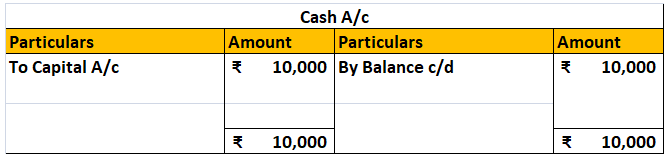
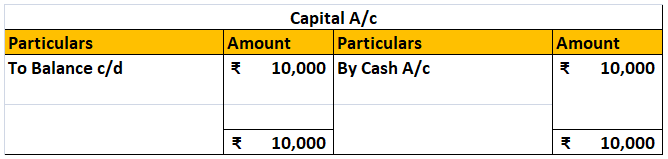
    For example, When cash is introduced in the business, the journal entry passed is:

    Cash A/c    Dr.      ₹10,000

    To Capital A/c  ₹10,000

    The accounts affected here are Cash A/c and Capital A/c.

    Cash A/c gets debited by ₹10,000,

    and Capital A/c get credited by ₹10,000.

    All the processes of accounting are conducted in an ordered manner known as the accounting cycle.

    The first step in an accounting cycle is to identify the transactions and events which are monetary in nature.

    The second step is to record the identified transactions in form of journal entries.

    And the third step is to make postings in the general ledger accounts as per the journal entries.

    Hence, the preparation of the ledger is the third step in the accounting cycle and is prepared from the journal entries.

    See less
    • 0
    • Share
      Share
      • Share on Facebook
      • Share on Twitter
      • Share on LinkedIn
      • Share on WhatsApp
Simerpreet
SimerpreetHelpful
In: 4. Taxes & Duties > GST

What is input tax credit example?

  • 1 Answer
  • 0 Followers
Answer
  1. Rahul_Jose Aspiring CA currently doing Bcom
    Added an answer on December 12, 2021 at 9:46 pm
    This answer was edited.

    Under GST, Input Tax Credit (ITC) refers to the tax already paid by a person on input, which is available as a deduction from tax payable on output. This means that if you have paid tax on some purchases, then at the time of paying tax on the sale of goods, you can reduce it by the amount you alreadRead more

    Under GST, Input Tax Credit (ITC) refers to the tax already paid by a person on input, which is available as a deduction from tax payable on output. This means that if you have paid tax on some purchases, then at the time of paying tax on the sale of goods, you can reduce it by the amount you already paid on purchase and pay only the balance amount.

    EXAMPLE

    Suppose Ashok purchased goods worth Rs 100 while paying tax at 10%, that is Rs 10. He now sold the goods for Rs 200, with a tax payable of Rs 20. Now, Ashok can avail input tax credit of Rs 10 that he already paid for the purchase and hence the net tax payable is Rs 10 (20-10).

    METHOD OF UTILISATION OF ITC

    The central government collects CGST, SGST, UTGST or IGST based on whether the transactions are done intrastate or interstate.

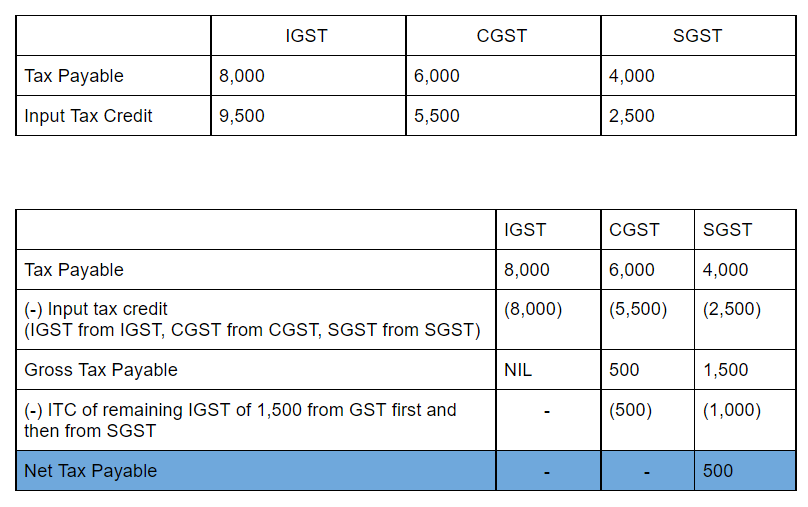
    The amount of input tax credit on IGST is first used for paying IGST and then utilised for the payment of CGST and SGST or UTGST. Similarly, the amount of ITC relating to CGST is first utilised for payment of CGST and then for the payment of IGST. It is not used for the payment of SGST or UTGST. Meanwhile, the amount of ITC relating to SGST is utilised for payment of SGST or UTGST and then for the payment of IGST. Such amounts are not used for payment of CGST.

    We can see how Input Tax Credit is used from the below example and table:

    See less
    • 0
    • Share
      Share
      • Share on Facebook
      • Share on Twitter
      • Share on LinkedIn
      • Share on WhatsApp
Ishika Pandey
Ishika PandeyCurious
In: 1. Financial Accounting > Miscellaneous

Why is profit and loss suspense an asset?

  • 0 Answers
  • 1 Follower
Answer
Mehak
Mehak
In: 1. Financial Accounting > Contingent Liabilities & Assets

How are contingent liabilities disclosed in financial statements?

  • 0 Answers
  • 0 Followers
Answer
SAMKV
SAMKVCurious
In: 1. Financial Accounting > Journal Entries

PASS THE JOURNAL ENTRIES (WHICH SHOULD HAVE AT LEAST 20 TRANSACTIONS WITH GST) POST THEM INTO THE LEDGER, PREPARE A TRIAL BALANCE BY BALANCE METHOD-

  • 0 Answers
  • 0 Followers
Answer
Load More Questions

Sidebar

Question Categories

  • 1. Financial Accounting

      • Accounting Terms & Basics
      • Bank Reconciliation Statement
      • Banks & NBFCs
      • Bills of Exchange
      • Capital & Revenue Expenses
      • Consignment & Hire Purchase
      • Consolidation
      • Contingent Liabilities & Assets
      • Departments & Branches
      • Depreciation & Amortization
      • Financial Statements
      • Goodwill
      • Insurance Accounting
      • Inventory or Stock
      • Investment Accounting
      • Journal Entries
      • Ledger & Trial Balance
      • Liquidation & Amalgamation
      • Miscellaneous
      • Not for Profit Organizations
      • Partnerships
      • Ratios
      • Shares & Debentures
      • Source Documents & Vouchers
      • Subsidiary Books
  • 2. Accounting Standards

      • AS
      • IFRS
      • IndAS
  • 3. Cost & Mgmt Accounting
  • 4. Taxes & Duties

      • GST
      • Income Tax
  • 5. Audit

      • Bank Audit
      • Internal Audit
      • Miscellaneous - Audit
      • Statutory Audit
  • 6. Software & ERPs

      • Tally
  • 7. MS-Excel
  • 8. Interview & Career
  • Top Questions
  • I need 20 journal entries with ledger and trial balance?

  • Can you show 15 transactions with their journal entries, ledger, ...

  • What is furniture purchased for office use journal entry?

  • What is loose tools account and treatment in final accounts?

  • What is the Journal Entry for Closing Stock?

  • What is the journal entry for goods purchased by cheque?

  • What is commission earned but not received journal entry?

  • How to show adjustment of loose tools revalued in final ...

  • What is the journal entry for interest received from bank?

  • Following is the Receipts and Payments Account of Bharti Club ...

Hot Topics

Accounting Policies Accounting Principles Balance Sheet Bank Reconciliation Statement Bill of Exchange Branch Accounting Calls in Advance Capital Capital Expenditure Companies Act Compound Entry Consignment Creditors Current Assets Debit Balance Debtors Depreciation Difference Between Dissolution of Firm Dissolution of Partnership Drawings External Users Fictitious Assets Final Accounts Financial Statements Fixed Assets Fixed Capital Fluctuating Capital Gain Impairment Installation Interest Received in Advance Internal Users Journal Entry Ledger Loose Tools Miscellaneous Expenditure Profit Rent Rent Received in Advance Reserves Revaluation Revenue Expenditure Revenue Reserve Sacrificing Ratio Subscription Subscription Received in Advance Trial Balance Type of Account Uncalled Capital
  • Home
  • Questions
    • Most Visited
    • Most Active
    • Trending
    • Recent
  • Follow
    • Categories
    • Users
    • Tags
  • Write an Answer
  • Badges & Points
  • Request New Category
  • Send a Suggestion

Most Helping Users

Astha

Astha

  • 50,291 Points
Leader
Simerpreet

Simerpreet

  • 72 Points
Helpful
AbhishekBatabyal

AbhishekBatabyal

  • 65 Points
Helpful

Footer

  • About Us
  • Contact Us
  • Pricing
  • Refund
  • Forum Rules & FAQs
  • Terms and Conditions
  • Privacy Policy
  • Career

© 2021 All Rights Reserved
Accounting Capital.