Please briefly explain why you feel this question should be reported.

Please briefly explain why you feel this answer should be reported.

Please briefly explain why you feel this user should be reported.

Sign InSign Up

AccountingQA

AccountingQA Logo AccountingQA Logo

AccountingQA Navigation

  • Home
  • Ask Questions
  • Write Answers
  • Explore
  • FAQs
Search
Ask A Question

Mobile menu

Close
Ask a Question
  • Home
  • Questions
    • Most Visited
    • Most Active
    • Trending
    • Recent
  • Follow
    • Categories
    • Users
    • Tags
  • Write an Answer
  • Badges & Points
  • Request New Category
  • Send a Suggestion
  • Search Your Accounting Question..

AccountingQA Latest Questions

Aadil
AadilCurious
In: 1. Financial Accounting > Shares & Debentures

Is ‘Reserve Capital’ a Part of ‘Unsubscribed Capital’ or ‘Uncalled Capital’?

CapitalReserve CapitalReservesUncalled CapitalUnsubscribed Capital
  • 1 Answer
  • 0 Followers
Answer
  1. Ayushi Curious Pursuing CA
    Added an answer on November 15, 2021 at 7:27 pm
    This answer was edited.

    Reserve capital is part of ‘Uncalled capital’. ‘Uncalled capital’ means the outstanding amount on shares on which the call money is not yet called. A company may issue its shares and receive the money either in full or in instalments. The instalments are named: Application money – Received by a compRead more

    Reserve capital is part of ‘Uncalled capital’. ‘Uncalled capital’ means the outstanding amount on shares on which the call money is not yet called.

    A company may issue its shares and receive the money either in full or in instalments. The instalments are named:

    • Application money – Received by a company from the people who apply for allotment of the shares.
    • Allotment money – Called by the company from the people to whom the shares are allotted at the time of allotment.
    • Call money – The outstanding amount is called by way of call money in one or more instalments.

     For example, X Ltd issues 1000 shares at a price of Rs. 100 per share which is payable Rs. 25 at application, Rs. 30 at the allotment, Rs. 25 at the first call and Rs. 20 at the second and final call.

    The shares at fully subscribed and X Ltd has called and received money till the first call. The second call is not made yet.

     This amount of Rs 20,000 (1000 x Rs.20) will be uncalled capital.

    Now, It is up to the management when to make the second and final call.

    If the management shows no intention of calling the outstanding money on such shares, then the uncalled capital will be called reserve capital.

    Such shares which are not fully called are known as party paid shares.

    It is ultimately payable to the company by the shareholders of partly paid shares at the time of dissolution.

    Reserve capital is not shown either in the balance sheet or in the notes to accounts to the balance sheet. But one can ascertain it just by examining the notes to accounts to the balance. If the shares are partly paid and the management seems to have no intention of calling the outstanding money then such uncalled share capital is reserve capital.

    Reserve capital is neither a liability nor an asset for the company.

    But at the time of winding up of the company, it becomes a liability for the shareholders to pay the balance amount of their shares.

    By now, you must have understood why reserve capital is not part of unsubscribed capital. It is because reserve capital is related to shares that are issued and subscribed.

    See less
    • 0
    • Share
      Share
      • Share on Facebook
      • Share on Twitter
      • Share on LinkedIn
      • Share on WhatsApp
Karan
Karan
In: 1. Financial Accounting > Miscellaneous

What is the difference between fixed and fluctuating capital account?

Difference BetweenFixed CapitalFluctuating Capital
  • 1 Answer
  • 0 Followers
Answer
  1. Radhika
    Added an answer on November 15, 2021 at 11:18 am
    This answer was edited.

    Capital Accounts record transactions of owners of a business and typically includes amount invested, retained, and withdrawn from the business. In the case of a partnership firm, there are multiple capital accounts as multiple people own the business. Capital Accounts in a partnership firm can be ofRead more

    Capital Accounts record transactions of owners of a business and typically includes amount invested, retained, and withdrawn from the business. In the case of a partnership firm, there are multiple capital accounts as multiple people own the business.

    Capital Accounts in a partnership firm can be of two types:

    • Fixed Capital Account
    • Fluctuating Capital Account

    A fixed Capital Account is one where only non-recurring transactions related to capital accounts are recorded. For example:

    • Capital introduced
    • Capital withdrawn/ Drawings

    For transactions that are recurring in nature like interest on capital, the interest of drawings a separate account called Partner’s Current Account is created.

    Fluctuating Capital Accounts are the ones where there is a single account to record all types of transactions related to the partner’s capital account, whether recurring or nonrecurring.

    Fixed Capital Accounts are usually created in cases where there are numerous recurring transactions and partners want to keep a record of the fixed amount invested in the business by all the partners at any point in time.

    Fluctuating Capital Account is usually created in cases where the number of recurring transactions is not high or partners want to keep a record of the amount due to all the partners in business at any point in time.

    However, the decision to choose what kind of capital account should be implemented in the firm is complete with the partners. They may choose whatever they think is a more suitable fit.

    To summarise the difference between the two following table can be used:

    Fixed Capital Account Fluctuating Capital Account
       
    Non-recurring transactions are recorded. Recurring transactions are recorded.
    Created where the number of recurring transactions is high to maintain a separate record. Created where the number of recurring transactions is low.
    Examples:

    ·       Capital introduced

    ·       Capital withdrawn

    Examples:

    ·       Interest on capital

    ·       Interest in drawings


    See less
    • 0
    • Share
      Share
      • Share on Facebook
      • Share on Twitter
      • Share on LinkedIn
      • Share on WhatsApp
Karan
Karan
In: 1. Financial Accounting > Partnerships

What is the difference between dissolution of partnership and dissolution of firm?

Difference BetweenDissolution of FirmDissolution of Partnership
  • 1 Answer
  • 0 Followers
Answer
  1. PriyanshiGupta Graduated, B.Com
    Added an answer on November 12, 2021 at 1:35 pm
    This answer was edited.

    Dissolution of partnership means partnership coming to an end while the firm still stands. Various reasons for the dissolution of partnership could be: Admission of a partner Death of a partner Retirement of a partner Dissolution of firm In the event of the above cases, the existing partnership is dRead more

    Dissolution of partnership means partnership coming to an end while the firm still stands. Various reasons for the dissolution of partnership could be:

    • Admission of a partner
    • Death of a partner
    • Retirement of a partner
    • Dissolution of firm

    In the event of the above cases, the existing partnership is dissolved and a new partnership is created with the new partners without affecting the firm.

    A new partnership deed is created, in case there is a partnership deed agreed among partners and new profit-sharing ratios among the partners are decided, while the assets and liabilities of the firm remain the same.

    Dissolution of a firm means the firm no longer exists. Various reasons for the dissolution of a partnership firm could be:

    • Mutual decision of partners
    • By the court of law

    A partnership firm is dissolved by a court of law when there has been a non-compliance of law, the firm is engaged in illegal practices, or that the court’s opinion is that it is in the public interest for the firm to be dissolved.

    The partnership is also dissolved with the dissolution of the firm but the converse need not be true.

    When a firm is dissolved, there is a sequence that is followed to pay creditors and partners.

    • First, outside creditors like banks, third party creditors are paid firstly with the cash available with the firm and then by selling the assets.
    • Second, partners who have lent money in the form of a loan to the firm are paid.
    • Lastly, if there is any surplus, partners are paid with the amount of their capital. In case of loss, partners are required to pay from their personal assets.

    Dissolution of the firm can be done by the partners themselves and they could also appoint a third person to do so on the payment of fees, charges, the proportion of surplus, or any contract that has been agreed to.

    To summarize, we can a draw a difference table as follows:

    Dissolution of Partnership Dissolution of Partnership Firm
    The partnership ends but the firm still stands. A partnership firm no longer exists.
    A new partnership deed is created by the mutual agreement of partners. A new partnership firm is created if the partners decide.
    Reasons:

    ·        Admission

    ·        Retirement

    ·        Death

    Reasons:

    ·        By court

    ·        Mutual decision of partners

    See less
    • 0
    • Share
      Share
      • Share on Facebook
      • Share on Twitter
      • Share on LinkedIn
      • Share on WhatsApp
Radha
Radha
In: 1. Financial Accounting > Ratios

What is sacrificing ratio?

Sacrificing Ratio
  • 1 Answer
  • 0 Followers
Answer
  1. Rahul_Jose Aspiring CA currently doing Bcom
    Added an answer on November 12, 2021 at 4:02 pm
    This answer was edited.

    When a partnership firm consisting of some partners, decide to admit a new partner into their firm, they have to forego a part of their share for the new partner. Therefore, sacrificing Ratio is the proportion in which the existing partners of a company give up a part of their share to give to the nRead more

    When a partnership firm consisting of some partners, decide to admit a new partner into their firm, they have to forego a part of their share for the new partner. Therefore, sacrificing Ratio is the proportion in which the existing partners of a company give up a part of their share to give to the new partner. The partners can choose to forego their shares equally or in an agreed proportion.

    Before admission of the new partner, the existing partners would be sharing their profits in the old ratio. Upon admission, the profit-sharing ratio would change to accommodate the new partner. This would give rise to the new ratio. Hence Sacrificing ratio can be calculated as:

    Sacrificing Ratio = Old Ratio – New Ratio

    For example, Tony and Steve are partners in a firm, sharing profits in the ratio of 3:2. They decide to admit Bruce into the partnership such that the new profit-sharing ratio is 2:1:2. Now, to calculate the sacrificing ratio of Tony and Steve, we subtract their new share from their old share.

    Tony’s Sacrifice = 3/5 – 2/5 = 1/5

    Steve’s Sacrifice = 2/5 – 1/5 = 1/5

    Therefore, the Sacrificing ratio of Tony and Steve is 1:1. This shows that Tony gave up 1/5th of his share while Steve also sacrificed 1/5th of his share.

    Calculation of sacrificing ratio is important in a partnership as it helps in measuring that portion of the share of existing partners that have to be sacrificed. This ensures a smooth reconstitution of the partnership. Since the old partners are foregoing a part of their share in profits, the new partner has to bring in some amount as goodwill to compensate for their loss.

    See less
    • 0
    • Share
      Share
      • Share on Facebook
      • Share on Twitter
      • Share on LinkedIn
      • Share on WhatsApp
Radha
Radha
In: 1. Financial Accounting > Ledger & Trial Balance

How to show interest on investment in trial balance?

Interest on investmentTrial Balance
  • 1 Answer
  • 0 Followers
Answer
  1. Rahul_Jose Aspiring CA currently doing Bcom
    Added an answer on November 11, 2021 at 3:59 pm
    This answer was edited.

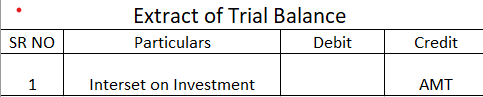
    Interest on Investment is to be shown on the Credit side of a Trial Balance. Interest on investment refers to the income received on investment in securities. These securities can be shares, debentures etc. of another company. When one invests in securities, they are expected to receive a return onRead more

    Interest on Investment is to be shown on the Credit side of a Trial Balance.

    Interest on investment refers to the income received on investment in securities. These securities can be shares, debentures etc. of another company. When one invests in securities, they are expected to receive a return on investment (ROI).

    Since interest on investment is an income, it is shown on the credit side of the Trial Balance. This is based on the accounting rule that all increase in incomes are credited and all increase in expenses are debited. A Trial Balance is a worksheet where the balances of all assets, expenses and drawings are shown on the debit side while the balances of all liabilities, incomes and capital are shown on the credit side.

    For example, if Jack bought Corporate Bonds of Amazon, worth $50,000 with a 10% interest on investment, then the accounting treatment for interest on investment would be

    Cash/Bank A/C Dr     5,000
    To Interest on Investment in Corporate Bonds (Amazon) 5,000

    As per the above entry, since interest on investment is credited, it will show a credit balance and hence be shown on the credit side of the Trial Balance. Interest on investment account is not to be confused with an Investment account. Investment is an asset whereas interest on investment is an income.

    See less
    • 0
    • Share
      Share
      • Share on Facebook
      • Share on Twitter
      • Share on LinkedIn
      • Share on WhatsApp
Nistha
Nistha
In: 1. Financial Accounting > Journal Entries

What is dividend paid journal entry?

Journal Entry
  • 1 Answer
  • 0 Followers
Answer
  1. Radhika
    Added an answer on November 18, 2021 at 7:48 am
    This answer was edited.

    When a company earns profit, it distributes a proportion of its income to its shareholders, and such distribution is called the dividend. The dividend is allocated as a fixed amount per share and shareholders receive dividends proportional to their shareholdings. However, a company can only pay diviRead more

    When a company earns profit, it distributes a proportion of its income to its shareholders, and such distribution is called the dividend. The dividend is allocated as a fixed amount per share and shareholders receive dividends proportional to their shareholdings.

    However, a company can only pay dividends out of its current year profits or retained earnings (profits of the company that are not distributed as dividend and retained in the business is called retained earnings) of previous years but not out of capital.

    Dividends can be paid to shareholders in the form of

    • Cash
    • dividend re-investing plan of the company
    • future shares
    • share repurchase.

    For companies, payment of regular dividends boosts the morale of the shareholders, investors trust the companies more and it reflects positively on the share price of the company.

    For example, Nestle in India paid an interim dividend of 1100.00% to its shareholders in 2021.

    The journal entry for dividend paid is

    Particulars Debit Credit
    Retained Earnings A/c                                                          Dr. Amt  
    To Cash A/c   Amt


    According to the golden rules of accounting-

    • Retained earnings is a credit account by nature and since dividends are paid from retained earnings resulting in a deduction of the account, we debit
    • Cash is credited because the account is debit in nature and since dividends are paid in cash it’s credited to present the deduction in the account.

    According to modern rules of accounting-

    • Since cash is decreasing, we credit
    • Since retained earnings are decreasing and it is a part of capital it should be

    For example-

    A company paid a dividend of 25 crores to its shareholders in cash, the journal entry according to golden rules will be-

    Particulars Debit

    (in crores)

    Credit

    (in crores)

    Retained Earnings A/c  (Dr.) 25  
    To Cash A/c   25


    See less
    • 0
    • Share
      Share
      • Share on Facebook
      • Share on Twitter
      • Share on LinkedIn
      • Share on WhatsApp
Nistha
Nistha
In: 1. Financial Accounting > Financial Statements

What is debit balance of profit and loss account?

Debit Balance
  • 1 Answer
  • 0 Followers
Answer
  1. Pooja_Parikh Aspiring Chartered Accountant
    Added an answer on November 13, 2021 at 4:44 pm
    This answer was edited.

    A Profit and Loss (P&L) statement is a financial statement that records a summary of all expenses and incomes of a business during a period of time. It helps in determining the financial performance of the business. After recording all transactions in an account, if the debit side is greater thaRead more

    A Profit and Loss (P&L) statement is a financial statement that records a summary of all expenses and incomes of a business during a period of time. It helps in determining the financial performance of the business.

    After recording all transactions in an account, if the debit side is greater than the credit side, then the account is said to have a debit balance. Similarly, if the credit side is greater than the debit side, then the account has a credit balance.

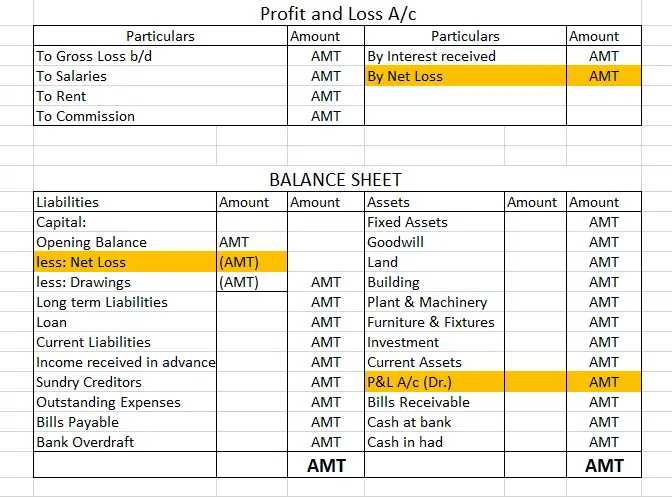
    In a P&L account, when the expenses (debit) are greater than the incomes (credit), the business is said to be in a net loss. This loss is what we call the debit balance of a Profit and Loss account. A P&L account with a debit balance can be subtracted from Capital or be shown on the asset side of the Balance Sheet.

    As you can see above, the net loss is shown on the right side of the P&L account. This represents the debit balance of P&L. Once it is transferred to the balance sheet, it is either subtracted from capital or shown on the asset side as shown in the second image. However, they cannot be shown on both sides of the balance sheet at the same time.

    However, if the credit side is greater, that is if income is greater than expenses, then the P&L account shows a credit balance which is also known as net profit. This profit is added with Capital to show the final balance in the Balance Sheet.

    Debit balance of Profit & Loss account is not preferable for a business. Hence they should put in efforts to either reduce costs or increase their income to gain profits.

    See less
    • 0
    • Share
      Share
      • Share on Facebook
      • Share on Twitter
      • Share on LinkedIn
      • Share on WhatsApp
A_Team
A_Team
In: 1. Financial Accounting > Accounting Terms & Basics

Capital account is which type of account?

I mean to ask is it real, nominal, or personal and why?

CapitalType of Account
  • 2 Answers
  • 0 Followers
Answer
  1. AbhishekBatabyal Helpful Pursuing CA, BCOM (HONS)
    Added an answer on November 7, 2021 at 4:06 pm

    The correct option is option A. Journal is the book of original entry. It is from the journal, the postings in the ledgers are made. As it is the journal first to record the transactions, it is called the book of original entry. It is from the journal, the postings in the ledgers are made. Ledgers aRead more

    The correct option is option A.

    Journal is the book of original entry. It is from the journal, the postings in the ledgers are made. As it is the journal first to record the transactions, it is called the book of original entry.

    It is from the journal, the postings in the ledgers are made. Ledgers are called the books of principal book of entry.

    Option B Duplicate is wrong as there is no such thing as the book of duplicate entry in financial accounting. Journal entries are the first-hand record of business transactions. Hence, it cannot be the book of duplicate entries.

    Option C Personal is wrong. This classification of ‘personal’ is a type of account as per traditional rules of accounting, not books of accounts

    Option D Nominal is wrong. It is also a type of account as per the traditional rules of accounting.

    See less
    • 0
    • Share
      Share
      • Share on Facebook
      • Share on Twitter
      • Share on LinkedIn
      • Share on WhatsApp
A_Team
A_Team
In: 1. Financial Accounting > Accounting Terms & Basics

Journal is a book of which entry?

A. Original B. Duplicate C. Personal D. Nominal

  • 1 Answer
  • 0 Followers
Answer
  1. AbhishekBatabyal Helpful Pursuing CA, BCOM (HONS)
    Added an answer on December 12, 2021 at 4:57 pm

    The correct option is (A) Original. Journal entry is the book of the original entry. It is because every event or transaction which is of monetary nature is first recorded in the journal. The transactions recorded in the journal are known as journal entries. Journal follows the double-entry system oRead more

    The correct option is (A) Original. Journal entry is the book of the original entry. It is because every event or transaction which is of monetary nature is first recorded in the journal. The transactions recorded in the journal are known as journal entries.

    Journal follows the double-entry system of accounting. It means a journal entry affects at least two accounts. It is from the journal entries, the ledger accounts are prepared. For example, the transaction, ‘sale of goods for Rs 1000 for cash’ affects two accounts. The journal entry is:

    There are many special journals that record some special set of transactions which are called subsidiary journals or daybooks. Such special journals are not considered the books of original entry.

    Option (B) Duplicate is wrong. It is because the journal is the book where monetary events and transactions are recorded. It cannot be the book of duplicate entries. There is no such thing as ‘book of duplicate entry.’

    Option (C) Personal is wrong. Personal is a type of account under the golden rules of accounting. A personal account is a type of account that represents a person. But, the journal is not an account, it is a book. Also, there is no such thing as book of personal entry.

    Option (D) Nominal is wrong. Nominal is also a type of account under the golden rules of accounting. The nominal account is a type of account that represents an income, expense, gain or loss. Journal is a type of account but a book.

    See less
    • 0
    • Share
      Share
      • Share on Facebook
      • Share on Twitter
      • Share on LinkedIn
      • Share on WhatsApp
Simerpreet
SimerpreetHelpful
In: 1. Financial Accounting > Subsidiary Books

When a petty cash book is kept there will be

A) No entries made at all in the general ledger for items paid by petty cash B) The same number of entries in the general ledger. C) Fewer entries made in the ...

  • 1 Answer
  • 0 Followers
Answer
  1. AbhishekBatabyal Helpful Pursuing CA, BCOM (HONS)
    Added an answer on November 1, 2021 at 12:02 pm
    This answer was edited.

    The correct option is D) Fewer entries in the general ledger To understand why option D is correct, we need to understand the concept. Petty cashbook is a special cashbook prepared for recording petty or small cash expenses. The benefit is that the chief cashier can focus on large cash and bank tranRead more

    The correct option is D) Fewer entries in the general ledger

    To understand why option D is correct, we need to understand the concept.

    • Petty cashbook is a special cashbook prepared for recording petty or small cash expenses.
    • The benefit is that the chief cashier can focus on large cash and bank transactions and there are fewer transactions in the main cashbook.
    • The petty cashier is provided with a fixed amount for a month or week and is reimbursed the amount spent at the end of the period after he sends the details of expenses to the chief cashier.
    • There are entries for the transfer of cash to the petty cashier in the main cashbook only.

    Option A ‘No entries made at all in the general ledger for items paid by petty cash ‘ is wrong. It is not possible to omit entries of petty expense just because there is a petty cashbook. There will be entries related to:

    • The cash is given to the petty cashier in a fixed amount or the amount spent as petty expenses during the month or week.

    Petty cash A/c  Dr.        Amt

        To Cash A/c                   Amt

     Option (B) ‘The same number of entries in the general ledger is wrong because there can never be the same number of entries as all the petty expenses are recorded in the petty cashbook and only the entries for transfer of cash to the petty cashier is recorded in the main cash book.

    Option D ‘More entries made in the general ledger​’ is wrong because the number of entries actually reduce as only petty cash transfer entries are recorded in the main cashbook instead of numerous entries of petty cash transactions.

    See less
    • 0
    • Share
      Share
      • Share on Facebook
      • Share on Twitter
      • Share on LinkedIn
      • Share on WhatsApp

Sidebar

Question Categories

  • 1. Financial Accounting

      • Accounting Terms & Basics
      • Bank Reconciliation Statement
      • Banks & NBFCs
      • Bills of Exchange
      • Capital & Revenue Expenses
      • Consignment & Hire Purchase
      • Consolidation
      • Contingent Liabilities & Assets
      • Departments & Branches
      • Depreciation & Amortization
      • Financial Statements
      • Goodwill
      • Insurance Accounting
      • Inventory or Stock
      • Investment Accounting
      • Journal Entries
      • Ledger & Trial Balance
      • Liquidation & Amalgamation
      • Miscellaneous
      • Not for Profit Organizations
      • Partnerships
      • Ratios
      • Shares & Debentures
      • Source Documents & Vouchers
      • Subsidiary Books
  • 2. Accounting Standards

      • AS
      • IFRS
      • IndAS
  • 3. Cost & Mgmt Accounting
  • 4. Taxes & Duties

      • GST
      • Income Tax
  • 5. Audit

      • Bank Audit
      • Internal Audit
      • Miscellaneous - Audit
      • Statutory Audit
  • 6. Software & ERPs

      • Tally
  • 7. MS-Excel
  • 8. Interview & Career
  • Top Questions
  • I need 20 journal entries with ledger and trial balance?

  • Can you show 15 transactions with their journal entries, ledger, ...

  • What is furniture purchased for office use journal entry?

  • What is loose tools account and treatment in final accounts?

  • What is the Journal Entry for Closing Stock?

  • What is the journal entry for goods purchased by cheque?

  • What is commission earned but not received journal entry?

  • How to show adjustment of loose tools revalued in final ...

  • What is the journal entry for interest received from bank?

  • Following is the Receipts and Payments Account of Bharti Club ...

Hot Topics

Accounting Policies Accounting Principles Balance Sheet Bank Reconciliation Statement Bill of Exchange Branch Accounting Calls in Advance Capital Capital Expenditure Companies Act Compound Entry Consignment Creditors Current Assets Debit Balance Debtors Depreciation Difference Between Dissolution of Firm Dissolution of Partnership Drawings External Users Fictitious Assets Final Accounts Financial Statements Fixed Assets Fixed Capital Fluctuating Capital Gain Impairment Installation Interest Received in Advance Internal Users Journal Entry Ledger Loose Tools Miscellaneous Expenditure Profit Rent Rent Received in Advance Reserves Revaluation Revenue Expenditure Revenue Reserve Sacrificing Ratio Subscription Subscription Received in Advance Trial Balance Type of Account Uncalled Capital
  • Home
  • Questions
    • Most Visited
    • Most Active
    • Trending
    • Recent
  • Follow
    • Categories
    • Users
    • Tags
  • Write an Answer
  • Badges & Points
  • Request New Category
  • Send a Suggestion

Most Helping Users

Astha

Astha

  • 50,291 Points
Leader
Simerpreet

Simerpreet

  • 72 Points
Helpful
AbhishekBatabyal

AbhishekBatabyal

  • 65 Points
Helpful

Footer

  • About Us
  • Contact Us
  • Pricing
  • Refund
  • Forum Rules & FAQs
  • Terms and Conditions
  • Privacy Policy
  • Career

© 2021 All Rights Reserved
Accounting Capital.