Please briefly explain why you feel this question should be reported.

Please briefly explain why you feel this answer should be reported.

Please briefly explain why you feel this user should be reported.

Sign InSign Up

AccountingQA

AccountingQA Logo AccountingQA Logo

AccountingQA Navigation

  • Home
  • Ask Questions
  • Write Answers
  • Explore
  • FAQs
Search
Ask A Question

Mobile menu

Close
Ask a Question
  • Home
  • Questions
    • Most Visited
    • Most Active
    • Trending
    • Recent
  • Follow
    • Categories
    • Users
    • Tags
  • Write an Answer
  • Badges & Points
  • Request New Category
  • Send a Suggestion
  • Search Your Accounting Question..

  • Recent Questions
  • Most Answered
  • Answers
  • Most Visited
  • Most Voted
  • No Answers

AccountingQA Latest Questions

Astha
AsthaLeader
In: 1. Financial Accounting > Consignment & Hire Purchase

In accounting Consignment means?

Consignment
  • 1 Answer
  • 0 Followers
Answer
  1. Naina@123 (B.COM and CMA-Final)
    Added an answer on July 17, 2021 at 4:45 am
    This answer was edited.

    Consignment is "goods sent by its owners to his agent for the purpose of sale". In simple language, the word consignment means to send goods to another person for sale on his behalf without transfer of ownership. In accounting terms, consignment is the process where the owner (consignor) transfers tRead more

    Consignment is “goods sent by its owners to his agent for the purpose of sale”. In simple language, the word consignment means to send goods to another person for sale on his behalf without transfer of ownership.

    In accounting terms, consignment is the process where the owner (consignor) transfers the possession of the goods to the agent (consignee) to make a sale on his behalf while the ownership of goods remains with the owner until the sale is made by the agent. In return, the agent receives an agreed percentage of the sum in the form of commission. 

    Generally, there are two parties involved in consignment, those are as follows:

    1. CONSIGNOR: the person who is the owner and sender of goods.
    2. CONSIGNEE: the person who receives goods for sale/resale from the consignor in exchange for a percentage of the sale or on an agreed sum known as commission.

    The relationship between consignor and consignee is that of principal and agent.

    Let me give you a simple example of how consignment works.

    Mr. John (consignor) sends goods to Mr. Jeh (consignee) worth Rs 20,000 to sell these goods at a cost plus 10%. Mr. Jeh agrees to sell these goods on his behalf for a commission of 1% on the sale. Therefore Mr. Jeh sold these goods at the agreed amount i.e Rs 22,000 [20,000+ 10% of 20,000] and charges Rs 220 [1% of Rs 22,000] as commission made on such sale and remit the remaining balance to the owner Mr. John.

    There is a lot of confusion regarding “is consignment the same as the sale of goods?“. The answer is NO.

    The reason what makes it different from the sale is

    a) In sale the ownership gets transferred from seller to buyer but in case of consignment the ownership remains with the consignor until the sale is made by the agent.

    b) In sale the risk gets transferred with the transfer of goods, whereas in consignment the risk remains with the owner till the sale is made.

    c) Also goods once sold cannot be returned on damages /defaults, but in case of consignment goods that come to be faulty can be returned to the consignor.

    See less
    • 0
    • Share
      Share
      • Share on Facebook
      • Share on Twitter
      • Share on LinkedIn
      • Share on WhatsApp
Radha
Radha
In: 1. Financial Accounting > Capital & Revenue Expenses

Expenses on installation of new machinery?

Installation
  • 1 Answer
  • 0 Followers
Answer
  1. Karan B.com and Pursuing ACCA
    Added an answer on July 17, 2021 at 6:13 am
    This answer was edited.

    The installation expenses for a new machinery will be debited to the "Machinery A/c". Installation expenses are the expense incurred to bring an asset to a working condition where it can be used. For example, installation charges are incurred on machinery to make it operational. Installation chargesRead more

    The installation expenses for a new machinery will be debited to the “Machinery A/c“. Installation expenses are the expense incurred to bring an asset to a working condition where it can be used. For example, installation charges are incurred on machinery to make it operational.

    Installation charges will be capitalized along with the cost of machinery. It is so because this expense is concerning the machinery and any expense directly related to an asset should be capitalized, as an asset will be with the business for a longer period of time.

    This charge will be incurred only once as a part of bringing the machinery to its working condition, and hence it should be capitalized and should be added to the cost of the machine. The whole amount will be shown in the balance sheet on the asset side as a Fixed Asset.

    This charge will not be shown in Profit and Loss A/c as it reflects all the revenue expenditure incurred in the period.

    Example:

    Starbucks purchased a coffee blending machine for the business purpose for $1,00,000. The installation expense incurred on it to make it operational was $20,000. How will Starbucks record this in the Balance Sheet on 31 December?
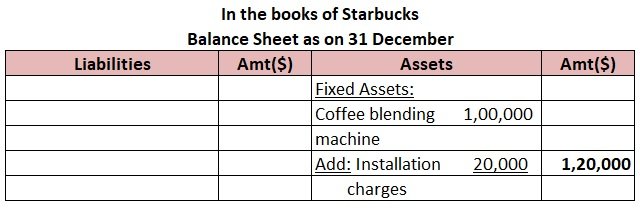
    In the Balance Sheet, Starbucks will add the installation expense incurred on the machine to the cost of the machine as it is the cost incurred to make the machine operational for further business use. Hence, the cost of $20,000 will be shown along with the cost of the coffee blending machine ($1,00,000+$20,000=$1,20,000)

    See less
    • 0
    • Share
      Share
      • Share on Facebook
      • Share on Twitter
      • Share on LinkedIn
      • Share on WhatsApp
Aadil
AadilCurious
In: 1. Financial Accounting > Depreciation & Amortization

Total depreciation of an asset cannot exceed its?

book value replacement value depreciable value market value

Depreciation
  • 1 Answer
  • 0 Followers
Answer
  1. Vijay Curious M.Com
    Added an answer on July 20, 2021 at 2:11 pm
    This answer was edited.

    The total depreciation of an asset cannot exceed its 3. depreciable value.  Depreciable value means the original cost of the asset minus its residual/salvage value. The asset's original cost is inclusive of the purchase price and other expenses incurred to make the asset operational. To put it simplRead more

    The total depreciation of an asset cannot exceed its 3. depreciable value. 

    Depreciable value means the original cost of the asset minus its residual/salvage value. The asset’s original cost is inclusive of the purchase price and other expenses incurred to make the asset operational. To put it simply,

    The accumulated depreciation on an asset can never exceed its depreciable value because depreciation is a gradual fall in the value of an asset over its useful life. Only a certain percentage of the asset’s book value/original cost is shown as depreciation every year. So, it is impossible/illogical for the accumulated depreciation of an asset to exceed its depreciable value.

    Let me show you an example to make it more understandable,

    Amazon installs machines to automate the job of packing orders. The original cost of the machine is $1,000,000. Now let’s assume,

    The estimated useful life of the machine – 10 years.

    Residual value at the end of 10 years – $50,000.

    Method of depreciation – Straight-line method.

    The depreciable value of the machine will be $950,000 (1,000,000 – 50,000). The depreciation for each year under SLM will be calculated as follows:

    Depreciation = (Original cost of the asset – Residual/Salvage Value) / (Useful life of the asset)

    Applying this formula, $95,000 (1,000,000 – 50,000/10) will be charged as depreciation every year. The accumulated depreciation at the end of 10 years will be $950,000 (95,000*10). As you can see, the accumulated depreciation ($950,000) of the machine does not exceed its depreciable value ($950,000).

    Thus, the total depreciation of an asset cannot be more than its depreciable value.


    See less
    • 0
    • Share
      Share
      • Share on Facebook
      • Share on Twitter
      • Share on LinkedIn
      • Share on WhatsApp
Aadil
AadilCurious
In: 1. Financial Accounting > Departments & Branches

In branch accounting depreciation on branch fixed assets is?

Credited to Debtors Account Debited to Fixed Asset Account Shown in Branch Account Not shown in Branch Account

Branch AccountingDepreciationFixed Assets
  • 1 Answer
  • 0 Followers
Answer
  1. Manvi Pursuing ACCA
    Added an answer on July 20, 2021 at 1:02 pm
    This answer was edited.

    The correct answer is 4. Not shown in Branch Account. The value of depreciation of fixed assets will be not shown in the branch accounting because the opening value of the asset is recorded at the start of the period on the debit side and the closing value of the asset is shown on the credit side atRead more

    The correct answer is 4. Not shown in Branch Account.

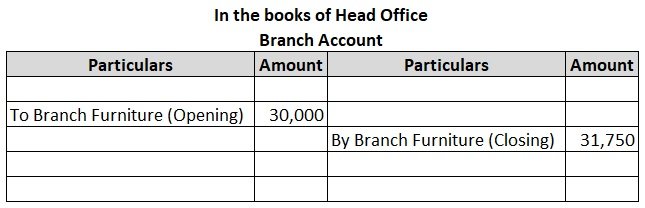
    The value of depreciation of fixed assets will be not shown in the branch accounting because the opening value of the asset is recorded at the start of the period on the debit side and the closing value of the asset is shown on the credit side at the end of the period.

    The difference between the opening and closing values of the asset is the value of depreciation which is automatically charged. In this case, if depreciation is also shown it will be counted twice.

    Example:

    XYZ Ltd purchased furniture for one of its branches on 1st January. Following are the details of the purchase:

    Furniture as on 1st January $30,000
    Furniture purchased on 1st June $5,000

    Depreciation is provided on furniture at @10% per annum on the straight-line method.

    Woking Notes: Amt 
    i. Depreciation on furniture:
    On $30,000 @10% p.a for full year 3,000
    On $5,000 @10% p.a for 6 months 250
    3,250
    ii. Branch Furniture as of 31 Dec:
    Furniture as of 1 January 30,000
    Add: Addition made during the year 5,000
    35,000
    Less: Depreciation (3,250)
    31,750

    As additional furniture was purchased after 6 months, depreciation will be charged on that and the total depreciation of 3,250 will be charged on the furniture of $35,000 ($30,000+$5,000) and the difference will be the closing balance which will be shown in the branch account on the credit side.

    The depreciation amount will not be shown in the Branch Account as the difference between the opening and closing values of the furniture reflects the value of depreciation. If depreciation is shown in the account it will be counted twice.

    See less
    • 0
    • Share
      Share
      • Share on Facebook
      • Share on Twitter
      • Share on LinkedIn
      • Share on WhatsApp
Jasmeet_Sethi
Jasmeet_SethiCurious
In: 1. Financial Accounting > Depreciation & Amortization

Depreciation in spirit is similar to?

Depletion Amortization Depression

  • 1 Answer
  • 0 Followers
Answer
  1. Simerpreet Helpful CMA Inter qualified
    Added an answer on July 20, 2021 at 2:51 pm
    This answer was edited.

    The correct option is 2. Amortization. Depreciation in spirit is similar to Amortization because both depreciation and amortization have the same characteristics except that depreciation is used for tangible assets and amortization for intangible assets. To make it clear, intangible assets are thoseRead more

    The correct option is 2. Amortization.

    Depreciation in spirit is similar to Amortization because both depreciation and amortization have the same characteristics except that depreciation is used for tangible assets and amortization for intangible assets.

    To make it clear, intangible assets are those assets that cannot be touched i.e. they are not physically present. For example, goodwill, patent, trademark, etc. Hence, these assets are amortized over their useful life and not depreciated.

    Example for Amortizing intangible assets: A manufacturing company buys a patent for Rs 80,000 for 8 years. Assuming that the residual value of the patent after 8 years to be zero.

    The depreciation to be written off will be

    Yearly Depreciation = Cost of the patent – Residual value / Expected life of the asset.

    = 80,000 – 0 / 8

    = Rs 10,000 every year.

    Whereas, tangible assets are those assets that can be touched i.e. they are physically present. For example, building, plant & machinery, furniture, etc. Hence, these assets are depreciated over their useful life and not amortized.

    Example of Depreciating tangible asset:  A manufacturing company bought machinery for Rs 8,10,000 and its estimated life is 8 years, scrap value being Rs 10,000.

    The depreciation to be written off will be

    Yearly Depreciation = Cost of machinery – Scrap value / Expected life of the asset.

    = 8,10,000 – 10,000 / 8

    = 8,00,000 / 8

    = Rs 1,00,000 every year.

    See less
    • 0
    • Share
      Share
      • Share on Facebook
      • Share on Twitter
      • Share on LinkedIn
      • Share on WhatsApp
Jasmeet_Sethi
Jasmeet_SethiCurious
In: 1. Financial Accounting > Depreciation & Amortization

What is depreciation on computer as per companies act 2013?

  • 1 Answer
  • 0 Followers
Answer
  1. prashant06 B.com, CMA pursuing
    Added an answer on July 20, 2021 at 12:55 pm
    This answer was edited.

    Let me brief you about the nature of computers, their parts, laptops according to the companies act 2013. Basically, these are treated as non-current tangible fixed assets. This is because these types of equipment are used in business to generate revenue over its useful life for more than a year. AsRead more

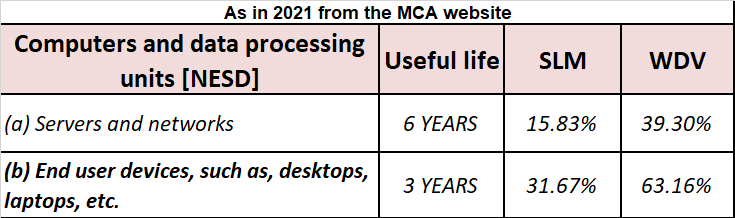
    Let me brief you about the nature of computers, their parts, laptops according to the companies act 2013. Basically, these are treated as non-current tangible fixed assets. This is because these types of equipment are used in business to generate revenue over its useful life for more than a year. As per the companies act 2013, the following extract of the depreciation rate chart is given for computers.

    Giving you a short example, suppose M/s spy Ltd purchased 20 computers worth Rs 30000 each. As per the companies act 2013, the computer’s useful life is taken to be 3 years, and the rate of depreciation rate is 63.16%. Applying the WDV method we can calculate depreciation as follows:

     Depreciation as per WDV = (Cost of an asset – salvage value)* Depreciation rate

    So for the first year, the depreciation amount will be

    Cost of computers = Rs 6,00,000 (20*30000)

    Salvage value = NIL

    Rate of depreciation as per the Act = 63.16%

    Therefore depreciation = (6,00,000 – NIL)* 63.16%

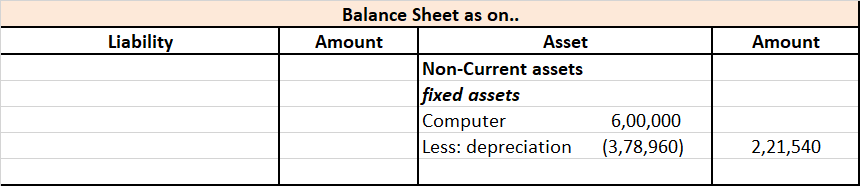
    = Rs 3,78,960

    this amount of depreciation will be shown in the profit & loss account as depreciation charged to computers and the same will be adjusted in the balance sheet. The extract of Profit & Loss and corresponding year Balance sheet is shown below.

    See less
    • 0
    • Share
      Share
      • Share on Facebook
      • Share on Twitter
      • Share on LinkedIn
      • Share on WhatsApp
Bonnie
BonnieCurious
In: 1. Financial Accounting > Not for Profit Organizations

What is the difference between receipts and payments account and income and expenditure account?

  • 1 Answer
  • 0 Followers
Answer
  1. Simerpreet Helpful CMA Inter qualified
    Added an answer on August 1, 2021 at 1:17 pm
    This answer was edited.

    To start with let me first explain the difference between receipts and income & payment and expenditure. Although Receipts and Income may look similar terms, there are some differences. Receipts have their relation with both cash and cheques received on account of various items of the organizatiRead more

    To start with let me first explain the difference between receipts and income & payment and expenditure.

    Although Receipts and Income may look similar terms, there are some differences.

    Receipts have their relation with both cash and cheques received on account of various items of the organization. Whereas, income is considered as a revenue item for finding surplus or deficit of the organization. All the receipts collected during the year may not be considered as income.

    For Example, if an organization sale of its assets that is of a capital nature, it would not be considered as an item of income and hence would be treated in the balance sheet.

    Similarly, Payment and Expenditure are two different terms. Payments are those that have their relation with cash and cheques given for various activities of the organization. Whereas, Expenditure is considered as revenue expenditure for ascertainment of surplus or deficit in the case of a not-for-profit organization. All payments made during the year may not be considered as expenditures.

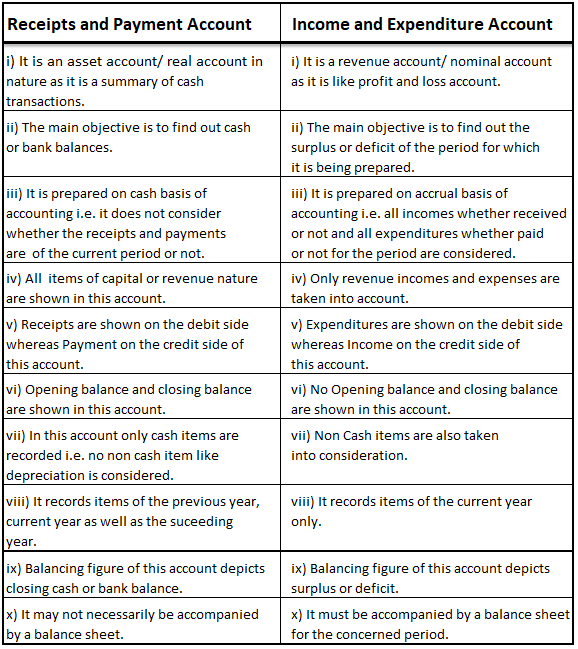
    Differences

    See less
    • 0
    • Share
      Share
      • Share on Facebook
      • Share on Twitter
      • Share on LinkedIn
      • Share on WhatsApp
Load More Questions

Sidebar

Question Categories

  • 1. Financial Accounting

      • Accounting Terms & Basics
      • Bank Reconciliation Statement
      • Banks & NBFCs
      • Bills of Exchange
      • Capital & Revenue Expenses
      • Consignment & Hire Purchase
      • Consolidation
      • Contingent Liabilities & Assets
      • Departments & Branches
      • Depreciation & Amortization
      • Financial Statements
      • Goodwill
      • Insurance Accounting
      • Inventory or Stock
      • Investment Accounting
      • Journal Entries
      • Ledger & Trial Balance
      • Liquidation & Amalgamation
      • Miscellaneous
      • Not for Profit Organizations
      • Partnerships
      • Ratios
      • Shares & Debentures
      • Source Documents & Vouchers
      • Subsidiary Books
  • 2. Accounting Standards

      • AS
      • IFRS
      • IndAS
  • 3. Cost & Mgmt Accounting
  • 4. Taxes & Duties

      • GST
      • Income Tax
  • 5. Audit

      • Bank Audit
      • Internal Audit
      • Miscellaneous - Audit
      • Statutory Audit
  • 6. Software & ERPs

      • Tally
  • 7. MS-Excel
  • 8. Interview & Career
  • Top Questions
  • I need 20 journal entries with ledger and trial balance?

  • Can you show 15 transactions with their journal entries, ledger, ...

  • What is furniture purchased for office use journal entry?

  • What is loose tools account and treatment in final accounts?

  • What is the Journal Entry for Closing Stock?

  • What is the journal entry for goods purchased by cheque?

  • What is commission earned but not received journal entry?

  • How to show adjustment of loose tools revalued in final ...

  • What is the journal entry for interest received from bank?

  • Following is the Receipts and Payments Account of Bharti Club ...

Hot Topics

Accounting Policies Accounting Principles Balance Sheet Bank Reconciliation Statement Bill of Exchange Branch Accounting Calls in Advance Capital Capital Expenditure Companies Act Compound Entry Consignment Creditors Current Assets Debit Balance Debtors Depreciation Difference Between Dissolution of Firm Dissolution of Partnership Drawings External Users Fictitious Assets Final Accounts Financial Statements Fixed Assets Fixed Capital Fluctuating Capital Gain Impairment Installation Interest Received in Advance Internal Users Journal Entry Ledger Loose Tools Miscellaneous Expenditure Profit Rent Rent Received in Advance Reserves Revaluation Revenue Expenditure Revenue Reserve Sacrificing Ratio Subscription Subscription Received in Advance Trial Balance Type of Account Uncalled Capital
  • Home
  • Questions
    • Most Visited
    • Most Active
    • Trending
    • Recent
  • Follow
    • Categories
    • Users
    • Tags
  • Write an Answer
  • Badges & Points
  • Request New Category
  • Send a Suggestion

Most Helping Users

Astha

Astha

  • 50,291 Points
Leader
Simerpreet

Simerpreet

  • 72 Points
Helpful
AbhishekBatabyal

AbhishekBatabyal

  • 65 Points
Helpful

Footer

  • About Us
  • Contact Us
  • Pricing
  • Refund
  • Forum Rules & FAQs
  • Terms and Conditions
  • Privacy Policy
  • Career

© 2021 All Rights Reserved
Accounting Capital.