Please briefly explain why you feel this question should be reported.

Please briefly explain why you feel this answer should be reported.

Please briefly explain why you feel this user should be reported.

Sign InSign Up

AccountingQA

AccountingQA Logo AccountingQA Logo

AccountingQA Navigation

  • Home
  • Ask Questions
  • Write Answers
  • Explore
  • FAQs
Search
Ask A Question

Mobile menu

Close
Ask a Question
  • Home
  • Questions
    • Most Visited
    • Most Active
    • Trending
    • Recent
  • Follow
    • Categories
    • Users
    • Tags
  • Write an Answer
  • Badges & Points
  • Request New Category
  • Send a Suggestion
  • Search Your Accounting Question..

  • Recent Questions
  • Most Answered
  • Answers
  • Most Visited
  • Most Voted
  • No Answers

AccountingQA Latest Questions

Naina@123
Naina@123
In: 1. Financial Accounting > Subsidiary Books

Overdraft as per cash book means?

1. Credit balance in the cash column of the cash book 2. Credit balance in the bank column of the cash book 3. Neither of the two 4. Both (a) ...

  • 1 Answer
  • 0 Followers
Answer
  1. Radha M.Com, NET
    Added an answer on July 31, 2021 at 9:28 am
    This answer was edited.

    The correct answer is 2. Credit balance in the bank column of the cash book. The credit balance in the bank column of Cash Book represents the overdraft facility utilized by the business. Overdraft is a credit extension facility offered by banks to both savings and current account holders. It allowsRead more

    The correct answer is 2. Credit balance in the bank column of the cash book.

    The credit balance in the bank column of Cash Book represents the overdraft facility utilized by the business. Overdraft is a credit extension facility offered by banks to both savings and current account holders. It allows the account holder to borrow a specified sum of money over and above the balance in their accounts.

    It is a form of short-term borrowing offered by banks and is extremely useful for businesses to resolve short-term cash flow issues.

    The account holder can withdraw money even when his/her account does not have enough balance to cover the withdrawal. Since the business is withdrawing money that is not in its account, an overdraft is represented by a negative bank balance. That is why they are shown as a credit balance in the bank column of the Cash Book.

    Overdraft is a liability for the business. Hence, it is shown on the Equity and Liability part of the Balance Sheet under the head Current Liabilities and sub-head Short Term Borrowings.

    Banks do not offer this facility to all customers. Only those who have a good reputation and credit score are eligible for this facility. Like any other borrowing, interest is charged on the amount utilized by the account holder as an overdraft.

    See less
    • 0
    • Share
      Share
      • Share on Facebook
      • Share on Twitter
      • Share on LinkedIn
      • Share on WhatsApp
Bonnie
BonnieCurious
In: 1. Financial Accounting > Not for Profit Organizations

Can you please explain income and expenditure account?

  • 1 Answer
  • 0 Followers
Answer
  1. prashant06 B.com, CMA pursuing
    Added an answer on July 30, 2021 at 4:13 pm
    This answer was edited.

    The "Income and Expenditure" account lists all the income and expenses incurred by the entity throughout the year. This account is very identical to the profit and loss account and is generally prepared on an accrual basis irrespective of whether the amount is received or paid. Non-profit organizatiRead more

    The “Income and Expenditure” account lists all the income and expenses incurred by the entity throughout the year. This account is very identical to the profit and loss account and is generally prepared on an accrual basis irrespective of whether the amount is received or paid. Non-profit organizations (NPO) prepare this type of account to ascertain surplus earned or deficit incurred by them during the period.

    Talking about the format of income and expenditure accounts we generally see that all the expenses are recorded on the debit side while all incomes are recorded on the credit side. One important thing to note is that items so recorded are revenue items while capital nature items are generally ignored because only current period items are recorded in this statement.

    Since it is a Nominal account, we follow the golden rules to prepare this, stating “debit all expenses and losses and credit all incomes and gains”. The closing balance at the end shows the surplus or deficit for the year. If the balancing figure appears on the debit side it is surplus and if the balancing figure appears on the credit side it is a deficit for the entity.

    Following is the format of income and expenditure account


    See less
    • 0
    • Share
      Share
      • Share on Facebook
      • Share on Twitter
      • Share on LinkedIn
      • Share on WhatsApp
Simerpreet
SimerpreetHelpful
In: 1. Financial Accounting > Depreciation & Amortization

Depreciation on software as per companies act?

  • 1 Answer
  • 0 Followers
Answer
  1. Karan B.com and Pursuing ACCA
    Added an answer on July 22, 2021 at 4:34 pm
    This answer was edited.

    Software is not depreciated but amortized, as it is an intangible asset. As per companies act the useful life of software is 3 years. The treatment of depreciation is the same as computers. Following are the software depreciation rates as per the companies act: As of 2021 Nature of Asset Useful LifeRead more

    Software is not depreciated but amortized, as it is an intangible asset. As per companies act the useful life of software is 3 years. The treatment of depreciation is the same as computers. Following are the software depreciation rates as per the companies act:

    As of 2021

    Nature of Asset Useful Life Depreciation
    WDV SLM
    Servers and networks 6 years 39.30% 15.83%
    End-user devices such as desktops, laptops, etc. 3 years 63.16% 31.67%

    For example, XYZ Ltd purchased a new accounting software on 1 October for Rs.50,000. As per the Companies Act, the useful life of software is 3 years. Hence, the software will be amortized for 3 years and the company amortizes on the straight-line method.

    Amortization amount = 50,000*31.67%

    For full year = Rs.15,835

    As the software was purchased on 1 October hence it will be amortized for 6 months.

    For 6 months = 15,835*6/12

    = Rs.7,917.50

    Amortization is the same as depreciation. Hence, treatment will also be the same. The amortization amount will be transferred to the Profit & Loss A/c on the debit side as a non-cash expense.

    See less
    • 0
    • Share
      Share
      • Share on Facebook
      • Share on Twitter
      • Share on LinkedIn
      • Share on WhatsApp
Bonnie
BonnieCurious
In: 1. Financial Accounting > Not for Profit Organizations

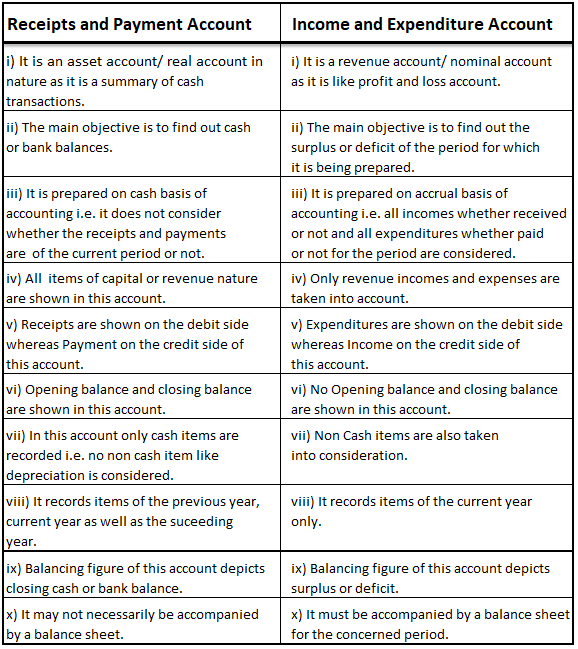
What is the difference between receipts and payments account and income and expenditure account?

  • 1 Answer
  • 0 Followers
Answer
  1. Simerpreet Helpful CMA Inter qualified
    Added an answer on August 1, 2021 at 1:17 pm
    This answer was edited.

    To start with let me first explain the difference between receipts and income & payment and expenditure. Although Receipts and Income may look similar terms, there are some differences. Receipts have their relation with both cash and cheques received on account of various items of the organizatiRead more

    To start with let me first explain the difference between receipts and income & payment and expenditure.

    Although Receipts and Income may look similar terms, there are some differences.

    Receipts have their relation with both cash and cheques received on account of various items of the organization. Whereas, income is considered as a revenue item for finding surplus or deficit of the organization. All the receipts collected during the year may not be considered as income.

    For Example, if an organization sale of its assets that is of a capital nature, it would not be considered as an item of income and hence would be treated in the balance sheet.

    Similarly, Payment and Expenditure are two different terms. Payments are those that have their relation with cash and cheques given for various activities of the organization. Whereas, Expenditure is considered as revenue expenditure for ascertainment of surplus or deficit in the case of a not-for-profit organization. All payments made during the year may not be considered as expenditures.

    Differences

    See less
    • 0
    • Share
      Share
      • Share on Facebook
      • Share on Twitter
      • Share on LinkedIn
      • Share on WhatsApp
Vijay
VijayCurious
In: 1. Financial Accounting > Not for Profit Organizations

Payment of honorarium to secretary is treated as?

Capital Expenditure Revenue Expenditure Cash Expense Credit Expense

  • 1 Answer
  • 0 Followers
Answer
  1. Karan B.com and Pursuing ACCA
    Added an answer on July 30, 2021 at 9:52 am
    This answer was edited.

    The correct answer is 2. Revenue Expenditure. An honorarium is a voluntary payment paid to a person for the services provided. It is a type of cost incurred for the expenses of guests and volunteers. This is a payment made to the person who is not an employee of the institution. Revenue expendituresRead more

    The correct answer is 2. Revenue Expenditure. An honorarium is a voluntary payment paid to a person for the services provided. It is a type of cost incurred for the expenses of guests and volunteers. This is a payment made to the person who is not an employee of the institution.

    Revenue expenditures are the short-term expenses and consumed within one accounting year and are also known as operating expenses.

    Payment of honorarium to the secretary is treated as revenue expenditure because benefits from the expense are derived in the same accounting period. The honorarium is a type of outside expense and any outside expense is revenue in nature. It is a daily allowance incurred to cover the hotel/stay expense.

    Payment of honorarium to the secretary is shown on the Expenditure side of the Income and Expenditure Account.

    Capital Expenditure is the expense incurred on acquiring an asset and honorarium cannot be a capital expenditure as benefits derived from it cannot be carried forward to the next year.

    It cannot be treated as cash or credit expense although it is paid in cash or credit. In this case, it will be treated as a revenue expense while preparing financial statements.

    Payment of honorarium is mainly a topic of not-for-profit organizations.

    See less
    • 0
    • Share
      Share
      • Share on Facebook
      • Share on Twitter
      • Share on LinkedIn
      • Share on WhatsApp
Astha
AsthaLeader
In: 1. Financial Accounting > Miscellaneous

Difference between return inwards and return outwards?

  • 1 Answer
  • 0 Followers
Answer
  1. Naina@123 (B.COM and CMA-Final)
    Added an answer on July 29, 2021 at 1:18 pm
    This answer was edited.

    Return inwards in simple terms means sending back goods by the customer to the seller. Simply speaking when your customer purchases items from your business but is not satisfied with the items so received they return those items back to you. Some of the reasons for sending back the items are statedRead more

    Return inwards in simple terms means sending back goods by the customer to the seller. Simply speaking when your customer purchases items from your business but is not satisfied with the items so received they return those items back to you. Some of the reasons for sending back the items are stated below:

    • Incorrect items delivered by the seller
    • The excess amount delivered to the buyer
    • Return of expired/ spoiled good


    In such a case, the return is initiated by the buyer and a credit note is issued to the buyer, and the same is recorded in the books of accounts. Also, this return inward is deducted from the total sales.

    Example: M/s Pest ltd sold 4 units of fertilizers spraying tools of Rs 10,000 each to Mr. Zen. On inspection, he found 1 unit worth Rs 10,000 so received to be defective. Therefore the return of Rs 10,000 was initiated and goods were returned to the seller. A credit note of Rs 10,000 will be raised by the seller (M/s Pest ltd) to the buyer (Mr. Zen). The following adjustment will be shown in the trading account.


    Return outwards means returning the goods by the buyer to the supplier. In layman language, when you purchase items for your business and you are not happy with the items then you may decide to return them.

    In this case, a debit note is issued to the seller and is recorded in the books of accounts, and the same is reduced from the total purchases in the trading account so prepared.

    Example: Suppose you are dealing in a business of clothing. You purchased 20 shirts for Rs.10,000 from a wholesale market. When you sold these shirts, you found 10 shirts worth Rs 5,000 to be defective which were returned by your customer. Therefore you will return these shirts to the wholesale market from where you purchased them. The following adjustment will be shown in the trading account.


    See less
    • 0
    • Share
      Share
      • Share on Facebook
      • Share on Twitter
      • Share on LinkedIn
      • Share on WhatsApp
Manvi
Manvi
In: 1. Financial Accounting > Ledger & Trial Balance

How to show sales return in trial balance?

  • 1 Answer
  • 0 Followers
Answer
  1. Simerpreet Helpful CMA Inter qualified
    Added an answer on July 28, 2021 at 3:34 pm
    This answer was edited.

    Sales Return is shown on the debit side of the Trial Balance. Sales Return is also called Return Inward. Sales Return refers to those goods which are returned by the customer to the seller of the goods. The goods can be returned due to various reasons. For example, due to defects, quality differenceRead more

    Sales Return is shown on the debit side of the Trial Balance.

    Sales Return is also called Return Inward.

    Sales Return refers to those goods which are returned by the customer to the seller of the goods. The goods can be returned due to various reasons. For example, due to defects, quality differences, damaged products, and so on.

    In a business, sales is a form of income as it generates revenue. So, when the customer sends back those goods sold earlier, it reduces the income generated from sales and hence goes on the debit side of the trial balance as per the modern rule of accounting Debit the increases and Credit the decreases.

    For Example, Mr. Sam sold goods to Mr. John for Rs 500. Mr. John found the goods damaged and returned those goods to Mr. Sam.

    So, here Sam is the seller and John is the customer.

    The journal entry for sales return in the books of Mr. Sam will be

    Particulars Amt Amt
    Sales Return A/c 500
         To Mr John 500

    Treatment in Trial Balance

    See less
    • 0
    • Share
      Share
      • Share on Facebook
      • Share on Twitter
      • Share on LinkedIn
      • Share on WhatsApp
Load More Questions

Sidebar

Question Categories

  • 1. Financial Accounting

      • Accounting Terms & Basics
      • Bank Reconciliation Statement
      • Banks & NBFCs
      • Bills of Exchange
      • Capital & Revenue Expenses
      • Consignment & Hire Purchase
      • Consolidation
      • Contingent Liabilities & Assets
      • Departments & Branches
      • Depreciation & Amortization
      • Financial Statements
      • Goodwill
      • Insurance Accounting
      • Inventory or Stock
      • Investment Accounting
      • Journal Entries
      • Ledger & Trial Balance
      • Liquidation & Amalgamation
      • Miscellaneous
      • Not for Profit Organizations
      • Partnerships
      • Ratios
      • Shares & Debentures
      • Source Documents & Vouchers
      • Subsidiary Books
  • 2. Accounting Standards

      • AS
      • IFRS
      • IndAS
  • 3. Cost & Mgmt Accounting
  • 4. Taxes & Duties

      • GST
      • Income Tax
  • 5. Audit

      • Bank Audit
      • Internal Audit
      • Miscellaneous - Audit
      • Statutory Audit
  • 6. Software & ERPs

      • Tally
  • 7. MS-Excel
  • 8. Interview & Career
  • Top Questions
  • I need 20 journal entries with ledger and trial balance?

  • Can you show 15 transactions with their journal entries, ledger, ...

  • What is furniture purchased for office use journal entry?

  • What is loose tools account and treatment in final accounts?

  • What is the Journal Entry for Closing Stock?

  • What is the journal entry for goods purchased by cheque?

  • What is commission earned but not received journal entry?

  • How to show adjustment of loose tools revalued in final ...

  • What is the journal entry for interest received from bank?

  • Following is the Receipts and Payments Account of Bharti Club ...

Hot Topics

Accounting Policies Accounting Principles Balance Sheet Bank Reconciliation Statement Bill of Exchange Branch Accounting Calls in Advance Capital Capital Expenditure Companies Act Compound Entry Consignment Creditors Current Assets Debit Balance Debtors Depreciation Difference Between Dissolution of Firm Dissolution of Partnership Drawings External Users Fictitious Assets Final Accounts Financial Statements Fixed Assets Fixed Capital Fluctuating Capital Gain Impairment Installation Interest Received in Advance Internal Users Journal Entry Ledger Loose Tools Miscellaneous Expenditure Profit Rent Rent Received in Advance Reserves Revaluation Revenue Expenditure Revenue Reserve Sacrificing Ratio Subscription Subscription Received in Advance Trial Balance Type of Account Uncalled Capital
  • Home
  • Questions
    • Most Visited
    • Most Active
    • Trending
    • Recent
  • Follow
    • Categories
    • Users
    • Tags
  • Write an Answer
  • Badges & Points
  • Request New Category
  • Send a Suggestion

Most Helping Users

Astha

Astha

  • 50,291 Points
Leader
Simerpreet

Simerpreet

  • 72 Points
Helpful
AbhishekBatabyal

AbhishekBatabyal

  • 65 Points
Helpful

Footer

  • About Us
  • Contact Us
  • Pricing
  • Refund
  • Forum Rules & FAQs
  • Terms and Conditions
  • Privacy Policy
  • Career

© 2021 All Rights Reserved
Accounting Capital.