Please briefly explain why you feel this question should be reported.

Please briefly explain why you feel this answer should be reported.

Please briefly explain why you feel this user should be reported.

Sign InSign Up

AccountingQA

AccountingQA Logo AccountingQA Logo

AccountingQA Navigation

  • Home
  • Ask Questions
  • Write Answers
  • Explore
  • FAQs
Search
Ask A Question

Mobile menu

Close
Ask a Question
  • Home
  • Questions
    • Most Visited
    • Most Active
    • Trending
    • Recent
  • Follow
    • Categories
    • Users
    • Tags
  • Write an Answer
  • Badges & Points
  • Request New Category
  • Send a Suggestion
  • Search Your Accounting Question..

  • Recent Questions
  • Most Answered
  • Answers
  • Most Visited
  • Most Voted
  • No Answers

AccountingQA Latest Questions

Karan
Karan
In: 1. Financial Accounting > Journal Entries

What is the journal entry for loan to employee?

  • 1 Answer
  • 0 Followers
Answer
  1. prashant06 B.com, CMA pursuing
    Added an answer on August 4, 2021 at 6:41 pm
    This answer was edited.

    The journal entry for a loan to an employee is as follows: Loans to employee A/c                                            …..Dr xxx             To Bank/Cash A/c xxx (Being loan given to employee) From the above journal entry, we see that there are two accounts-first one is "Loan to employee accounRead more

    The journal entry for a loan to an employee is as follows:

    Loans to employee A/c                                            …..Dr xxx
                To Bank/Cash A/c xxx
    (Being loan given to employee)

    From the above journal entry, we see that there are two accounts-first one is “Loan to employee account” and the second one is “Bank/cash account“. Both are assets for the company.

    Loan to employees is considered an asset because they are expected to be returned by the employee within the stipulated time period. If the loan is repaid within one year it will be shown under the current asset and if it is not expected to be collected within a year or in short might be repaid after a year then it will be shown under long-term assets.

    Also, we all know Bank/cash is an asset for the company.

    Why loan to employee A/c is debited and Bank/cash A/c is credited?

    As per the modern rule:

    ASSETS
    Increase Debit
    Decrease Credit

    Connecting the above-stated entry with the modern rule “loan to an employee” is debited as money comes back into the business hence there is an increase in an asset therefore debited. While in the second case “bank/cash account” is credited as the money goes out of the business, there is a decrease in assets of the company therefore credited.

    Loan to employee The inflow of cash in a future date Increase in an asset Debit
    Bank/ cash The outflow of cash Decrease in an asset Credit

    We notice that in this entry there is an increase in one asset while a decrease of another asset. Therefore the impact on the balance sheet is Nil.

    Let me give you a simple illustration of the above entry

    Mr. Ross was an employee of Maxwell Pvt ltd. Mr. Ross was lent Rs 2,00,000 by the company for some emergency purpose. So as per modern rules the accounting entry in the books of the company will be as follows:

    Loans to Mr. Ross A/c                                            …..Dr 2,00,000
                To Bank/Cash A/c 2,00,000
    (Being loan given to Mr. Ross)
    See less
    • 0
    • Share
      Share
      • Share on Facebook
      • Share on Twitter
      • Share on LinkedIn
      • Share on WhatsApp
Radha
Radha
In: 1. Financial Accounting > Journal Entries

What is the journal entry for asset purchase?

  • 1 Answer
  • 0 Followers
Answer
  1. Simerpreet Helpful CMA Inter qualified
    Added an answer on August 4, 2021 at 4:31 pm
    This answer was edited.

    The journal entry for asset purchase is- Particulars Amount Amount Asset A/c                                                             Dr $$$      To  Bank A/c $$$ According to the Modern Approach for Assets Account: When there is an increase in the Asset, it is ‘Debited’. When there is a decreaseRead more

    The journal entry for asset purchase is-

    Particulars Amount Amount
    Asset A/c                                                             Dr $$$
         To  Bank A/c $$$

    According to the Modern Approach for Assets Account:

    • When there is an increase in the Asset, it is ‘Debited’.
    • When there is a decrease in the Asset, it is ‘Credited’.


    So the journal entry here is about the purchase of an asset and since there is an increase in Asset, the assets account will be debited as per the modern rule and due to the decrease of cash in the bank account, it will be credited.

    For Example, Richard purchased furniture worth Rs 6,000 for his business.

    I will try to explain it with the help of steps.

    Step 1: To identify the account heads.

    In this transaction, two accounts are involved, i.e. Furniture A/c and Bank A/c as Richard has acquired the furniture paying a certain amount.

    Step 2: To Classify the account heads.

    According to the modern approach: Furniture A/c is an Asset account and Bank A/c is also an Asset account.

    According to the traditional approach: Furniture A/c is a Real account and Bank A/c is also a Real account.

    Step 3: Application of Rules for Debit and Credit:

    According to the modern approach: As asset increases because Furniture has been bought, ‘Furniture A/c’ will be debited. (Rule – increase in Asset is debited).

    Bank account is also an Asset account. As the asset is in the form of cash decreases because the amount has been paid by cash or cheque, Bank account will be credited. (Rule – decrease in Asset is credited).

    According to the traditional approach: Furniture A/c is a Real account and Bank is also a Real account, for which the rule to be applied is ‘Debit what comes in and Credit what goes out’. Furniture being asset comes in the business, so Furniture A/c will be debited and as cash goes out Bank A/c will be credited.

    So from the above explanation, the Journal Entry will be-

    Particulars Amount Amount
    Furniture A/c                                                      Dr 6,000
         To  Bank A/c 6,000


    See less
    • 0
    • Share
      Share
      • Share on Facebook
      • Share on Twitter
      • Share on LinkedIn
      • Share on WhatsApp
Simerpreet
SimerpreetHelpful
In: 1. Financial Accounting > Journal Entries

What is the Journal Entry for Closing Stock?

  • 1 Answer
  • 0 Followers
Answer
  1. Radha M.Com, NET
    Added an answer on August 4, 2021 at 4:17 pm
    This answer was edited.

    The journal entry for the closing stock is passed at the year-end as closing stock is the inventory held by a business at the end of its accounting period. However, the entry for recording closing stock depends on how it is treated in the books of accounts. The two types of the accounting treatmentRead more

    The journal entry for the closing stock is passed at the year-end as closing stock is the inventory held by a business at the end of its accounting period. However, the entry for recording closing stock depends on how it is treated in the books of accounts.

    The two types of the accounting treatment of closing stock are as follows:

    • Closing stock is not shown in the Trial Balance.
    • Closing stock is shown in the Trial Balance.


    Closing stock is not shown in the Trial Balance:

    As per this treatment, the closing stock is not shown in the Trial Balance because it is already a part of the purchases of the business. Showing it in the Trial Balance would lead to a double effect. This will not give us accurate profit/loss at the end of the year.

    The closing stock is transferred to Trading A/c by passing a closing entry.

    Closing stock is an asset. It is debited because there is an increase in the assets. Trading A/c is credited because of the Matching concept as the value of the closing stock is adjusted against the cost of goods sold.

    At the end of the year, it is shown on the Asset side of the Balance Sheet, under the head Current Assets and sub-head Inventory.

    For example,

    ABC Ltd. at the beginning of the year had an opening inventory of 20,000. During the year, purchases worth 5,000 were made and goods worth 10,000 were sold. At the end of the year, the value of the closing stock will be 15,000 (20,000 + 5,000 – 10,000).

    Now the closing stock worth 15,000 will be recorded through this journal entry:

    Closing Stock A/c  15,000
       To Trading A/c  15,000
    (Being closing stock worth 15,000 transferred to Trading A/c)

    Closing stock is shown in the Trial Balance:

    This scenario is possible only when the closing stock is adjusted against purchases. By adjusting against purchases, the double effect of showing both purchases and closing stock in Trial Balance is eliminated.

    The following entry is recorded to adjust closing stock against purchases.

    Closing Stock is debited as there is an increase in the asset. Purchase A/c is credited because of the Matching concept.

    After recording the adjustment entry, the closing stock is shown on the debit column of the Trial Balance. It is not shown in the Trading A/c as it is already adjusted against purchases. In the Balance Sheet, it is shown as a Current Asset.


    See less
    • 0
    • Share
      Share
      • Share on Facebook
      • Share on Twitter
      • Share on LinkedIn
      • Share on WhatsApp
Aadil
AadilCurious
In: 1. Financial Accounting > Not for Profit Organizations

What is receipts and payments account and income and expenditure account format?

  • 1 Answer
  • 0 Followers
Answer
  1. Simerpreet Helpful CMA Inter qualified
    Added an answer on August 3, 2021 at 6:50 pm
    This answer was edited.

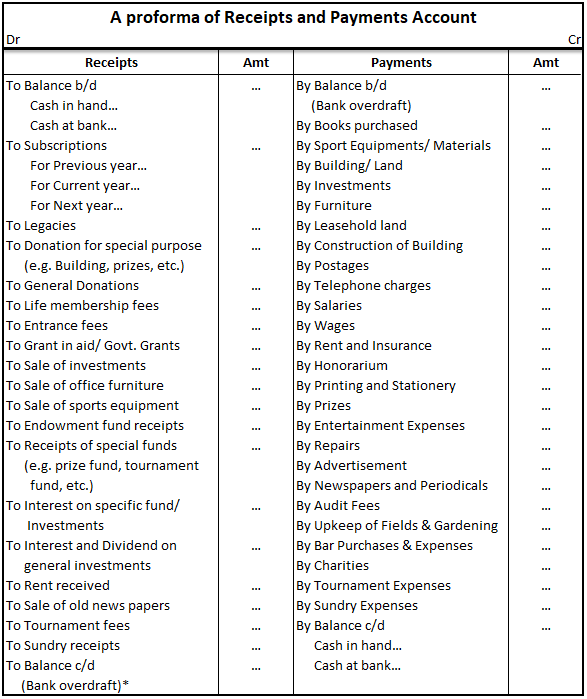
    Receipts and payment account is a summary of cash transactions prepared at the end of the accounting period from the cash book where the transactions are recorded in chronological order. It is an Asset/ Real Account that records both revenue and capital receipts and payments. It is mainly prepared fRead more

    Receipts and payment account is a summary of cash transactions prepared at the end of the accounting period from the cash book where the transactions are recorded in chronological order. It is an Asset/ Real Account that records both revenue and capital receipts and payments. It is mainly prepared for non-profit organizations and helps in the preparation of final accounts.

    Proforma

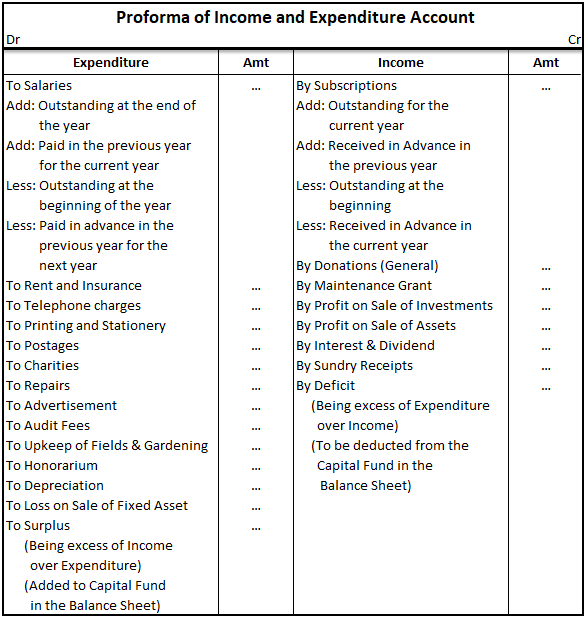
    Income and Expenditure Account is an account prepared by not-for-profit organizations to see whether the income of a particular period is sufficient to cover the expenses of that period. If the revenue is more than the expenses, it is known as “Surplus” or “Excess of Income over Expenditure” and if the expenses are more than Income, it is known as “Deficit” or “Excess of Expenditure over Income”. The account is prepared on the accrual basis of accounting i.e. all revenue incomes whether received or not and all revenue expenditures of the period whether paid or not are taken into account. However, in case of surplus, the money is not distributed among the members. Similarly, if there is a deficit it is not borne by the members.

    Proforma

    See less
    • 0
    • Share
      Share
      • Share on Facebook
      • Share on Twitter
      • Share on LinkedIn
      • Share on WhatsApp
Aadil
AadilCurious
In: 1. Financial Accounting > Not for Profit Organizations

Following is the Receipts and Payments Account of Bharti Club for the year ended 31st March 2019?

RECEIPTS AND PAYMENTS ACCOUNT OF BHARTI CLUB for the year ended 31st March, 2019 Receipts Amount Payments Amount To Balance b/d           10,500 By Salary           25,000 To Subscriptions           70,500 By Travelling Expenses             4,000 To Donations             5,000 By Stationery           ...

  • 1 Answer
  • 0 Followers
Answer
  1. Vijay Curious M.Com
    Added an answer on August 4, 2021 at 3:43 am
    This answer was edited.

    Here I have prepared the Income & Expenditure A/c and Balance Sheet of Bharti Club: Income & Expenditure A/c for the year ended 31st March 2019 Expenditure Amt Income Amt To Salary          25,000 By Subscriptions (WN 1)          69,900 To Travelling Expenses            4,000 By Donations   Read more

    Here I have prepared the Income & Expenditure A/c and Balance Sheet of Bharti Club:

    Income & Expenditure A/c for the year ended 31st March 2019

    Expenditure Amt Income Amt
    To Salary          25,000 By Subscriptions (WN 1)          69,900
    To Travelling Expenses            4,000 By Donations            5,000
    To Stationery          13,000 By Life Membership Fees          10,000
    To Rent          32,000 By Income from Investments            2,000
    To Surplus (Balancing figure)          12,900
             86,900          86,900


    Balance Sheet as on 31st March 2019

    Liabilities  Amt Assets  Amt
    Capital Fund (WN 2)     44,900 Cash         30,000
    Add: Surplus     12,900         57,800 9% Investments         25,000
    Advance Subscription           3,500 Books         12,000
    Life Membership Fees         10,000 Outstanding Subscription           4,300
            71,300         71,300


    Working Note 1: Calculation of Subscriptions

    Particulars Amt
    Total subscriptions received in 2018-19        70,500
    Add: Advance subscription for 2018-19          2,000
              Subscription outstanding for 2018-19          4,300          6,300
           76,800
    Less: Advance subscription for 2019-20          (3,500)
              Subscription outstanding for 2017-18          (3,400)          (6,900)
           69,900

    Working Note 2: Calculation of Capital Fund

    We prepare the previous year’s balance sheet of Bharti Club to identify the capital.

    Balance Sheet as on 31st March 2018

    Liabilities  Amount Assets  Amount
    Capital Fund (Balancing figure)    44,900 Cash    10,500
    Advance Subscription      2,000 9% Investments    25,000
    Books      8,000
    Outstanding Subscription      3,400
       46,900    46,900
    See less
    • 0
    • Share
      Share
      • Share on Facebook
      • Share on Twitter
      • Share on LinkedIn
      • Share on WhatsApp
Bonnie
BonnieCurious
In: 1. Financial Accounting > Partnerships

How to make a partnership deed?

  • 1 Answer
  • 0 Followers
Answer
  1. Naina@123 (B.COM and CMA-Final)
    Added an answer on August 3, 2021 at 7:27 pm
    This answer was edited.

    To proceed with how to make a partnership deed, let me explain to you in short what is partnership deed? A partnership deed is the written agreement between the partners who have agreed to share profits of a business carried on by them. This basically contains terms and conditions to be followed betRead more

    To proceed with how to make a partnership deed, let me explain to you in short what is partnership deed?

    A partnership deed is the written agreement between the partners who have agreed to share profits of a business carried on by them. This basically contains terms and conditions to be followed between the partners.

    Few contents of the partnership deed are as follows:

    • Name, address, and type of business of the partnership firm.
    • Name & address of all the partners
    • Profit-sharing ratio.
    • Rights, duties, and liabilities of all partners.
    • Date of commencement of the partnership
    • Method of settlement of dispute among the partners.
    • Treatment of loss in case of insolvency of one or more partners.


    Generally, a partnership deed contains all those matters which can affect the relationship between the partners. However, if there is no such agreement the partnership should follow the provisions mentioned under The Partnership Act, 1932.

    Now coming to the main question how to make a partnership deed? See the process is not so complicated. The partnership deed may be oral or written, but as the oral agreement has no value for obtaining tax benefits, a partnership firm always prefers a written agreement.

    To prepare the same the partnership deed must be prepared on a stamp paper and signed by all the partners as per Indian Stamp Act and copies of the same should be with all the partners and also must be filed by the registrar of the firm.

    A deed may vary depending on the nature of the partnership they are engaged in. Generally, partnerships are of three types

    • General partnership
    • Limited partnership
    • Limited liability partnership

    the process of making deed is same for all but, the content of deed may vary depending on the liability of partners in the partnership.

    Further to know more about the registration process of partnership firm you can refer the following link https://www.mca.gov.in/Ministry/actsbills/pdf/Partnership_Act_1932.pdf

    See less
    • 0
    • Share
      Share
      • Share on Facebook
      • Share on Twitter
      • Share on LinkedIn
      • Share on WhatsApp
Karan
Karan
In: 1. Financial Accounting > Depreciation & Amortization

Depreciation on solar panels as per income tax act?

  • 1 Answer
  • 0 Followers
Answer
  1. prashant06 B.com, CMA pursuing
    Added an answer on July 26, 2021 at 2:11 pm
    This answer was edited.

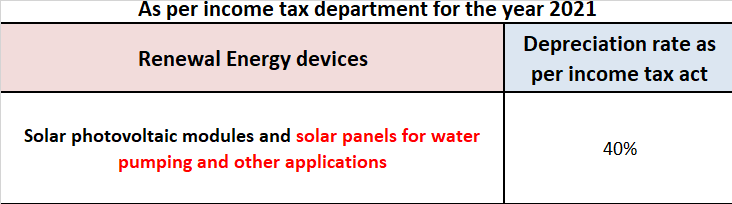
    As per the Income-tax act, solar panels are categorized under the heading renewal energy devices. The rate of depreciation for these devices is mentioned below. As per the act, the rate of depreciation for solar panels is given as 40% as per the WDV method. Generally, these devices are treated as inRead more

    As per the Income-tax act, solar panels are categorized under the heading renewal energy devices. The rate of depreciation for these devices is mentioned below.

    As per the act, the rate of depreciation for solar panels is given as 40% as per the WDV method. Generally, these devices are treated as investments in fixed assets. Therefore they are treated accordingly like other fixed assets and are depreciated periodically in an organized and regular time period. The useful life of such solar devices is taken to be 5 years.

    Giving you a small example of the depreciation on solar panels.

    Solar panels were purchased by Agro Farm ltd. for installing them to be used for electricity generation. These panels were bought for Rs 2,00,000. Therefore depreciation to be charged as per income tax act over its useful life of 5 years is as follows:

    Depreciation as per WDV = (Cost of an asset – salvage value)* rate of depreciation

    Depreciation for 1st year = (2,00,000 – 0)* 40% = Rs 80,000

    WDV at the end of 1st year = (2,00,000 – 80,000) = Rs 1,20,000

    Depreciation for 2nd year = (1,20,000 – 0)* 40% = Rs 48,000

    the same process will continue till the useful life of an asset.

    The depreciation amount will be written off from the book value as shown below:

    Useful life Value at the beginning of the year Depreciation amount Value at the end of the period
    1 2,00,000 80,000 1,20,000
    2 1,20,000 48,000 72,000
    3 72,000 28,800 43,200
    4 43,200 17,280 25,920
    5 25,920 10,368 15,552


    See less
    • 0
    • Share
      Share
      • Share on Facebook
      • Share on Twitter
      • Share on LinkedIn
      • Share on WhatsApp
Load More Questions

Sidebar

Question Categories

  • 1. Financial Accounting

      • Accounting Terms & Basics
      • Bank Reconciliation Statement
      • Banks & NBFCs
      • Bills of Exchange
      • Capital & Revenue Expenses
      • Consignment & Hire Purchase
      • Consolidation
      • Contingent Liabilities & Assets
      • Departments & Branches
      • Depreciation & Amortization
      • Financial Statements
      • Goodwill
      • Insurance Accounting
      • Inventory or Stock
      • Investment Accounting
      • Journal Entries
      • Ledger & Trial Balance
      • Liquidation & Amalgamation
      • Miscellaneous
      • Not for Profit Organizations
      • Partnerships
      • Ratios
      • Shares & Debentures
      • Source Documents & Vouchers
      • Subsidiary Books
  • 2. Accounting Standards

      • AS
      • IFRS
      • IndAS
  • 3. Cost & Mgmt Accounting
  • 4. Taxes & Duties

      • GST
      • Income Tax
  • 5. Audit

      • Bank Audit
      • Internal Audit
      • Miscellaneous - Audit
      • Statutory Audit
  • 6. Software & ERPs

      • Tally
  • 7. MS-Excel
  • 8. Interview & Career
  • Top Questions
  • I need 20 journal entries with ledger and trial balance?

  • Can you show 15 transactions with their journal entries, ledger, ...

  • What is furniture purchased for office use journal entry?

  • What is loose tools account and treatment in final accounts?

  • What is the Journal Entry for Closing Stock?

  • What is the journal entry for goods purchased by cheque?

  • What is commission earned but not received journal entry?

  • How to show adjustment of loose tools revalued in final ...

  • What is the journal entry for interest received from bank?

  • Following is the Receipts and Payments Account of Bharti Club ...

Hot Topics

Accounting Policies Accounting Principles Balance Sheet Bank Reconciliation Statement Bill of Exchange Branch Accounting Calls in Advance Capital Capital Expenditure Companies Act Compound Entry Consignment Creditors Current Assets Debit Balance Debtors Depreciation Difference Between Dissolution of Firm Dissolution of Partnership Drawings External Users Fictitious Assets Final Accounts Financial Statements Fixed Assets Fixed Capital Fluctuating Capital Gain Impairment Installation Interest Received in Advance Internal Users Journal Entry Ledger Loose Tools Miscellaneous Expenditure Profit Rent Rent Received in Advance Reserves Revaluation Revenue Expenditure Revenue Reserve Sacrificing Ratio Subscription Subscription Received in Advance Trial Balance Type of Account Uncalled Capital
  • Home
  • Questions
    • Most Visited
    • Most Active
    • Trending
    • Recent
  • Follow
    • Categories
    • Users
    • Tags
  • Write an Answer
  • Badges & Points
  • Request New Category
  • Send a Suggestion

Most Helping Users

Astha

Astha

  • 50,291 Points
Leader
Simerpreet

Simerpreet

  • 72 Points
Helpful
AbhishekBatabyal

AbhishekBatabyal

  • 65 Points
Helpful

Footer

  • About Us
  • Contact Us
  • Pricing
  • Refund
  • Forum Rules & FAQs
  • Terms and Conditions
  • Privacy Policy
  • Career

© 2021 All Rights Reserved
Accounting Capital.