Please briefly explain why you feel this question should be reported.

Please briefly explain why you feel this answer should be reported.

Please briefly explain why you feel this user should be reported.

Sign InSign Up

AccountingQA

AccountingQA Logo AccountingQA Logo

AccountingQA Navigation

  • Home
  • Ask Questions
  • Write Answers
  • Explore
  • FAQs
Search
Ask A Question

Mobile menu

Close
Ask a Question
  • Home
  • Questions
    • Most Visited
    • Most Active
    • Trending
    • Recent
  • Follow
    • Categories
    • Users
    • Tags
  • Write an Answer
  • Badges & Points
  • Request New Category
  • Send a Suggestion
  • Search Your Accounting Question..

  • Recent Questions
  • Most Answered
  • Answers
  • Most Visited
  • Most Voted
  • No Answers

AccountingQA Latest Questions

Bonnie
BonnieCurious
In: 1. Financial Accounting > Accounting Terms & Basics

What are fictitious assets and intangible assets?

  • 1 Answer
  • 0 Followers
Answer
  1. AbhishekBatabyal Helpful Pursuing CA, BCOM (HONS)
    Added an answer on September 18, 2021 at 3:21 am
    This answer was edited.

    Fictitious assets On seeing or hearing ‘fictitious’, the words which come to our mind are ‘not true, ‘fake’ or ‘fantasy’. So, fictitious assets are those items that appear on the assets side of the balance sheet but are actually not assets. In substance, fictitious assets are the expenses and lossesRead more

    Fictitious assets

    On seeing or hearing ‘fictitious’, the words which come to our mind are ‘not true, ‘fake’ or ‘fantasy’. So, fictitious assets are those items that appear on the assets side of the balance sheet but are actually not assets.

    In substance, fictitious assets are the expenses and losses that are not completely written off in a financial year and are required to be carried forward to the next financial year.

    The examples of fictitious assets are as follows:

    1. Deferred Advertisement expense
    2. Loss on the issue of debentures.
    3. Debit balance of Profit and Loss account ( Net loss )*
    4. Preliminary expenses.

    Fictitious assets appear on the asset side of the balance sheet as expenses and losses have a debit balance.

    *when the balance sheet is prepared as per Schedule III of Companies Act, the Net loss is shown as a negative figure under the head Reserve and Surplus.

    Intangible Assets

    Intangible assets mean the assets which don’t have any physical existence. They cannot be seen or touched but are assets because they do provide future economic benefits to the business. Like tangible assets (like machinery and building), they can be also created, purchased or sold.

    Like tangible assets are depreciated, intangible assets are gradually written over by amortization over their useful lifespan to account for the economic benefits provided by them.

    Following are the examples of intangible assets:

    1. Goodwill
    2. Brand name
    3. Trademark
    4. Patents
    5. Copyrights

    Intangible assets which are created by the business-like goodwill or brand recognition do not appear in the balance sheet.

    Only acquired intangible assets can be shown in the balance sheet. Like purchased goodwill, patents, trademarks etc.

    Intangible assets also face impairment if their fair value is less than their carrying value after deducting amortization expense. The difference between carrying value and fair value is shown in the Profit and loss A/c as impairment charge and the asset is valued at fair value in the balance sheet.


    See less
    • 0
    • Share
      Share
      • Share on Facebook
      • Share on Twitter
      • Share on LinkedIn
      • Share on WhatsApp
Jayesh Gupta
Jayesh GuptaCurious
In: 2. Accounting Standards > AS

When to start charging depreciation on an asset as per AS 10?

  • 1 Answer
  • 0 Followers
Answer
  1. AbhishekBatabyal Helpful Pursuing CA, BCOM (HONS)
    Added an answer on September 21, 2021 at 8:06 pm
    This answer was edited.

    As per AS-10 ( Revised ): Property, Plant and Equipment, depreciation on an asset should begin when the asset is in the location and condition necessary for it to be capable of operating in the manner as intended by the management. This means a firm should start charging depreciation when the assetRead more

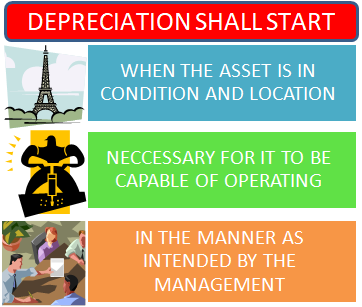
    As per AS-10 ( Revised ): Property, Plant and Equipment, depreciation on an asset should begin when the asset is in the location and condition necessary for it to be capable of operating in the manner as intended by the management.
    This means a firm should start charging depreciation when the asset is ready to be used as per the management’s desire.

    Let’s take an example to understand this clearly:

    A business bought a drinking water cooler for its office use on 1st April 2021. Now, this water cooler needs to be installed and wiped with Isopropyl Alcohol before it can be put to use.

    The business completed all the required procedures by 1st May 2021, but it opened the machine for office use from 1st August 2021.

    So the question arises, from when to start charging depreciation?

    • 1st April 2021 – The date of Purchase
    • 1st May 2021- The date when the machine was ready to use.
    • 1st August 2021 –The date from which the machine was put to use.

    The answer is 1st May 2021– The date when the machine was ready to use.

    It doesn’t matter whether the company started the use of an asset or not. Once an asset is in

    • the location and condition
    • necessary for it to be capable of operating
    • as intended by the management,

    the depreciation should begin.


    See less
    • 0
    • Share
      Share
      • Share on Facebook
      • Share on Twitter
      • Share on LinkedIn
      • Share on WhatsApp
Ayushi
AyushiCurious
In: 2. Accounting Standards > AS

What is the difference integral foreign operations and non-integral foreign operations as per AS-11?

  • 1 Answer
  • 0 Followers
Answer
  1. AbhishekBatabyal Helpful Pursuing CA, BCOM (HONS)
    Added an answer on September 24, 2021 at 12:01 pm
    This answer was edited.

    AS-11: The effects of changes in foreign exchange rates deal with the issues in the translation of foreign currency transactions and foreign operations. Foreign operations of a reporting enterprise mean its subsidiary, associate, joint venture or branch which is based or conducted in a country otherRead more

    AS-11: The effects of changes in foreign exchange rates deal with the issues in the translation of foreign currency transactions and foreign operations.

    Foreign operations of a reporting enterprise mean its subsidiary, associate, joint venture or branch which is based or conducted in a country other than the country of the reporting entity

    For simple understanding let’s consider foreign operation as a branch of a business that is based in a foreign country.

    Foreign Integral operations

    So, integral foreign operations will be a dependent branch that works on the directions of the head office and it is like an extension of the business. The head office consigns goods to it and it sells them and remits cash and reports to the head office.

    It is dependent on head office for receiving goods to sell and to cover its expenses.

    Further, the difference in foreign exchange rate affects the present and future cash flows to the head office.

    Foreign Non-Integral operations

    A non-integral foreign operation will be like an independent branch that can operate without the aid of the head office. Apart from selling goods of the head office, it also buys goods from the local market and sells them.

    Also, it covers its expenses on its own. It doesn’t remit the cash from sales regularly like a dependent branch. It is like acts an investment of the main business.

    The difference in the foreign exchange rate has little or no effect on the present or future cash flows of the head office

    See less
    • 0
    • Share
      Share
      • Share on Facebook
      • Share on Twitter
      • Share on LinkedIn
      • Share on WhatsApp
A_Team
A_Team
In: 2. Accounting Standards > IndAS

What is Ind as 102?

  • 1 Answer
  • 0 Followers
Answer
  1. AbhishekBatabyal Helpful Pursuing CA, BCOM (HONS)
    Added an answer on September 28, 2021 at 2:49 pm
    This answer was edited.

    IND AS 102: ‘Share-based payments’ in its actual text is considerably lengthy and very detailed. The objective of my answer is to provide a basic understanding of what IND AS 102 is all about. Further reading of the actual text is suggested for a more detailed understanding. IND AS 102 is the IndiaRead more

    IND AS 102: ‘Share-based payments’ in its actual text is considerably lengthy and very detailed.

    The objective of my answer is to provide a basic understanding of what IND AS 102 is all about. Further reading of the actual text is suggested for a more detailed understanding.

    IND AS 102 is the India specific version of IFRS 2 which deals with the accounting of Share-based payments. IND AS 102 and IFRS are almost similar.

    It deals with the financial reporting of the share-based payment transactions entered into by an enterprise in the following cases:

    1. Transactions with suppliers of goods or services that are settled by share-based payments.
    2. Transactions with employees of the enterprise in nature of Employee Stock Option Plan.

    Share-based payments are of three types:

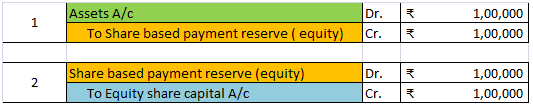
    • Equity settled share-based payment: It is a transaction in which an entity receives goods or services from the supplier of those goods and services (including an employee) and settles it by issuing equity instruments of the entity or its parent entity.

     Example: A business acquires an asset for Rs. 1,00,000 and makes payment by the issue of its equity shares.

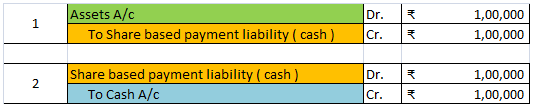
    • Cash settled share-based payment: It is a transaction in which an entity incurs a liability and settles the transaction by paying cash or other assets based on the price of the equity instruments of the entity or group’s entity.

    Example: A business acquires an asset for Rs. 1,00,000 and makes payment in amounts of case based upon its share price.


    • Share-based payment transaction with cash alternatives:- In this case,  either the entity or the counterparty has the option of settling the transaction either through with issue of equity or payment of cash by incurring liability.


    Things that are not under the scope of IND AS-102

    • Transactions with parties who are acting in the capacity of shareholders.
    • Where a business acquires net assets of a business in case of amalgamation, joint venture etc and issues shares as consideration.

    Recognition

    In a share-based transaction,

    • goods and services are to be recognised when the goods or services are received by the entity.
    • Also, the corresponding increase in equity in equity-settled transactions or liability in the cash-settled transactions is to be recognised.

    Measurement

    The amount at a share-based transaction is to be recorded depending upon the type of counterparty:

    1. Non-employee counter-party: The transaction will be measured based on the fair value of the goods or services received on the date when the goods or services are received.
    2. Employee counter-party: The transaction is to be recorded at the fair value of the equity instruments as on the grant date because the services rendered by the employee cannot be recorded reliably.

    I hope this is enough for a basic understanding of the IND AS 102.


    See less
    • 0
    • Share
      Share
      • Share on Facebook
      • Share on Twitter
      • Share on LinkedIn
      • Share on WhatsApp
A_Team
A_Team
In: 1. Financial Accounting > Miscellaneous

What is the difference between fictitious assets and deferred revenue expenditure?

  • 1 Answer
  • 0 Followers
Answer
  1. AbhishekBatabyal Helpful Pursuing CA, BCOM (HONS)
    Added an answer on September 27, 2021 at 12:58 pm
    This answer was edited.

    Fictitious assets are the expenses and losses which are yet to be written off, so they appear in the Asset side of the balance sheet of the relevant financial year because expenses and losses have a debit balance. They are not assets in substance. Examples: Business loss ( debit balance of Profit anRead more

    Fictitious assets are the expenses and losses which are yet to be written off, so they appear in the Asset side of the balance sheet of the relevant financial year because expenses and losses have a debit balance. They are not assets in substance.

    Examples:

    1. Business loss ( debit balance of Profit and loss A/c )*
    2. Prepaid expenses
    3. Discount on the issue of debentures.
    4. Huge promotional expenditure.

    *business loss is shown as a negative figure under the head Reserve and Surplus, when the balance sheet is prepared as per Schedule III of The Companies Act, 2013.

    Deferred revenue expenditures are the expenses incurred for which the benefits are expected to flow to the enterprise beyond the current year. Such expenses are huge and are not written off completely in a financial year. The part of the expenditure which is not written off is shown on the assets side of the balance sheet.

    Examples:

    1. Huge advertisement expense.

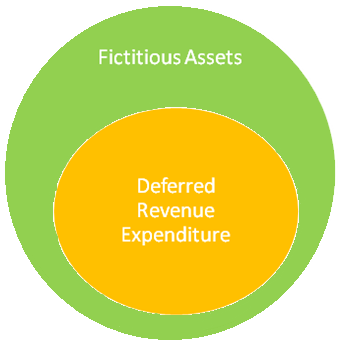
    As you can see, there is some similarity between the two. Deferred revenue expenditure can be called a type of fictitious asset as it is shown in the asset side of the balance sheet but it isn’t an asset.


    The term ‘fictitious asset’ has a broader meaning than deferred revenue expenditure and also includes the losses such as discounts on the issue of debenture and business loss.

    The difference between fictitious assets and deferred revenue expenditure are as follows:

    Fictitious Assets Deferred Revenue Expenditure
    1 These are no real assets but expenses and losses that are not completely written off in an F.Y. These are expenses incurred from which benefits are expected to flow for more than one accounting period.
    2 It has a broader meaning. It has a narrower meaning.
    3 Examples:- business loss, discount on issue of debentures, prepaid expenses etc. Examples:- huge promotional expenditure etc.
    See less
    • 0
    • Share
      Share
      • Share on Facebook
      • Share on Twitter
      • Share on LinkedIn
      • Share on WhatsApp
A_Team
A_Team
In: 1. Financial Accounting > Partnerships

What are the types of partners in partnership act 1932?

  • 1 Answer
  • 0 Followers
Answer
  1. Ayushi Curious Pursuing CA
    Added an answer on September 28, 2021 at 4:43 pm

    The partnership act 1932 does not mention the types of partners specifically. It does have mentions of ‘partner who is minor’ in section 30 and ‘partner by holding out in section 28. But we do come across many types of partners in partnership firms. Following is the list of the types of partners weRead more

    The partnership act 1932 does not mention the types of partners specifically. It does have mentions of ‘partner who is minor’ in section 30 and ‘partner by holding out in section 28.

    But we do come across many types of partners in partnership firms. Following is the list of the types of partners we generally see:-

    1. Active partner: – It is the partner who provides the capital and is also actively involved in the management and daily activities of the firm. Such a type of partner is of utmost importance to the firm. Apart from a share in profit and loss, he is also eligible to draw remuneration from the firm.


    1. Sleeping/ Dormant partner: – This type of partner does not participate in the daily workings of the firm nor actively participates in the management of the firm. Such a type of partner has a large sum of capital invested in the firm and shares the profits as well as losses of the firm.


    1. Partner by holding out:- If any partner, who by his words or by his conduct, represents himself as a partner of a firm, then he is called a partner by holding out. Such a partner is actually not a partner of the firm and doesn’t receive any share of profit as he has contributed no capital.

    As per section 28, such a partner is liable to any person who has given credit to the firm on             the belief that he is a partner of the firm.


    1. Minor partner: – If any person who is less than 18 years of age is admitted into the firm, such partner is known as a minor partner. Such a partner is entitled to the profits of the firm based on his capital but is immune from losses suffered by the firm.


    1. Secret partner: – It is a partner of a firm whose membership is kept hidden from the outsiders such as creditors and other third parties. But he is equally liable as other partners for the outside liabilities.


    1. Outgoing partner: – A partner who voluntarily leaves the partnership without dissolving the firm is called an outgoing partner or retiring partner. Such a partner is liable to all liabilities incurred before his retirement. But he can be held liable to outside liabilities if he fails to give public notice of his retirement.


    See less
    • 0
    • Share
      Share
      • Share on Facebook
      • Share on Twitter
      • Share on LinkedIn
      • Share on WhatsApp
Naina@123
Naina@123
In: 1. Financial Accounting > Journal Entries

Can you tell me journal entry for provision for depreciation?

  • 1 Answer
  • 0 Followers
Answer
  1. prashant06 B.com, CMA pursuing
    Added an answer on August 7, 2021 at 4:23 pm
    This answer was edited.

    First, let us understand the meaning of a provision of depreciation. It is nothing but the total collection of all the depreciation over the years. This account is not like a normal account but a contra asset account. It is also called accumulated depreciation. Annual depreciation charged is an expeRead more

    First, let us understand the meaning of a provision of depreciation. It is nothing but the total collection of all the depreciation over the years. This account is not like a normal account but a contra asset account. It is also called accumulated depreciation.

    Annual depreciation charged is an expense for the business and hence has a debit balance. Whereas provision for depreciation as a contra asset account has a credit balance.

    The journal entry for provision for depreciation is

    Depreciation A/c                                                      ……….Dr XXX
               To Provision for depreciation XXX

    Explaining the credit nature of this account. As we know that the depreciation is an expense for the business hence as per modern rules “Debit all the expenses and losses and credit all incomes and gains” therefore it is debited whereas the provision of depreciation is contra account it has a credit balance as it reduces the value of assets. So according to modern rule, we know a decrease in assets has a credit balance, hence shown in a negative balance on the balance sheet under long-term assets.

    With the preparation of this account, we do not credit depreciation in the asset account but transfer every year to the accumulated depreciation account, and when assets are disposed of or sold we credit the ‘total’ of the provision on depreciation to the credit of the asset account just to calculate the actual profit or loss on a sale of the asset.


    See less
    • 0
    • Share
      Share
      • Share on Facebook
      • Share on Twitter
      • Share on LinkedIn
      • Share on WhatsApp
Load More Questions

Sidebar

Question Categories

  • 1. Financial Accounting

      • Accounting Terms & Basics
      • Bank Reconciliation Statement
      • Banks & NBFCs
      • Bills of Exchange
      • Capital & Revenue Expenses
      • Consignment & Hire Purchase
      • Consolidation
      • Contingent Liabilities & Assets
      • Departments & Branches
      • Depreciation & Amortization
      • Financial Statements
      • Goodwill
      • Insurance Accounting
      • Inventory or Stock
      • Investment Accounting
      • Journal Entries
      • Ledger & Trial Balance
      • Liquidation & Amalgamation
      • Miscellaneous
      • Not for Profit Organizations
      • Partnerships
      • Ratios
      • Shares & Debentures
      • Source Documents & Vouchers
      • Subsidiary Books
  • 2. Accounting Standards

      • AS
      • IFRS
      • IndAS
  • 3. Cost & Mgmt Accounting
  • 4. Taxes & Duties

      • GST
      • Income Tax
  • 5. Audit

      • Bank Audit
      • Internal Audit
      • Miscellaneous - Audit
      • Statutory Audit
  • 6. Software & ERPs

      • Tally
  • 7. MS-Excel
  • 8. Interview & Career
  • Top Questions
  • I need 20 journal entries with ledger and trial balance?

  • Can you show 15 transactions with their journal entries, ledger, ...

  • What is furniture purchased for office use journal entry?

  • What is loose tools account and treatment in final accounts?

  • What is the Journal Entry for Closing Stock?

  • What is the journal entry for goods purchased by cheque?

  • What is commission earned but not received journal entry?

  • How to show adjustment of loose tools revalued in final ...

  • What is the journal entry for interest received from bank?

  • Following is the Receipts and Payments Account of Bharti Club ...

Hot Topics

Accounting Policies Accounting Principles Balance Sheet Bank Reconciliation Statement Bill of Exchange Branch Accounting Calls in Advance Capital Capital Expenditure Companies Act Compound Entry Consignment Creditors Current Assets Debit Balance Debtors Depreciation Difference Between Dissolution of Firm Dissolution of Partnership Drawings External Users Fictitious Assets Final Accounts Financial Statements Fixed Assets Fixed Capital Fluctuating Capital Gain Impairment Installation Interest Received in Advance Internal Users Journal Entry Ledger Loose Tools Miscellaneous Expenditure Profit Rent Rent Received in Advance Reserves Revaluation Revenue Expenditure Revenue Reserve Sacrificing Ratio Subscription Subscription Received in Advance Trial Balance Type of Account Uncalled Capital
  • Home
  • Questions
    • Most Visited
    • Most Active
    • Trending
    • Recent
  • Follow
    • Categories
    • Users
    • Tags
  • Write an Answer
  • Badges & Points
  • Request New Category
  • Send a Suggestion

Most Helping Users

Astha

Astha

  • 50,291 Points
Leader
Simerpreet

Simerpreet

  • 72 Points
Helpful
AbhishekBatabyal

AbhishekBatabyal

  • 65 Points
Helpful

Footer

  • About Us
  • Contact Us
  • Pricing
  • Refund
  • Forum Rules & FAQs
  • Terms and Conditions
  • Privacy Policy
  • Career

© 2021 All Rights Reserved
Accounting Capital.