
Please briefly explain why you feel this question should be reported.

Please briefly explain why you feel this answer should be reported.

Please briefly explain why you feel this user should be reported.

Sign InSign Up

AccountingQA

AccountingQA Logo AccountingQA Logo

AccountingQA Navigation

  • Home
  • Ask Questions
  • Write Answers
  • Explore
  • FAQs
Search
Ask A Question

Mobile menu

Close
Ask a Question
  • Home
  • Questions
    • Most Visited
    • Most Active
    • Trending
    • Recent
  • Follow
    • Categories
    • Users
    • Tags
  • Write an Answer
  • Badges & Points
  • Request New Category
  • Send a Suggestion
  • Search Your Accounting Question..

  • Recent Questions
  • Most Answered
  • Answers
  • Most Visited
  • Most Voted
  • No Answers

AccountingQA Latest Questions

AbhishekBatabyal
AbhishekBatabyalHelpful
In: 1. Financial Accounting > Miscellaneous

What is deferred revenue?

  • 1 Answer
  • 0 Followers
Answer
  1. Ayushi Curious Pursuing CA
    Added an answer on October 6, 2021 at 11:55 am
    This answer was edited.

    The word, “deferred” means delayed or postponed and “revenue” in layman’s terms means income. Therefore deferred revenue means the revenue which is yet to be recognised as income. It is actually unearned income. In accrual accounting, income is recognised only when it is accrued or earned. DeferredRead more

    The word, “deferred” means delayed or postponed and “revenue” in layman’s terms means income. Therefore deferred revenue means the revenue which is yet to be recognised as income. It is actually unearned income.

    In accrual accounting, income is recognised only when it is accrued or earned. Deferred revenue is the income received before the performance of the economic activity to earn it.

    Example:  A shoe shop owner gives an order to a shoe manufacturer of 1000 pair of shoes which is to be delivered after 4 months. He also gives him a cheque of ₹15,000 in advance, the rest ₹5000 is to be given at the time of delivery.

    So, in this case, the ₹15,000 is actually is unearned revenue i.e. deferred revenue. It will be recognised as revenue when the shoe manufacture completes the order and deliver it.

    Till then, the deferred revenue is reported as a liability in the balance sheet. Like this:

    After recognition as revenue, it will be reported in the statement of profit or loss:

    Hence, to summarise, deferred revenue is:

    • Unearned revenue
    • Recognised as income till it is earned
    • Till then it is recognised and reported as a liability in the balance sheet.

    Some examples of deferred revenue are as follows:

    • Advance rent received
    • Advance payment for goods to be delivered.
    • Advanced payment for services to be provided.

    Now the question arises why deferred revenue is recognised as a liability. It is due to the fact that the business may not be able to perform the economic activity successfully to earn that revenue.

    Taking the above example, suppose the shoe manufacturer is not able to honour its commitment and the shoe shop owner can wait no more, then the advanced money of ₹ 15,000 is to be refunded. That’s why deferred revenue is recognised as a liability because it is a liability if we consider the principle of conservatism (GAAP).

    See less
    • 0
    • Share
      Share
      • Share on Facebook
      • Share on Twitter
      • Share on LinkedIn
      • Share on WhatsApp
Ayushi
AyushiCurious
In: 1. Financial Accounting > Financial Statements

Are drawings recorded in profit and loss account?

  • 1 Answer
  • 0 Followers
Answer
  1. AbhishekBatabyal Helpful Pursuing CA, BCOM (HONS)
    Added an answer on October 7, 2021 at 9:16 am
    This answer was edited.

    No, drawings are not shown in the statement of profit or loss. By drawings, we mean the withdrawal of cash or goods by the owner of the business for his personal use. Drawings are actually shown in the balance sheet as a deduction from the capital account. Let’s take an example, Mr X runs a tradingRead more

    No, drawings are not shown in the statement of profit or loss. By drawings, we mean the withdrawal of cash or goods by the owner of the business for his personal use.

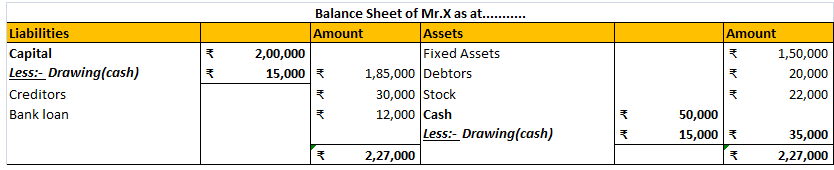
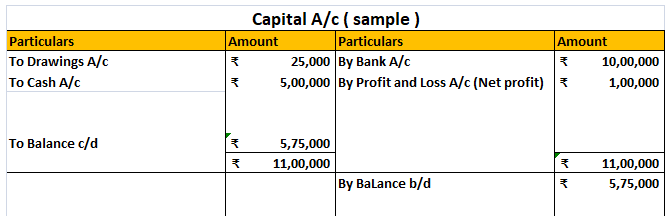
    Drawings are actually shown in the balance sheet as a deduction from the capital account.

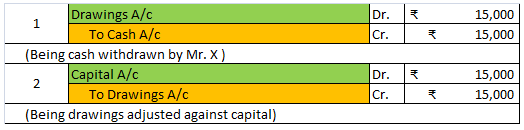
    Let’s take an example, Mr X runs a trading business. For meeting his personal expense we withdrew cash from his business cash of amount Rs. 15,000. It shall be reported like this:

    Journal Entries:
    Balance sheet:
    Profit and loss account reports only the nominal accounts i.e. incomes and expenses. That’s why drawings are not shown in the statement of profit or loss because it is neither an expense nor an income.

    It represents the owner’s withdrawal of capital from business for personal use. Hence, the drawings account is a personal account. Drawings lead to a simultaneous reduction in capital and cash or stock of a business which has nothing to do with Profit and loss A/c.

    Therefore it is reported in the balance sheet only.

    See less
    • 0
    • Share
      Share
      • Share on Facebook
      • Share on Twitter
      • Share on LinkedIn
      • Share on WhatsApp
Bonnie
BonnieCurious
In: 1. Financial Accounting > Accounting Terms & Basics

Is capital a real account?

  • 1 Answer
  • 0 Followers
Answer
  1. Ayushi Curious Pursuing CA
    Added an answer on October 8, 2021 at 5:55 am
    This answer was edited.

    No, capital account is not a real account. Capital account represents the amount of money invested by the owner/owners of the business along with the retained earnings net of drawings or dividends. Capital account has a natural credit balance because it is an internal liability of the business. CapiRead more

    No, capital account is not a real account.

    Capital account represents the amount of money invested by the owner/owners of the business along with the retained earnings net of drawings or dividends. Capital account has a natural credit balance because it is an internal liability of the business.

    Capital account is a personal account because, as discussed above, it represents the investment of the owner or owners. Personal account represents person or persons.

    Whereas a real account represents the material assets of a business. Example:-  Cash A/c, Fixed assets A/c etc. That’s why the capital account is not a real account.

    Being a personal account, the following golden rule of accounting applies to capital account:-

    “Debit the receiver and credit the giver”

    Here, as the owner gives an amount as an investment into the business (owner and the business are separate entities), the capital account has a credit balance.

    See less
    • 0
    • Share
      Share
      • Share on Facebook
      • Share on Twitter
      • Share on LinkedIn
      • Share on WhatsApp
Bonnie
BonnieCurious
In: 1. Financial Accounting > Financial Statements

What is order of liquidity and order of permanence related to balance sheet?

  • 1 Answer
  • 0 Followers
Answer
  1. Spriha Sparsh
    Added an answer on October 9, 2021 at 3:45 pm
    This answer was edited.

    Order of Liquidity Under this method, a company organizes current and fixed assets in the balance sheet in the order of liquidity and the degree of ease by which it is converts converted into cash.On the asset side, we will write most liquid assets at first i.e. cash in hand, cash at bank and so onRead more

    Order of Liquidity

    Under this method, a company organizes current and fixed assets in the balance sheet in the order of liquidity and the degree of ease by which it is converts converted into cash.On the asset side, we will write most liquid assets at first i.e. cash in hand, cash at bank and so on and further. In the end, we will write goodwill.

    Liabilities are presented based on the order of urgency of payment. On the liabilities side, we start from short-term liabilities for example outstanding expenses, creditors and bill payable, and so on. In the end, we write capital adjusted with net profit and drawings if any.

    This approach is generally used by sole traders and partnerships firms. The following is the format of Balance sheet in order of liquidity:


    Order of Permanence

    Under this method, while preparing a balance sheet by a company assets are listed according to their permanency. Permanent assets are shown at first and then less permanent assets are shown afterward. On the assets side of the balance sheet starts with more fixed and permanent assets i.e. it begins with goodwill, building, machinery, furniture, then investments and ends with cash in hand as the last item.

    The fixed or long-term liabilities are shown first under the order of permanence method, and the current liabilities are listed afterward. On the liabilities side, we start from capital, Reserve and surplus, Long term loans and end with outstanding expenses.

    The following is the format of the Balance sheet in order of permanence:


    Such order or arrangement of balance sheet items are refer as ‘Marshalling of Balance Sheet’. 

    See less
    • 0
    • Share
      Share
      • Share on Facebook
      • Share on Twitter
      • Share on LinkedIn
      • Share on WhatsApp
Jayesh Gupta
Jayesh GuptaCurious
In: 1. Financial Accounting > Accounting Terms & Basics

The following is a statement of revenues and expenses for a specific period of time?

A. Trading Account B. Trial Balance C. Profit and Loss Statements D. Balance Sheet  

  • 1 Answer
  • 0 Followers
Answer
  1. Ayushi Curious Pursuing CA
    Added an answer on October 12, 2021 at 6:05 pm
    This answer was edited.

    The correct answer is Option C. The Profit and loss statement is also referred to as the statement of revenues and expenses. It is because the Profit and Loss statement reports all types of revenue that have been earned and all types of expenses that have been incurred during a particular period ofRead more

    The correct answer is Option C.

    The Profit and loss statement is also referred to as the statement of revenues and expenses. It is because the Profit and Loss statement reports all types of revenue that have been earned and all types of expenses that have been incurred during a particular period of time.

    Option A Trading Account reports only the operating revenues and operating expenses.

    Option B Trial Balance shows the balances of all the ledgers of a business and is prepared to check the arithmetical accuracy of the books of accounts.

    Option D Balance sheet reports the balances of assets and liabilities of a business as at a particular date.

    People often confuse the trading and the profit and loss statement to be the same. But they are different.

    Trading Account is prepared with aim of arriving at operating profit or gross profit whereas the profit and loss statement is prepared to arrive at the net profit of a business and reports every revenue and expense whether operating or non operating in nature.

    Operating revenue and operating expense are earned or incurred respectively are related to the chief business activities of a business.

    Features of profit and loss statement:

    1. It is prepared to measure the net profit of a business hence its profitability.
    2. It is usually prepared for a period of one year but many companies do prepare quarterly statements to better judge their performance.
    3. It helps the management in decision making and the other stakeholders like shareholders, creditors to make informed decisions.
    See less
    • 0
    • Share
      Share
      • Share on Facebook
      • Share on Twitter
      • Share on LinkedIn
      • Share on WhatsApp
Ayushi
AyushiCurious
In: 4. Taxes & Duties > GST

What is Input Tax Credit in GST?

  • 1 Answer
  • 0 Followers
Answer
  1. Samar Sparsh
    Added an answer on October 10, 2021 at 12:23 pm
    This answer was edited.

    Let us assume that we are discussing Input Tax Credit in GST of India. Input Tax Credit or ITC is the tax that a business pays on a purchase and that it can claim credit and use it to reduce its tax liability when it makes a sale. In other words, it means at the time of paying tax on output (Final sRead more

    Let us assume that we are discussing Input Tax Credit in GST of India.

    Input Tax Credit or ITC is the tax that a business pays on a purchase and that it can claim credit and use it to reduce its tax liability when it makes a sale. In other words, it means at the time of paying tax on output (Final sale product), you can reduce the tax you have already paid on inputs (Purchase).

    Example  For a manufacturer, tax payable on output (Final product) is Rs 500 and tax paid on input A is Rs 100, input B is Rs 50 and, input C is Rs50. You can claim INPUT CREDIT of Rs 200(100+50+50) and you only need to deposit Rs 300(500-200) in taxes.

    Conditions- Only a Registered Person would be able to claim the benefit of Input Tax Credit of GST after satisfying the following:

    1. He is in possession of a Tax Invoice or any other specified tax-paid document.
    2. He has received the goods or services. Includes “Bill to ship” scenarios.
    3. Tax is actually paid by the supplier.
    4. The supplier has furnished the GST Return.
    5. To claim ITC, the buyer should pay the supplier for the supplies received (inclusive of tax) within 180 days from the date of issuing the invoice.

    Claiming of ITC – Discussed by taking an example, seller A sold his goods to B. Now B who is a buyer will be eligible to claim the input tax credit on purchases based on the invoices when he makes further sales. Now,

    •  S will upload the details of all the tax invoices in GSTR 1.
    • All the details in accordance with the sales to B will reflect in GSTR 2A, and the same data will be taken by B to file GSTR 2 (i.e. details of inward supply).
    • B will accept the details about the purchase that has been made and uploaded by the seller, the tax on purchases will be credited to ‘Electronic Credit Ledger’ of B and he can adjust it against future output tax liability and get the refund.
    See less
    • 0
    • Share
      Share
      • Share on Facebook
      • Share on Twitter
      • Share on LinkedIn
      • Share on WhatsApp
AbhishekBatabyal
AbhishekBatabyalHelpful
In: 4. Taxes & Duties > Income Tax

What is advance tax?

  • 1 Answer
  • 0 Followers
Answer
  1. Ayushi Curious Pursuing CA
    Added an answer on October 27, 2021 at 4:56 am

    By the name, it can be easily deduced that Advance tax means the tax paid in advance. Advance tax is the tax paid by an assessee in the Previous Year itself based on his estimated income. We know that Income tax liability is known in the Assessment Year based on the income of the Previous Year. But,Read more

    By the name, it can be easily deduced that Advance tax means the tax paid in advance.

    Advance tax is the tax paid by an assessee in the Previous Year itself based on his estimated income.

    We know that Income tax liability is known in the Assessment Year based on the income of the Previous Year. But, the government encourages the taxpayers to pay the tax in the Previous Year itself based on the estimated income.

    As per section 208 of the Income Tax 1961, if the total income liability on the estimated income comes up more than Rs. 10,000, then advance tax has to be paid.

    The advance tax has to be paid according to the following schedule for the individual and corporate assessees [Other than the assessee who computing profits on a presumptive basis under section 44AD(1) and 44ADA(1)]:

    Due date of Instalment Amount Payable
    On or before 15th June No less than 15% advance tax liability.
    On or before 15th September No less than 45% of tax liability, as reduced by any amount if any paid in the earlier instalment.
    On or before 15th December No less than 75% of tax liability, as reduced by any amount or amounts if any paid in the earlier instalments.
    On or before 15th March No less than 100% of tax liability, as reduced by any amount or amounts if any paid in the earlier instalments.


    Any amount paid by the way of advance tax on or before 15th March shall be treated as advance tax paid during each financial year on or before 15th March.

    Also as per section 219, the tax credit is given for the advance tax paid in the regular assessment of income tax.

    In case of non-payment or short payment of the advance tax,  interest is payable as per section 234B. Interest is also attracted in case of delayed payment of advance tax as per section 234C.

    That’s all, I would conclude my answer hoping that it was helpful in making the concept of advance tax easy to grasp.

    See less
    • 0
    • Share
      Share
      • Share on Facebook
      • Share on Twitter
      • Share on LinkedIn
      • Share on WhatsApp
Load More Questions

Sidebar

Question Categories

  • 1. Financial Accounting

      • Accounting Terms & Basics
      • Bank Reconciliation Statement
      • Banks & NBFCs
      • Bills of Exchange
      • Capital & Revenue Expenses
      • Consignment & Hire Purchase
      • Consolidation
      • Contingent Liabilities & Assets
      • Departments & Branches
      • Depreciation & Amortization
      • Financial Statements
      • Goodwill
      • Insurance Accounting
      • Inventory or Stock
      • Investment Accounting
      • Journal Entries
      • Ledger & Trial Balance
      • Liquidation & Amalgamation
      • Miscellaneous
      • Not for Profit Organizations
      • Partnerships
      • Ratios
      • Shares & Debentures
      • Source Documents & Vouchers
      • Subsidiary Books
  • 2. Accounting Standards

      • AS
      • IFRS
      • IndAS
  • 3. Cost & Mgmt Accounting
  • 4. Taxes & Duties

      • GST
      • Income Tax
  • 5. Audit

      • Bank Audit
      • Internal Audit
      • Miscellaneous - Audit
      • Statutory Audit
  • 6. Software & ERPs

      • Tally
  • 7. MS-Excel
  • 8. Interview & Career
  • Top Questions
  • I need 20 journal entries with ledger and trial balance?

  • Can you show 15 transactions with their journal entries, ledger, ...

  • What is furniture purchased for office use journal entry?

  • What is loose tools account and treatment in final accounts?

  • What is the Journal Entry for Closing Stock?

  • What is the journal entry for goods purchased by cheque?

  • What is commission earned but not received journal entry?

  • How to show adjustment of loose tools revalued in final ...

  • What is the journal entry for interest received from bank?

  • Following is the Receipts and Payments Account of Bharti Club ...

Hot Topics

Accounting Policies Accounting Principles Balance Sheet Bank Reconciliation Statement Bill of Exchange Branch Accounting Calls in Advance Capital Capital Expenditure Companies Act Compound Entry Consignment Creditors Current Assets Debit Balance Debtors Depreciation Difference Between Dissolution of Firm Dissolution of Partnership Drawings External Users Fictitious Assets Final Accounts Financial Statements Fixed Assets Fixed Capital Fluctuating Capital Gain Impairment Installation Interest Received in Advance Internal Users Journal Entry Ledger Loose Tools Miscellaneous Expenditure Profit Rent Rent Received in Advance Reserves Revaluation Revenue Expenditure Revenue Reserve Sacrificing Ratio Subscription Subscription Received in Advance Trial Balance Type of Account Uncalled Capital
  • Home
  • Questions
    • Most Visited
    • Most Active
    • Trending
    • Recent
  • Follow
    • Categories
    • Users
    • Tags
  • Write an Answer
  • Badges & Points
  • Request New Category
  • Send a Suggestion

Most Helping Users

Astha

Astha

  • 50,291 Points
Leader
Simerpreet

Simerpreet

  • 72 Points
Helpful
AbhishekBatabyal

AbhishekBatabyal

  • 65 Points
Helpful

Footer

  • About Us
  • Contact Us
  • Pricing
  • Refund
  • Forum Rules & FAQs
  • Terms and Conditions
  • Privacy Policy
  • Career

© 2021 All Rights Reserved
Accounting Capital.