Please briefly explain why you feel this question should be reported.

Please briefly explain why you feel this answer should be reported.

Please briefly explain why you feel this user should be reported.

Sign InSign Up

AccountingQA

AccountingQA Logo AccountingQA Logo

AccountingQA Navigation

  • Home
  • Ask Questions
  • Write Answers
  • Explore
  • FAQs
Search
Ask A Question

Mobile menu

Close
Ask a Question
  • Home
  • Questions
    • Most Visited
    • Most Active
    • Trending
    • Recent
  • Follow
    • Categories
    • Users
    • Tags
  • Write an Answer
  • Badges & Points
  • Request New Category
  • Send a Suggestion
  • Search Your Accounting Question..

AccountingQA Latest Questions

AbhishekBatabyal
AbhishekBatabyalHelpful
In: 1. Financial Accounting > Miscellaneous

What is deferred revenue?

  • 1 Answer
  • 0 Followers
Answer
  1. Ayushi Curious Pursuing CA
    Added an answer on October 6, 2021 at 11:55 am
    This answer was edited.

    The word, “deferred” means delayed or postponed and “revenue” in layman’s terms means income. Therefore deferred revenue means the revenue which is yet to be recognised as income. It is actually unearned income. In accrual accounting, income is recognised only when it is accrued or earned. DeferredRead more

    The word, “deferred” means delayed or postponed and “revenue” in layman’s terms means income. Therefore deferred revenue means the revenue which is yet to be recognised as income. It is actually unearned income.

    In accrual accounting, income is recognised only when it is accrued or earned. Deferred revenue is the income received before the performance of the economic activity to earn it.

    Example:  A shoe shop owner gives an order to a shoe manufacturer of 1000 pair of shoes which is to be delivered after 4 months. He also gives him a cheque of ₹15,000 in advance, the rest ₹5000 is to be given at the time of delivery.

    So, in this case, the ₹15,000 is actually is unearned revenue i.e. deferred revenue. It will be recognised as revenue when the shoe manufacture completes the order and deliver it.

    Till then, the deferred revenue is reported as a liability in the balance sheet. Like this:

    After recognition as revenue, it will be reported in the statement of profit or loss:

    Hence, to summarise, deferred revenue is:

    • Unearned revenue
    • Recognised as income till it is earned
    • Till then it is recognised and reported as a liability in the balance sheet.

    Some examples of deferred revenue are as follows:

    • Advance rent received
    • Advance payment for goods to be delivered.
    • Advanced payment for services to be provided.

    Now the question arises why deferred revenue is recognised as a liability. It is due to the fact that the business may not be able to perform the economic activity successfully to earn that revenue.

    Taking the above example, suppose the shoe manufacturer is not able to honour its commitment and the shoe shop owner can wait no more, then the advanced money of ₹ 15,000 is to be refunded. That’s why deferred revenue is recognised as a liability because it is a liability if we consider the principle of conservatism (GAAP).

    See less
    • 0
    • Share
      Share
      • Share on Facebook
      • Share on Twitter
      • Share on LinkedIn
      • Share on WhatsApp
Ayushi
AyushiCurious
In: 1. Financial Accounting > Capital & Revenue Expenses

What are some capital and revenue expenditure examples?

  • 1 Answer
  • 0 Followers
Answer
  1. Spriha Sparsh
    Added an answer on October 7, 2021 at 8:59 pm
    This answer was edited.

    Based on duration, expenses can be categorized as capital expenditure and revenue expenditure. A) Capital expenditure or CAPEX are those funds that are used to acquire or maintain or enhance long-term assets. Such expenses do not occur frequently and are incurred to enhance the company’s utility inRead more

    Based on duration, expenses can be categorized as capital expenditure and revenue expenditure.

    A) Capital expenditure or CAPEX are those funds that are used to acquire or maintain or enhance long-term assets. Such expenses do not occur frequently and are incurred to enhance the company’s utility in the long-term i.e. more than one year.

    The formula of CAPEX can be given as –

    Capital expenditure = Net increase in PP & E + Depreciation Expense

    . It is showed in companies’ cash flow statement and in its Balance Sheet under the head of fixed assets. These capital expenditures are capitalized.

    List of some capital expenses –

    • Buildings (Including costs of purchase and other cost that extend the useful life of a building)
    • Computer equipment (Cost of purchase and installation cost)
    • Office equipment (Purchase cost)
    • Furniture and fixtures (Cost of purchase and installation cost)
    • Intangible assets (i.e. patent, trademark)
    • Land (Including the cost of purchasing and upgrading the land)
    • Machinery (Purchase cost and costs that bring the equipment to its location and for its intended use)
    • Software (Installation cost)
    • Vehicles

    Example- If an asset costs Rs10,000 when bought and installation cost is Rs2000. The total capital expenditure will be Rs12000 and is expected to be in use for five years, Rs2,500 may be charged to depreciation in each year over the next five years.

    B) Revenue expenditure or OPEX are those expenses that are incurred during its course of the operation. It can also be termed as  total expenses that are incurred by firms through their production activities. Such costs do not result in asset creation, and the benefits resulting from it are limited to one accounting year. These are for managing operational activities and revenue within a given accounting period.

    The accounting treatment for revenue expenditure for an accounting period is shown in a companies Income Statement, but it is not recorded in the firm’s Balance Sheet. OPEX is not capitalized and depreciation is not levied on such expenses.

    Examples for revenue expenditures are as follows –

    • Direct expenses

    These types of expenses are mostly incurred directly through the production process. Common direct expenses include – direct wages, freight charge, rent, material cost, legal expenses, and electricity cost.

    • Indirect expenses

    These expenses are indirectly related to production like during sale, distribution, and management of finished goods or services. They include expenses like selling salaries, repairs, interest, commission, depreciation, rent, and taxes, among others.


    See less

    • 0
    • Share
      Share
      • Share on Facebook
      • Share on Twitter
      • Share on LinkedIn
      • Share on WhatsApp
AbhishekBatabyal
AbhishekBatabyalHelpful
In: 1. Financial Accounting > Depreciation & Amortization

How much is depreciation on camera?

  • 1 Answer
  • 0 Followers
Answer
  1. Ayushi Curious Pursuing CA
    Added an answer on October 5, 2021 at 10:29 am
    This answer was edited.

    The Income Tax 1961 does not provide any rate of depreciation specifically for cameras. But we can consider camera within the block of ‘Computer including software’ for which the rate of depreciation is 40% at WDV method. It is a general practice for non-corporates to charge depreciation at rates slRead more

    The Income Tax 1961 does not provide any rate of depreciation specifically for cameras. But we can consider camera within the block of ‘Computer including software’ for which the rate of depreciation is 40% at WDV method.

    It is a general practice for non-corporates to charge depreciation at rates slightly lower than the rate provided by the Income Tax Act, 1961. But one cannot charge depreciation more than it.

    In the case of corporate, the rates for charging depreciation are provided by the Companies Act 2013, which is

    • 20.58% WDV and 7.31% SLM for cameras to be used for the production of cinematography and motion pictures.
    • 25.89% WDV and 9.50% SLM for cameras which is part of electrical installations and equipment (CCTV cameras).

    Let’s take an example:

    Mr X is a jewellery shop owner and has installed CCTV cameras on 1st April 2021, costing ₹ 40,000 at various points in his shop to ensure safety and security. Keeping in mind the Income-tax rates, his accountant decided to charge depreciation @ 30% p.a. on the CCTV cameras.

    Following is the journal entry:

    The balance sheet will look like this:

    See less
    • 0
    • Share
      Share
      • Share on Facebook
      • Share on Twitter
      • Share on LinkedIn
      • Share on WhatsApp
Bonnie
BonnieCurious
In: 1. Financial Accounting > Journal Entries

What is the journal entry for prepaid rent?

  • 1 Answer
  • 0 Followers
Answer
  1. Spriha Sparsh
    Added an answer on October 6, 2021 at 4:41 pm
    This answer was edited.

    Journal Entry Prepaid Rent A/c Dr. To Cash A/C (Being rent paid in advance) "Prepaid Account" is treated as an asset and as per the modern rules debit the increase in the asset. "Cash Account" is an asset and as per the accounting rules credit the decrease in the asset.   Adjustment entry: TheRead more

    Journal Entry

    Prepaid Rent A/c Dr.

    To Cash A/C

    (Being rent paid in advance)

    “Prepaid Account” is treated as an asset and as per the modern rules debit the increase in the asset.

    “Cash Account” is an asset and as per the accounting rules credit the decrease in the asset.


    Adjustment entry: The prepaid rent entry has an adjustment entry when the rent expense account is due. The journal entry for that is

    Rent Expense A/c

    To Prepaid Rent A/c

    (Being the rent expense due and adjusted from the prepaid expense)


    Example:  ABC.Ltd signs a one-year lease on an office floor for Rs 10,000 a month. The landlord requires that the Company pays the annual amount Rs 120,000 at the beginning of the year.

    The journal entry for Company would be as follows:

    At the beginning

    Prepaid Rent A/c – 1,20,000

    To Cash A/c – 1,20,000

    (Being rent paid in advance for the year)


    At the time rent was due (Month 1)

    Rent Expense A/c – 10,000

    To Prepaid Rent A/c – 10,000

    (Being the rent expense due and adjusted from the prepaid expense)


    The same entry done in month 1 will be repeated in the next 11 months.

    See less
    • 0
    • Share
      Share
      • Share on Facebook
      • Share on Twitter
      • Share on LinkedIn
      • Share on WhatsApp
Aadil
AadilCurious
In: 1. Financial Accounting > Depreciation & Amortization

What is a provision for depreciation account?

  • 1 Answer
  • 0 Followers
Answer
  1. AbhishekBatabyal Helpful Pursuing CA, BCOM (HONS)
    Added an answer on October 4, 2021 at 7:46 pm
    This answer was edited.

    You must have knowledge of what depreciation is. Depreciation is the process of allocating the value of an asset over its useful life. It reduces the carrying value of the asset year by year till it is scraped. It is an expense (expense of using the asset for business purposes) and it is charged toRead more

    You must have knowledge of what depreciation is. Depreciation is the process of allocating the value of an asset over its useful life. It reduces the carrying value of the asset year by year till it is scraped.

    It is an expense (expense of using the asset for business purposes) and it is charged to profit and loss account.

    Depreciation can be reported in the financial statement in two ways:

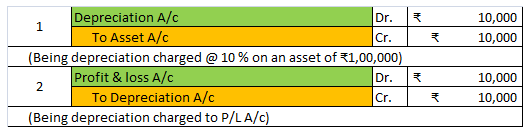
    1. Deduct depreciation from the asset account and show the asset at “depreciation less” value. See the journal entries below:

    1. Maintain a provision for depreciation account and show the asset account at original cost. In this method, no entry is passed through the asset account. See the journal entries below:


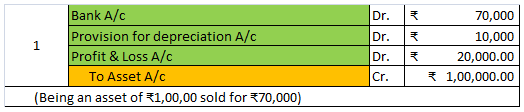
    Provision for depreciation account represents the collection of total depreciation till date on an asset. That’s why it is also called accumulated depreciation account. When an asset is sold, its accumulated depreciation is credited to the asset account. See the journal entry below:

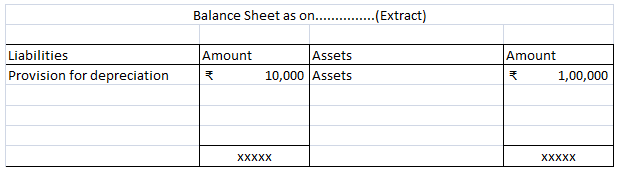
    It is shown on the liabilities side of the balance sheet. It is a nominal account because it is shown as an expense in the statement of profit or loss.

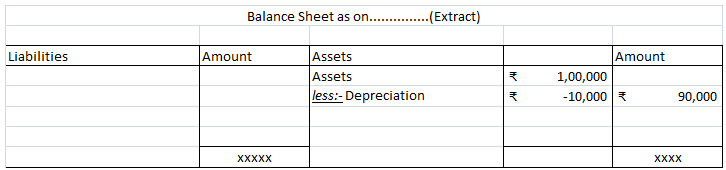
    In case provision for depreciation account is not maintained then the balance sheet looks like this:

    See less
    • 0
    • Share
      Share
      • Share on Facebook
      • Share on Twitter
      • Share on LinkedIn
      • Share on WhatsApp
Aadil
AadilCurious
In: 1. Financial Accounting > Miscellaneous

What are some examples of revenue receipts and capital receipts?

  • 1 Answer
  • 0 Followers
Answer
  1. Ayushi Curious Pursuing CA
    Added an answer on October 3, 2021 at 2:41 pm
    This answer was edited.

    Firstly, let’s understand the meaning of both terms. Revenue receipts:  The term 'revenue' suggests these are the amounts received by a business due to its operating activities. These receipts arise in a recurring manner in a business. Such receipts don’t affect the balance sheet. They are shown inRead more

    Firstly, let’s understand the meaning of both terms.

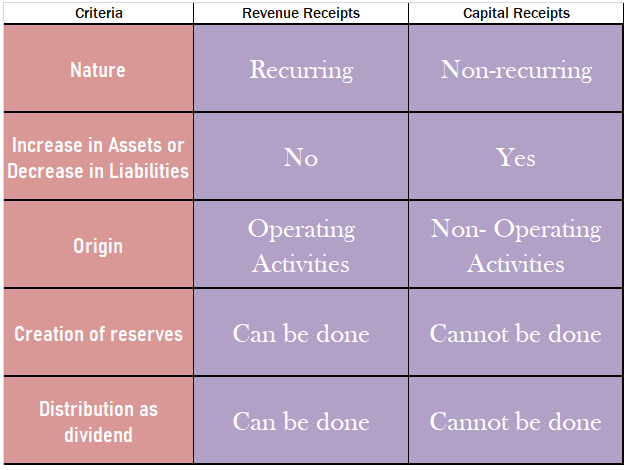
    Revenue receipts:  The term ‘revenue‘ suggests these are the amounts received by a business due to its operating activities. These receipts arise in a recurring manner in a business. Such receipts don’t affect the balance sheet. They are shown in the statement of profit or loss. Such receipts are essential for the survival of the business.

    Examples of revenue receipts are as follows:

    • Proceeds from the sale of goods.
    • Proceeds from the provision of services
    • Rent received
    • Interest received from deposits in banks or financial institutions
    • Discount received from creditors (shown in the debit side of P/L A/c)

    Capital receipts: The term ‘capital’ that such receipts are do not arise due to operating activities, hence not shown in the Profit and loss statement.  These are the money received by a business when they sell any asset or undertake any liability. These receipts do not arise in a  recurring manner in a business.  They don’t affect the profit or loss of the business. They are not essential for the survival of the business.

    Examples of capital receipts are as follows:

    • Loan from a bank or financial institution. (Increase in liabilities)
    • Proceeds from the sale of an asset. (decrease in assets)
    • Proceeds from sale of  investments. (decrease in assets)
    • Proceeds from the issue of equity shares. (Increase in liabilities)
    • Proceeds from issue of debentures. (Increase in liabilities)

    I have given a table below for more understanding:

    See less
    • 0
    • Share
      Share
      • Share on Facebook
      • Share on Twitter
      • Share on LinkedIn
      • Share on WhatsApp
Jayesh Gupta
Jayesh GuptaCurious
In: 1. Financial Accounting > Depreciation & Amortization

How much is depreciation on commercial vehicle?

If someone can tell me the complete accounting with the percentage that would be great.

  • 1 Answer
  • 0 Followers
Answer
  1. AbhishekBatabyal Helpful Pursuing CA, BCOM (HONS)
    Added an answer on October 1, 2021 at 11:06 am
    This answer was edited.

    I am assuming that you are asking the question with reference to the sole proprietorship business. In the case of a company, the rates as per the Companies Act, 2013 will apply. A sole proprietor can charge the depreciation in its books of accounts at whatever rate it wants but it should not be moreRead more

    I am assuming that you are asking the question with reference to the sole proprietorship business. In the case of a company, the rates as per the Companies Act, 2013 will apply. A sole proprietor can charge the depreciation in its books of accounts at whatever rate it wants but it should not be more than the rates prescribed in the Income Tax Act, 1961.

    It is a general practice to take depreciation rate lower than the Income Tax Act, 1961, so that the financial statements look good because of slightly higher profit. There is no harm in it as it is a sole proprietor.

    The Income Tax Act, 1961 has prescribed rates at which depreciation is to be given on different blocks of assets. For motor vehicles, the rates are as follows:

    Particulars Rates (WDV)
    1 Motor buses, motor Lorries and motor taxis used in a business of running them on hire. 30%
    2 Motor buses, motor lorries and motor taxis used in a business of running them on hire, acquired on or after the 23rd day of August 2019 but before the 1st day of April 2020 and is put to use before the 1st day of April 2020. 45%
    3 Commercial vehicles to use in business other than running them on hire. 40%

    Let’s take an example to understand the accounting treatment:-So a business can choose to charge depreciation at rates slightly lower than the above rates.

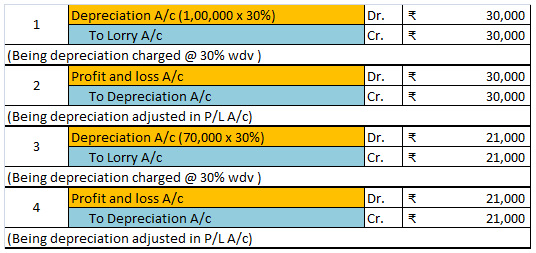
    Mr A purchased a lorry for ₹1,00,000 on 1st April 2021 for his business, to be used for transportation of the finished goods. Now, Mr A decided to charge depreciation on the WDV method @30% (prescribed rate is 40%).

    Following will be the journal entries.

    I hope I was able to answer your question.

    See less
    • 0
    • Share
      Share
      • Share on Facebook
      • Share on Twitter
      • Share on LinkedIn
      • Share on WhatsApp
Jayesh Gupta
Jayesh GuptaCurious
In: 1. Financial Accounting > Miscellaneous

Can you provide a list of external liabilities?

  • 1 Answer
  • 0 Followers
Answer
  1. Ayushi Curious Pursuing CA
    Added an answer on September 29, 2021 at 7:30 am

    External liabilities are the amounts which a business is obliged to pay to the outsiders (who are not owners of the business). Here is the list of external liabilities:- Accounts payable ( trade creditors and bills payables) Loan taken from outsiders Loan from bank Debentures Public deposits accepteRead more

    External liabilities are the amounts which a business is obliged to pay to the outsiders (who are not owners of the business).

    Here is the list of external liabilities:-

    1. Accounts payable ( trade creditors and bills payables)
    2. Loan taken from outsiders
    • Loan from bank
    • Debentures
    • Public deposits accepted
    1. Outstanding expenses
    • Outstanding salary
    • Outstanding rent
    • Outstanding tax
    1. Interest due on loans taken from outsiders

    The list is not exhaustive.

    Just for more understanding, internal liabilities are those liabilities which a business is supposed to pay back to its owners.  Such as capital balance, profit surplus etc.

    See less
    • 0
    • Share
      Share
      • Share on Facebook
      • Share on Twitter
      • Share on LinkedIn
      • Share on WhatsApp
A_Team
A_Team
In: 1. Financial Accounting > Partnerships

What are the types of partners in partnership act 1932?

  • 1 Answer
  • 0 Followers
Answer
  1. Ayushi Curious Pursuing CA
    Added an answer on September 28, 2021 at 4:43 pm

    The partnership act 1932 does not mention the types of partners specifically. It does have mentions of ‘partner who is minor’ in section 30 and ‘partner by holding out in section 28. But we do come across many types of partners in partnership firms. Following is the list of the types of partners weRead more

    The partnership act 1932 does not mention the types of partners specifically. It does have mentions of ‘partner who is minor’ in section 30 and ‘partner by holding out in section 28.

    But we do come across many types of partners in partnership firms. Following is the list of the types of partners we generally see:-

    1. Active partner: – It is the partner who provides the capital and is also actively involved in the management and daily activities of the firm. Such a type of partner is of utmost importance to the firm. Apart from a share in profit and loss, he is also eligible to draw remuneration from the firm.


    1. Sleeping/ Dormant partner: – This type of partner does not participate in the daily workings of the firm nor actively participates in the management of the firm. Such a type of partner has a large sum of capital invested in the firm and shares the profits as well as losses of the firm.


    1. Partner by holding out:- If any partner, who by his words or by his conduct, represents himself as a partner of a firm, then he is called a partner by holding out. Such a partner is actually not a partner of the firm and doesn’t receive any share of profit as he has contributed no capital.

    As per section 28, such a partner is liable to any person who has given credit to the firm on             the belief that he is a partner of the firm.


    1. Minor partner: – If any person who is less than 18 years of age is admitted into the firm, such partner is known as a minor partner. Such a partner is entitled to the profits of the firm based on his capital but is immune from losses suffered by the firm.


    1. Secret partner: – It is a partner of a firm whose membership is kept hidden from the outsiders such as creditors and other third parties. But he is equally liable as other partners for the outside liabilities.


    1. Outgoing partner: – A partner who voluntarily leaves the partnership without dissolving the firm is called an outgoing partner or retiring partner. Such a partner is liable to all liabilities incurred before his retirement. But he can be held liable to outside liabilities if he fails to give public notice of his retirement.


    See less
    • 0
    • Share
      Share
      • Share on Facebook
      • Share on Twitter
      • Share on LinkedIn
      • Share on WhatsApp
A_Team
A_Team
In: 1. Financial Accounting > Miscellaneous

What is the difference between fictitious assets and deferred revenue expenditure?

  • 1 Answer
  • 0 Followers
Answer
  1. AbhishekBatabyal Helpful Pursuing CA, BCOM (HONS)
    Added an answer on September 27, 2021 at 12:58 pm
    This answer was edited.

    Fictitious assets are the expenses and losses which are yet to be written off, so they appear in the Asset side of the balance sheet of the relevant financial year because expenses and losses have a debit balance. They are not assets in substance. Examples: Business loss ( debit balance of Profit anRead more

    Fictitious assets are the expenses and losses which are yet to be written off, so they appear in the Asset side of the balance sheet of the relevant financial year because expenses and losses have a debit balance. They are not assets in substance.

    Examples:

    1. Business loss ( debit balance of Profit and loss A/c )*
    2. Prepaid expenses
    3. Discount on the issue of debentures.
    4. Huge promotional expenditure.

    *business loss is shown as a negative figure under the head Reserve and Surplus, when the balance sheet is prepared as per Schedule III of The Companies Act, 2013.

    Deferred revenue expenditures are the expenses incurred for which the benefits are expected to flow to the enterprise beyond the current year. Such expenses are huge and are not written off completely in a financial year. The part of the expenditure which is not written off is shown on the assets side of the balance sheet.

    Examples:

    1. Huge advertisement expense.

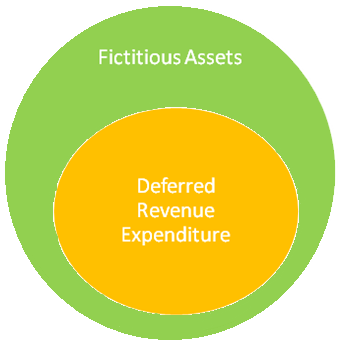
    As you can see, there is some similarity between the two. Deferred revenue expenditure can be called a type of fictitious asset as it is shown in the asset side of the balance sheet but it isn’t an asset.


    The term ‘fictitious asset’ has a broader meaning than deferred revenue expenditure and also includes the losses such as discounts on the issue of debenture and business loss.

    The difference between fictitious assets and deferred revenue expenditure are as follows:

    Fictitious Assets Deferred Revenue Expenditure
    1 These are no real assets but expenses and losses that are not completely written off in an F.Y. These are expenses incurred from which benefits are expected to flow for more than one accounting period.
    2 It has a broader meaning. It has a narrower meaning.
    3 Examples:- business loss, discount on issue of debentures, prepaid expenses etc. Examples:- huge promotional expenditure etc.
    See less
    • 0
    • Share
      Share
      • Share on Facebook
      • Share on Twitter
      • Share on LinkedIn
      • Share on WhatsApp

Sidebar

Question Categories

  • 1. Financial Accounting

      • Accounting Terms & Basics
      • Bank Reconciliation Statement
      • Banks & NBFCs
      • Bills of Exchange
      • Capital & Revenue Expenses
      • Consignment & Hire Purchase
      • Consolidation
      • Contingent Liabilities & Assets
      • Departments & Branches
      • Depreciation & Amortization
      • Financial Statements
      • Goodwill
      • Insurance Accounting
      • Inventory or Stock
      • Investment Accounting
      • Journal Entries
      • Ledger & Trial Balance
      • Liquidation & Amalgamation
      • Miscellaneous
      • Not for Profit Organizations
      • Partnerships
      • Ratios
      • Shares & Debentures
      • Source Documents & Vouchers
      • Subsidiary Books
  • 2. Accounting Standards

      • AS
      • IFRS
      • IndAS
  • 3. Cost & Mgmt Accounting
  • 4. Taxes & Duties

      • GST
      • Income Tax
  • 5. Audit

      • Bank Audit
      • Internal Audit
      • Miscellaneous - Audit
      • Statutory Audit
  • 6. Software & ERPs

      • Tally
  • 7. MS-Excel
  • 8. Interview & Career
  • Top Questions
  • I need 20 journal entries with ledger and trial balance?

  • Can you show 15 transactions with their journal entries, ledger, ...

  • What is furniture purchased for office use journal entry?

  • What is loose tools account and treatment in final accounts?

  • What is the Journal Entry for Closing Stock?

  • What is the journal entry for goods purchased by cheque?

  • What is commission earned but not received journal entry?

  • How to show adjustment of loose tools revalued in final ...

  • What is the journal entry for interest received from bank?

  • Following is the Receipts and Payments Account of Bharti Club ...

Hot Topics

Accounting Policies Accounting Principles Balance Sheet Bank Reconciliation Statement Bill of Exchange Branch Accounting Calls in Advance Capital Capital Expenditure Companies Act Compound Entry Consignment Creditors Current Assets Debit Balance Debtors Depreciation Difference Between Dissolution of Firm Dissolution of Partnership Drawings External Users Fictitious Assets Final Accounts Financial Statements Fixed Assets Fixed Capital Fluctuating Capital Gain Impairment Installation Interest Received in Advance Internal Users Journal Entry Ledger Loose Tools Miscellaneous Expenditure Profit Rent Rent Received in Advance Reserves Revaluation Revenue Expenditure Revenue Reserve Sacrificing Ratio Subscription Subscription Received in Advance Trial Balance Type of Account Uncalled Capital
  • Home
  • Questions
    • Most Visited
    • Most Active
    • Trending
    • Recent
  • Follow
    • Categories
    • Users
    • Tags
  • Write an Answer
  • Badges & Points
  • Request New Category
  • Send a Suggestion

Most Helping Users

Astha

Astha

  • 50,291 Points
Leader
Simerpreet

Simerpreet

  • 72 Points
Helpful
AbhishekBatabyal

AbhishekBatabyal

  • 65 Points
Helpful

Footer

  • About Us
  • Contact Us
  • Pricing
  • Refund
  • Forum Rules & FAQs
  • Terms and Conditions
  • Privacy Policy
  • Career

© 2021 All Rights Reserved
Accounting Capital.