Please briefly explain why you feel this question should be reported.

Please briefly explain why you feel this answer should be reported.

Please briefly explain why you feel this user should be reported.

Sign InSign Up

AccountingQA

AccountingQA Logo AccountingQA Logo

AccountingQA Navigation

  • Home
  • Ask Questions
  • Write Answers
  • Explore
  • FAQs
Search
Ask A Question

Mobile menu

Close
Ask a Question
  • Home
  • Questions
    • Most Visited
    • Most Active
    • Trending
    • Recent
  • Follow
    • Categories
    • Users
    • Tags
  • Write an Answer
  • Badges & Points
  • Request New Category
  • Send a Suggestion
  • Search Your Accounting Question..

AccountingQA Latest Questions

Manvi
Manvi
In: 1. Financial Accounting > Accounting Terms & Basics

Who are external users of accounting information?

External Users
  • 1 Answer
  • 0 Followers
Answer
  1. Karan B.com and Pursuing ACCA
    Added an answer on July 8, 2021 at 2:33 pm
    This answer was edited.

    External users are people outside the business or entity who use accounting information. They do not have a direct link with the organization but can influence or can be influenced by the organization's activities. For example - Tax Authorities, Banks, Customers, Trade Unions, Government, Investors,Read more

    External users are people outside the business or entity who use accounting information. They do not have a direct link with the organization but can influence or can be influenced by the organization’s activities.

    For example – Tax Authorities, Banks, Customers, Trade Unions, Government, Investors, or Creditors.

    External Users:

    • Investors – Investors are interested in the past performance and future earnings of the business. They want to track the performance of their business whether it is giving them any benefit or not. A business’s past information helps investors in assessing their investments.
    • Creditors or Suppliers – Some suppliers provide goods and services on credit, and before providing any credit they check the company’s ability to pay. Creditors are interested in the company’s liquidity i.e to see if a company can fulfill short-term obligations.
    • Customers – Customers are more interested in a company’s financial statement as they rely on them for goods and services. They check the ability of the company whether it is providing them good quality goods and will continue to provide them in future.
    • Banks – Banks are most likely interested in the liquidity and profitability of the company. They keep track of whether the company can pay the debt when it is due along with interest.
    • Government – The company’s activities are central to the economy and must be met by them. The government controls a company’s actions if they break a law or damage the environment.
    • Environmental agencies – They keep an eye on organizations whether their activities are harming the environment or not.
    • Trade unions – They take an active part in the decision-making process. They want to see the financial statements of the company and want to decide the compensation of the employees they represent.
    • Tax authorities – They determine whether the business has declared the correct amount of tax in its tax returns. They conduct audits of the tax returns to verify them with the accounting records disclosed.

    Here is a summary of external users

    See less
    • 0
    • Share
      Share
      • Share on Facebook
      • Share on Twitter
      • Share on LinkedIn
      • Share on WhatsApp
Vijay
VijayCurious
In: 1. Financial Accounting > Miscellaneous

What is useful life of assets as per the Companies Act?

Companies Act
  • 1 Answer
  • 0 Followers
Answer
  1. Naina@123 (B.COM and CMA-Final)
    Added an answer on July 5, 2021 at 6:54 pm
    This answer was edited.

    Simply explaining the meaning of the useful life of an asset, it is nothing but the number of years the asset would remain in the business for purpose of revenue generation, making it more simple, the amount of time an asset is expected to be functional and fit for use.  It is also called economic lRead more

    Simply explaining the meaning of the useful life of an asset, it is nothing but the number of years the asset would remain in the business for purpose of revenue generation, making it more simple, the amount of time an asset is expected to be functional and fit for use.  It is also called economic life or service life

    It is a useful concept in accounting as it is used to work out depreciation. By knowing this useful life of an asset an entity can easily analyze how to allot the initial cost of an asset across the relevant accounting period rather than doing it unfairly manner.

    How do we calculate the useful life of an asset?

    The useful life of an asset is not an accounting policy, but an accounting estimate. calculating useful life is not an exact phenomenon but an estimate that is done because it directly impacts how much an asset is to expense every year.

    Factors affecting “how long an asset is expected to be useful” depends on some stated points as below:

    1. Usage, the more the assets are used, the more quickly it will deteriorate.
    2. Whether the asset is new at the time of purchase or reused model.
    3. Change in technology.

    As per the companies act 2013, some of the useful life of assets are stated below
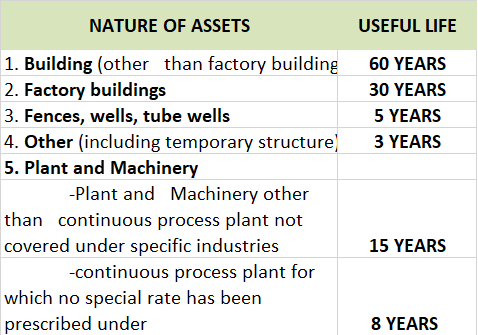
    To know more about the different categories of assets you can follow the given link useful life of assets.

    POINT TO BE NOTED:- There lies a huge difference in the useful life v/s the physical life of an asset. It is very important to note that amount of time an asset is used in a business is not always be same as an asset’s entire life span.


    See less
    • 1
    • Share
      Share
      • Share on Facebook
      • Share on Twitter
      • Share on LinkedIn
      • Share on WhatsApp
Jasmeet_Sethi
Jasmeet_SethiCurious
In: 1. Financial Accounting > Ledger & Trial Balance

How to treat drawings in the trial balance?

DrawingsTrial Balance
  • 1 Answer
  • 0 Followers
Answer
  1. Manvi Pursuing ACCA
    Added an answer on July 5, 2021 at 4:45 pm
    This answer was edited.

    Drawings mean the certain sum of amount or goods withdrawn by owners from the business for personal use. The drawings account is not an asset/liability/expense/income account, it is a contra account to the owner's equity or capital account. Drawings A/c will always have a debit balance. Drawings A/cRead more

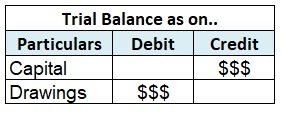
    Drawings mean the certain sum of amount or goods withdrawn by owners from the business for personal use. The drawings account is not an asset/liability/expense/income account, it is a contra account to the owner’s equity or capital account. Drawings A/c will always have a debit balance.

    Drawings A/c debit balance is contrary to the Capital A/c credit balance because any withdrawal from the business for personal use will reduce the capital.

    Effect on Trial Balance: Drawings will be shown in the debit column of the trial balance.

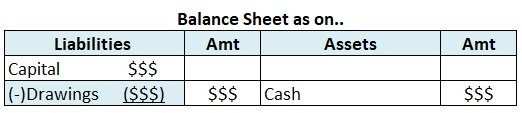
    Effect on Financial Statements: The owner’s drawings will affect the company’s balance sheet by decreasing the asset that is withdrawn, and a corresponding decrease in the owner’s equity or capital invested.

    Example:

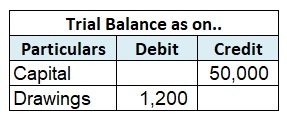
    Mr.B a sole proprietor withdraws $100 each month for personal use. At the end of the year Drawings A/c had a debit balance of $1,200.

    Mr.B records drawings of $100 each month and debits drawings a/c and credits cash a/c. At the end of the year, he will transfer the balance and will debit capital a/c and credit drawings a/c by $1,200.

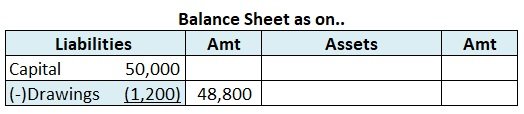
    He will show a balance of $1,200 ($100*12) in the trial balance in the debit column. Assuming closing capital of $50,000.

    In the financial statement, the balance of drawings a/c will be deducted from the owner’s capital because it is a contra account and this will reduce the owner’s capital for the year.


    See less
    • 0
    • Share
      Share
      • Share on Facebook
      • Share on Twitter
      • Share on LinkedIn
      • Share on WhatsApp
prashant06
prashant06
In: 1. Financial Accounting > Financial Statements

Do we show drawings in income statement?

DrawingsIncome Statement
  • 1 Answer
  • 0 Followers
Answer
  1. Radha M.Com, NET
    Added an answer on July 6, 2021 at 2:37 am
    This answer was edited.

    Whenever the proprietor/owner of a business withdraws cash or goods from the business for his/her personal use, we call it drawings. For example, Alex, proprietor of a soap manufacturing company, takes 50 pack of soaps costing 30 each for his personal use. So, 1,500 (50*30) will be considered as draRead more

    Whenever the proprietor/owner of a business withdraws cash or goods from the business for his/her personal use, we call it drawings. For example, Alex, proprietor of a soap manufacturing company, takes 50 pack of soaps costing 30 each for his personal use. So, 1,500 (50*30) will be considered as drawings of Alex. One important thing to note here is whenever goods are withdrawn for personal use they are valued at cost.

    Drawings are not an asset/liability/expense/income to the business. The drawings account is a contra-equity account. A contra-equity account is a capital account with a negative balance i.e. debit balance. It reduces the owner’s equity/capital.

    Drawings being a contra-equity account has a debit balance, reducing the owner’s capital in the business. This is because withdrawals for personal use represent a reduction of the owner’s equity in the business.

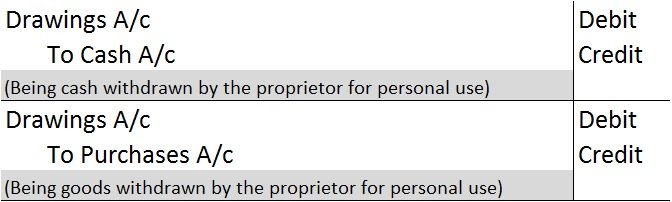
    Drawings are not shown in the Income Statement as they are neither an expense nor an income for the business. However, the following journal entries are passed to record drawings for the year:

    Drawings A/c is debited because it reduces the owner’s capital. Cash/Purchases A/c is debited as a withdrawal reduces the assets of the business.

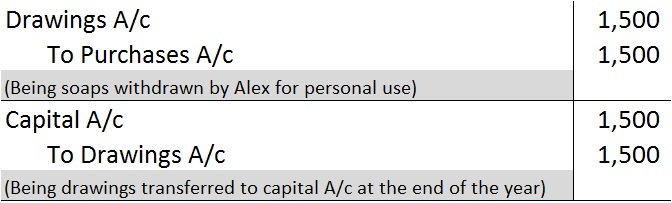
    At the end of the year, drawings A/c are closed by transferring it to the owner’s capital A/c. We post the following entry to close the drawings A/c at the end of the year:

    In the balance sheet, drawings are shown by deducting it from the owner’s capital A/c.

    Let us take our earlier example of Alex. He withdrew soaps worth 1,500. At the end of the year, his capital was worth 5,500. The journal entry for recording the drawings is as follows:

    In the balance sheet, drawings worth 1,500 are shown as follows:

    See less
    • 0
    • Share
      Share
      • Share on Facebook
      • Share on Twitter
      • Share on LinkedIn
      • Share on WhatsApp
Jasmeet_Sethi
Jasmeet_SethiCurious
In: 1. Financial Accounting > Miscellaneous

Are loose tools current assets?

Current AssetsLoose Tools
  • 1 Answer
  • 0 Followers
Answer
  1. Karan B.com and Pursuing ACCA
    Added an answer on July 3, 2021 at 6:26 am
    This answer was edited.

    Current assets are all the assets of the company which are expected to be used, sold, or consumed within one year. Current assets are those assets that can be converted into cash easily. For example - Inventory, Accounts Receivable, Cash, and Cash Equivalents. Loose tools are parts of machinery or sRead more

    Current assets are all the assets of the company which are expected to be used, sold, or consumed within one year. Current assets are those assets that can be converted into cash easily.

    For example – Inventory, Accounts Receivable, Cash, and Cash Equivalents.

    Loose tools are parts of machinery or spare parts of machinery. Loose can be classified on the nature of use whether it is a fixed asset or a current asset. If loose tools are used regularly or within one accounting year, it is classified as a current asset.

    Loose tools are usually classified as a current asset, however, there is one exception i.e it is excluded from the current ratio.

    They are excluded from the current ratio because the current ratio takes into account only current assets, and the nature of loose tools is either a fixed asset or a current asset and can’t be converted into cash easily.

    The current ratio is calculated to check the liquidity of the company.

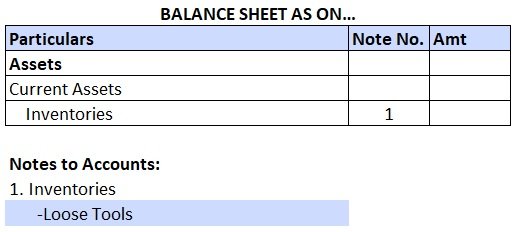
    Loose tools appear in the Asset Side of the Balance Sheet under the head Current Asset, subhead Inventories.

    The extract of the Balance Sheet is as follows:

    When the balance sheet prepared under Schedule III loose tools is shown under notes to accounts under sub-head Inventories on the asset side.

    When the balance sheet is in a T format loose appears as a current asset after recording fixed assets on the asset side.

    See less
    • 0
    • Share
      Share
      • Share on Facebook
      • Share on Twitter
      • Share on LinkedIn
      • Share on WhatsApp
A_Team
A_Team
In: 1. Financial Accounting > Financial Statements

What is loose tools account and treatment in final accounts?

Final AccountsLoose Tools
  • 1 Answer
  • 0 Followers
Answer
  1. Vijay Curious M.Com
    Added an answer on July 3, 2021 at 12:49 pm
    This answer was edited.

    Let me begin by giving a small explanation of what loose tools are before we dive into their accounting treatment. Loose tools are assets that are used in various steps of the production process and therefore are vital for the conversion of raw materials into finished goods. They are considered as cRead more

    Let me begin by giving a small explanation of what loose tools are before we dive into their accounting treatment.

    Loose tools are assets that are used in various steps of the production process and therefore are vital for the conversion of raw materials into finished goods. They are considered as current assets of the business as their useful life is limited. They have a small monetary value (cost-efficient) and high turnover. Examples of loose tools include screwdrivers, hammers, etc.

    One may say loose tools like screwdrivers and hammers can be used for more than one year and therefore should be classified as non-current assets. But unlike fixed assets, these loose tools have a high probability of being misplaced or lost. Hence they are classified as current assets.

    Since loose tools are treated as an asset for the business, they are shown as a debit balance in the trial balance.

    The cost of loose tools consumed for the year will be shown on the debit side of the Profit & Loss A/c as an expense. In the balance sheet, loose tools are shown on the Assets side under the head Current Assets and sub-head Inventories. Since they aid the production process, loose tools are shown as a part of the inventory of the business.

    Let us take an example,

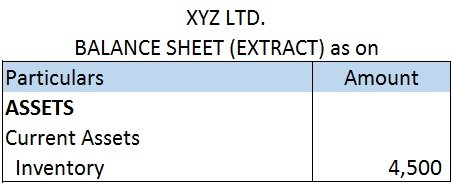
    XYZ Ltd. at the beginning of the year had loose tools worth 5,000. During the year they purchased loose tools worth 500. At the end of the year, the company valued its loose tools at 4,500.

    Now let us find the cost of loose tools consumed. The formula for finding the cost of loose tools consumed is as follows:

    Cost of loose tools consumed  = Opening inventory of loose tools + Purchases of loose tools – Closing inventory of loose tools

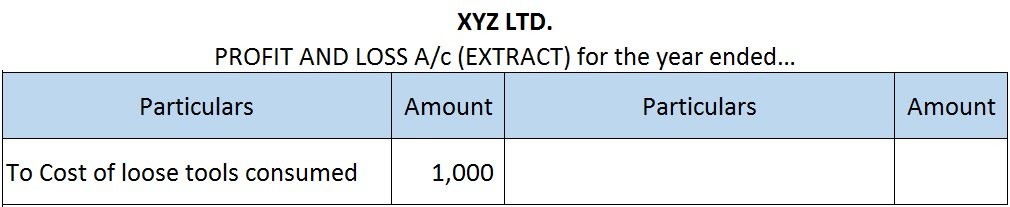
    Cost of loose tools consumed = 5,000 + 500 – 4,500 = 1,000

    So, the cost of loose tools consumed (1000) will be shown on the debit side of the P&L A/c as follows:

    The closing inventory of loose tools worth 4,500 will be shown on the assets side of the balance sheet under the head current assets and sub-head inventory in the following manner:

    One thing to remember here is there is an exception to loose tools. While calculating liquidity ratios like the Current ratio, Quick ratio, etc. loose tools are excluded from current assets. The reason for this is loose tools cannot be easily converted into cash i.e. they are less liquid. The purpose of calculating the current ratio is to check the liquidity of a company. Including loose tools (which cannot be easily converted into cash) in current assets defeats the purpose of calculating the ratio.


    See less
    • 0
    • Share
      Share
      • Share on Facebook
      • Share on Twitter
      • Share on LinkedIn
      • Share on WhatsApp
Jasmeet_Sethi
Jasmeet_SethiCurious
In: 1. Financial Accounting > Financial Statements

How to show adjustment of loose tools revalued in final accounts?

Final AccountsLoose ToolsRevaluation
  • 1 Answer
  • 0 Followers
Answer
  1. prashant06 B.com, CMA pursuing
    Added an answer on July 3, 2021 at 7:03 am
    This answer was edited.

    To begin with, let me explain what is revaluation all about. So basically revaluation is a method of calculating the depreciation of assets where there are multiple identifiable assets of low value such as loose tools, live stocks, etc. Under this method assets like loose tools are revalued at the eRead more

    To begin with, let me explain what is revaluation all about. So basically revaluation is a method of calculating the depreciation of assets where there are multiple identifiable assets of low value such as loose tools, live stocks, etc.

    Under this method assets like loose tools are revalued at the end of the accounting period and the same is compared with the value at the beginning of the year. the difference amount is considered as depreciation.

    The formula goes as :

    REVALUATION= OPENING VALUE + PURCHASES – CLOSING VALUE

    Let me take an example to show the same. Opening balance of Loose tools amounts to Rs.2,000 during the year, the business purchased loose tools of Rs.500 and at the year-end loose tool amounted to Rs.1,500 then revalued figure which will be shown as depreciation will be

    REVALUATION=  Rs.(2,000+ 500 – 1,500)

    = Rs.1,000

    The main discussion is”how to show adjustment of revaluation of the loose tool in financial statements”?

    As we all know, loose tools are considered assets for the business, hence shown under the head current assets or fixed assets depending upon the nature of the business and the time for which it is held.

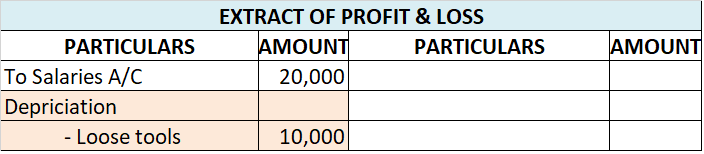
    When the trial balance shows the debit value of loose tools, later on in the year-end the loose tools are revalued to a certain amount then the difference amount will be shown as depreciation in the Profit & Loss A/c and the revalued figure will be posted in the balance sheet asset side.

    Let me support my explanation with an example,

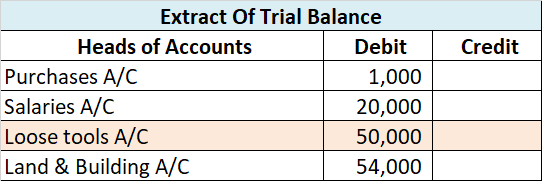
    Given is the extracted trial balance of XYZ & Co.


    we see the value of Loose tools in the given trial balance as Rs.50,000. At the year-end, these Loose tools were revalued at Rs.40,000.

    Therefore the adjustment in the financial statement would be like Rs (50,000 – 40,000) i.e Rs. 10,000 would be shown as depreciation under Profit & Loss A/c


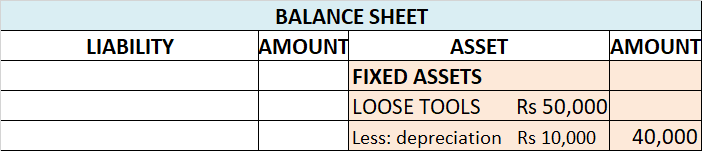
    and the adjusted figure of Rs. 40,000 (i.e Rs.50,000 – Rs.10,000), will be shown on the asset side under the head fixed assets of the Balance Sheet.

    See less
    • 0
    • Share
      Share
      • Share on Facebook
      • Share on Twitter
      • Share on LinkedIn
      • Share on WhatsApp
Bonnie
BonnieCurious
In: 1. Financial Accounting > Shares & Debentures

Can you explain calls in advance as per the companies act?

Calls in AdvanceCompanies Act
  • 1 Answer
  • 0 Followers
Answer
  1. Naina@123 (B.COM and CMA-Final)
    Added an answer on June 30, 2021 at 8:16 pm
    This answer was edited.

    To begin with, lets us understand what the Companies Act 2013 tells about calls-in-advance, so basically as per section 50 of the companies act 2013 "A company may if so authorized by its articles, accepts from any members the whole or part of amount remaining unpaid on any share held by him, even iRead more

    To begin with, lets us understand what the Companies Act 2013 tells about calls-in-advance, so basically as per section 50 of the companies act 2013 “A company may if so authorized by its articles, accepts from any members the whole or part of amount remaining unpaid on any share held by him, even if no amount has been called up”.

    To be more precise whenever excess money is received by the company than, what has been called up is known as calls-in-advance.

    Accounting Treatment

    Well, it is to be noted that calls-in-advance is never a part of share capital. A company when authorized by its article can accept those advance amounts and directly credit the amount received to the calls-in-advance account.

    As these advance amounts are a liability for the company these are shown under the head current liability of the balance sheet until calls are made and are paid to the shareholders.

    Since this is the liability of the company, it is liable to pay the interest amount on such call money from the date of receipt until the payment is done to the shareholders. The rate of interest is mentioned in the articles of association. If the article is silent regarding the rate on which interest is paid then it is assumed to be @6%.

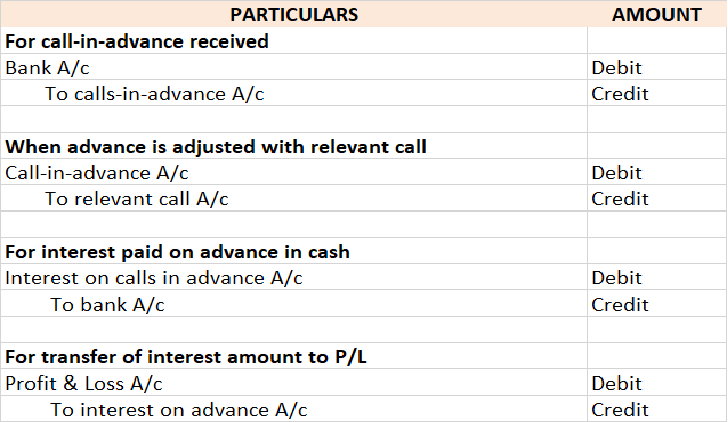
    Accounting Entry

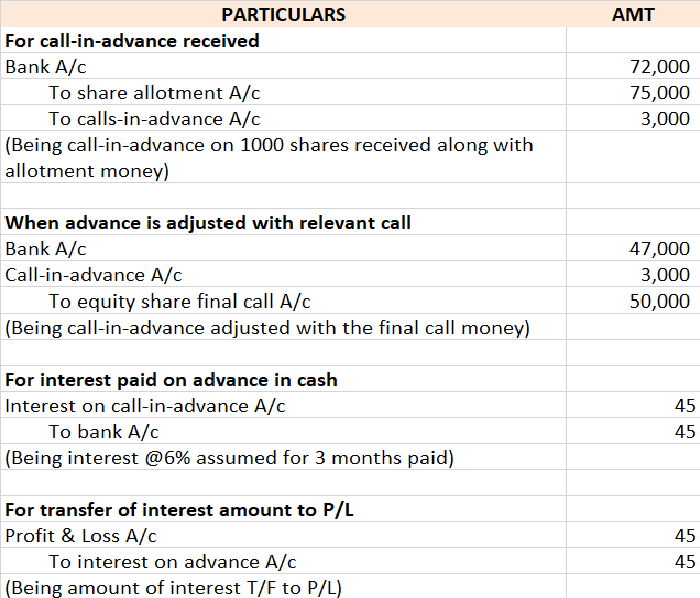
    Bonnie let us understand the entries with help of an example

    ADIDAS LTD issued 25,000 equity shares of Rs 10 each payable as follows:

    ON APPLICATION  Rs 5

    ON ALLOTMENT    Rs 3

    ON FINAL CALL     Rs 2

    Application on 30,000 shares was received. excess money received on the application was refunded immediately. Mr. X who was allotted 1,000 shares paid the call money at the time of allotment and all amounts were duly received assume interest rate @6% for 3 months, so the relevant accounting entry goes as follows:

    Important Points to be noted under calls-in-advance as per the companies act 2013

    • The shareholder is not entitled to any voting rights on money paid until the said money is called for.
    • No dividends are payable on advance money.
    • Board may pay interest on advance not exceeding 12%.
    • The shareholders are entitled to claim the interest amount as mentioned in the article, if there are no profits, then it must be paid out of capital because shareholders become the creditors of the company.
    See less
    • 0
    • Share
      Share
      • Share on Facebook
      • Share on Twitter
      • Share on LinkedIn
      • Share on WhatsApp
Bonnie
BonnieCurious
In: 1. Financial Accounting > Journal Entries

What is the journal entry for calls in advance?

Calls in AdvanceJournal Entry
  • 1 Answer
  • 0 Followers
Answer
  1. Manvi Pursuing ACCA
    Added an answer on June 30, 2021 at 4:35 pm
    This answer was edited.

    Journal Entry for Calls in Advance  Calls in advance mean excess money received by the company than what has been called up. Calls in advance are treated as Current Liability and shown in the Balance Sheet on the liability side. Journal Entry will be : Here we will "Debit" Bank A/c as it will increaRead more

    Journal Entry for Calls in Advance 

    Calls in advance mean excess money received by the company than what has been called up. Calls in advance are treated as Current Liability and shown in the Balance Sheet on the liability side.

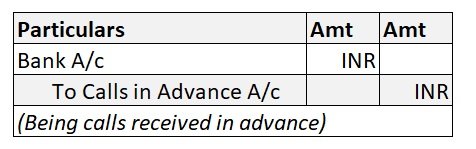
    Journal Entry will be :

    Here we will “Debit” Bank A/c as it will increase assets of the company and “Credit” Calls in Advance A/c because it will increase the company’s current liabilties.

    For Example:

    Mr.Z shareholder of ABC Ltd was allotted 2,000 equity shares of Rs.10 each. He paid call money at the time of allotment.

    On Application Rs 5
    On Allotment Rs 2
    On First and final call Rs 3


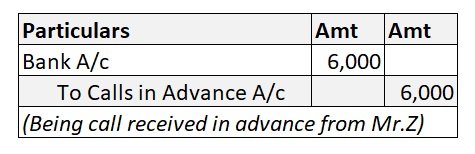
    Journal Entry is as follows:

    Here, the company received an excess amount of Rs.6,000 (2,000*3) from a shareholder Mr.Z who paid the call money in advance. ABC Ltd will record this under Calls in Advance A/c. While passing journal entry ABC Ltd will debit its Bank A/c by Rs.6,000 and credit calls in advance account by Rs.6,000.

    When share calls are called up, calls received in advance are adjusted. The company will hold only the required amount which will make allotted shares fully paid.

    Once the amount is transferred to relevant call accounts, calls in advance account will be written off.

    See less
    • 0
    • Share
      Share
      • Share on Facebook
      • Share on Twitter
      • Share on LinkedIn
      • Share on WhatsApp
Bonnie
BonnieCurious
In: 1. Financial Accounting > Shares & Debentures

How to show calls in advance in the balance sheet?

Balance SheetCalls in Advance
  • 1 Answer
  • 0 Followers
Answer
  1. Radha M.Com, NET
    Added an answer on June 30, 2021 at 1:52 pm
    This answer was edited.

    Let us begin with a short explanation of what Calls-in-Advance is: Whenever a company accepts money from its shareholders for calls not yet made, then we call it calls-in-advance. To put it in even simpler terms, it is the amount not yet called up by the company but paid by the shareholder. An imporRead more

    Let us begin with a short explanation of what Calls-in-Advance is:

    Whenever a company accepts money from its shareholders for calls not yet made, then we call it calls-in-advance. To put it in even simpler terms, it is the amount not yet called up by the company but paid by the shareholder. An important thing to note here is that a company can accept calls-in-advance from its shareholders only when authorized by its Articles of Association.

    Calls-in-advance is treated as the company’s liability because it has received the money in advance, which has not yet become due. Till the amount becomes due, it will be treated as a current liability of the company.

    The journal entry for recording calls-in-advance is as follows:

    The money received from the shareholder is an asset for the company and therefore Bank A/c is debited with the amount received as calls-in-advance. The calls-in-advance A/c is credited because it is a liability for the company.

    Since Calls-in-Advance is a liability, it is shown in the Equities and Liabilities part of the Balance Sheet under the head Current Liabilities and sub-head Other Current Liabilities.

    For better understanding, we will take an example,

    ABC Ltd. made the first call of 3 per share on its 10,00,000 equity shares on 1st May. Max, a shareholder, holding 5,000 shares paid the final call amount 2 along with the first call money. Now let me show the journal entry to record calls-in-advance.

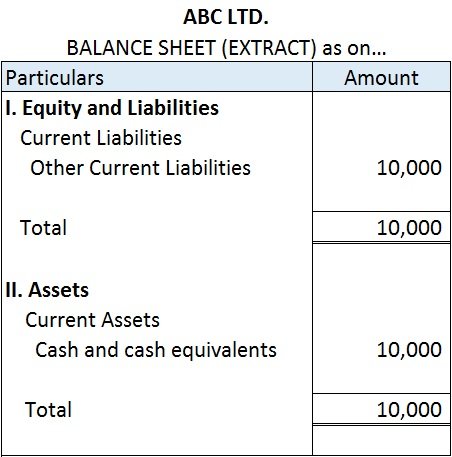
    In the Balance Sheet, I will show calls-in-advance in the following manner,

    The calls-in-advance of 10,000 is shown under the Equities and Liabilities side of the balance sheet under the head current liabilities and sub-head other current liabilities. It will be shown as a liability till the final call money becomes due. The amount received by the company from Max is shown on the Assets side of the balance sheet under head current assets and under the sub-head cash and cash equivalents.

    See less
    • 0
    • Share
      Share
      • Share on Facebook
      • Share on Twitter
      • Share on LinkedIn
      • Share on WhatsApp

Sidebar

Question Categories

  • 1. Financial Accounting

      • Accounting Terms & Basics
      • Bank Reconciliation Statement
      • Banks & NBFCs
      • Bills of Exchange
      • Capital & Revenue Expenses
      • Consignment & Hire Purchase
      • Consolidation
      • Contingent Liabilities & Assets
      • Departments & Branches
      • Depreciation & Amortization
      • Financial Statements
      • Goodwill
      • Insurance Accounting
      • Inventory or Stock
      • Investment Accounting
      • Journal Entries
      • Ledger & Trial Balance
      • Liquidation & Amalgamation
      • Miscellaneous
      • Not for Profit Organizations
      • Partnerships
      • Ratios
      • Shares & Debentures
      • Source Documents & Vouchers
      • Subsidiary Books
  • 2. Accounting Standards

      • AS
      • IFRS
      • IndAS
  • 3. Cost & Mgmt Accounting
  • 4. Taxes & Duties

      • GST
      • Income Tax
  • 5. Audit

      • Bank Audit
      • Internal Audit
      • Miscellaneous - Audit
      • Statutory Audit
  • 6. Software & ERPs

      • Tally
  • 7. MS-Excel
  • 8. Interview & Career
  • Top Questions
  • I need 20 journal entries with ledger and trial balance?

  • Can you show 15 transactions with their journal entries, ledger, ...

  • What is furniture purchased for office use journal entry?

  • What is loose tools account and treatment in final accounts?

  • What is the Journal Entry for Closing Stock?

  • What is the journal entry for goods purchased by cheque?

  • What is commission earned but not received journal entry?

  • How to show adjustment of loose tools revalued in final ...

  • What is the journal entry for interest received from bank?

  • Following is the Receipts and Payments Account of Bharti Club ...

Hot Topics

Accounting Policies Accounting Principles Balance Sheet Bank Reconciliation Statement Bill of Exchange Branch Accounting Calls in Advance Capital Capital Expenditure Companies Act Compound Entry Consignment Creditors Current Assets Debit Balance Debtors Depreciation Difference Between Dissolution of Firm Dissolution of Partnership Drawings External Users Fictitious Assets Final Accounts Financial Statements Fixed Assets Fixed Capital Fluctuating Capital Gain Impairment Installation Interest Received in Advance Internal Users Journal Entry Ledger Loose Tools Miscellaneous Expenditure Profit Rent Rent Received in Advance Reserves Revaluation Revenue Expenditure Revenue Reserve Sacrificing Ratio Subscription Subscription Received in Advance Trial Balance Type of Account Uncalled Capital
  • Home
  • Questions
    • Most Visited
    • Most Active
    • Trending
    • Recent
  • Follow
    • Categories
    • Users
    • Tags
  • Write an Answer
  • Badges & Points
  • Request New Category
  • Send a Suggestion

Most Helping Users

Astha

Astha

  • 50,291 Points
Leader
Simerpreet

Simerpreet

  • 72 Points
Helpful
AbhishekBatabyal

AbhishekBatabyal

  • 65 Points
Helpful

Footer

  • About Us
  • Contact Us
  • Pricing
  • Refund
  • Forum Rules & FAQs
  • Terms and Conditions
  • Privacy Policy
  • Career

© 2021 All Rights Reserved
Accounting Capital.