Please briefly explain why you feel this question should be reported.

Please briefly explain why you feel this answer should be reported.

Please briefly explain why you feel this user should be reported.

Sign InSign Up

AccountingQA

AccountingQA Logo AccountingQA Logo

AccountingQA Navigation

  • Home
  • Ask Questions
  • Write Answers
  • Explore
  • FAQs
Search
Ask A Question

Mobile menu

Close
Ask a Question
  • Home
  • Questions
    • Most Visited
    • Most Active
    • Trending
    • Recent
  • Follow
    • Categories
    • Users
    • Tags
  • Write an Answer
  • Badges & Points
  • Request New Category
  • Send a Suggestion
  • Search Your Accounting Question..

AccountingQA Latest Questions

Simerpreet
SimerpreetHelpful
In: 1. Financial Accounting > Capital & Revenue Expenses

How to know which expense is capital and which is revenue?

Capital ExpenditureRevenue Expenditure
  • 1 Answer
  • 0 Followers
Answer
  1. Astha Leader Pursuing CA, BCom (Hons.)
    Added an answer on June 8, 2021 at 2:42 pm
    This answer was edited.

    Capital Expense Capital expenses are incurred for acquiring assets including incidental expenses. Such expenses increase the revenue earning capacity of the business. These are incurred to acquire, upgrade and maintain long term assets such as buildings, machines, etc and are non-recurring in natureRead more

    Capital Expense

    Capital expenses are incurred for acquiring assets including incidental expenses. Such expenses increase the revenue earning capacity of the business. These are incurred to acquire, upgrade and maintain long term assets such as buildings, machines, etc and are non-recurring in nature.

    Revenue Expenses

    Revenue expenses are incurred to carry on operations of an entity during an accounting period. Such expenses help in maintaining the revenue earning capacity of the business and are recurring in nature.

    These include ordinary repair and maintenance costs necessary to keep an asset working without any substantial improvement that leads to an increase in the useful life of the asset.

    Suppose, company Takeaway ltd. purchases machinery for 50,000 and pays installation charges of 10,000. Salary of 15,000 is paid to the employees and existing machinery is painted costing 8,000. Here, the cost of machinery 50,000 and installation charges of 10,000 are treated as capital expenditure and the salary of 15,000 and painting cost of 8,000 is treated as revenue expenditure.

    Identification

    Points to categorize an expenditure as Capital or Revenue are as follows:

    • An expenditure that neither creates assets nor reduces liability is categorized as revenue expenditure. If it creates an asset or reduces a liability, it is categorized as capital expenditure.

    For example, a company Motors ltd. purchases furniture for 65,000, repays loans amounting to 1,00,000 and pays salary of 25,000.

    Here the company creates an asset of 65,000 and reduces liability by 1,00,000 as shown below and therefore is considered as capital expenditure.

    However, payment of salaries neither creates assets nor reduces liability. It only reduces profits and therefore is considered as revenue expenditure.

    • Usually, the amount of capital expenditure is larger than that of revenue expenditure. But it is not necessary that if the amount is small it is revenue expenditure and if the amount is large, it is a capital expenditure.

    For example, a company Stars ltd purchases machinery for 1,20,000, furniture for 35,000 and has a rental expense of 80,000.

    Here, the purchase of machinery is capital expenditure since it results in higher expense. However, the purchase of furniture cannot be regarded as a revenue expense and payment of rent cannot be regarded as a capital expense only because the rental expense is higher than the amount expended for the purchase of furniture.

    • Usually, capital expenditure is not frequent and is made at a time, in lump sum. On the other hand, revenue expenditure is paid periodically. However, it is possible that capital expenditure is paid in installments.

    For example, a company Caps ltd. purchases land for 1,00,00,000 on an equal monthly installment basis. Then such payments cannot be considered as revenue expense only because the payments are recurring. Since the installments are paid in lieu of the purchase of land which is a long term asset, the payments will be considered as capital expenditure.

    • Mostly capital expenditures are met out of capital whereas revenue expenditures are met out of revenue receipts. However, payments can be made vice-versa.
    • If an expenditure is incurred by the payer as a capital expenditure, it will remain a capital expenditure even if the amount may be revenue receipt in the hands of the payee.

    For example, a company Marks Ltd. purchases machinery directly from the manufacturer for 50,000. For the manufacturer, the proceeds from the sale of machine are revenue in nature but the amount expended by Marks Ltd. will be categorized as capital expenditure.

    Following conclusion can be inferred from the above explanation:

    *Such transactions may or may not hold true as explained above.

    See less
    • 0
    • Share
      Share
      • Share on Facebook
      • Share on Twitter
      • Share on LinkedIn
      • Share on WhatsApp
Astha
AsthaLeader
In: 1. Financial Accounting > Capital & Revenue Expenses

What is the difference between CAPEX and OPEX?

CapexCapital ExpenditureOperating ExpenditureOpex
  • 1 Answer
  • 0 Followers
Answer
  1. Simerpreet Helpful CMA Inter qualified
    Added an answer on June 9, 2021 at 2:17 pm
    This answer was edited.

    Let me first explain the meaning of both the terms CapEx and OpEx Capital expenditure (in short CapEx) is basically incurred for Fixed assets like building, furniture, machinery, etc., or an intangible asset like Goodwill, patent, etc. This expenses are incurred in order to acquire a new asset or imRead more

    Let me first explain the meaning of both the terms CapEx and OpEx

    Capital expenditure (in short CapEx) is basically incurred for Fixed assets like building, furniture, machinery, etc., or an intangible asset like Goodwill, patent, etc. This expenses are incurred in order to acquire a new asset or improve an existing one or maintain the asset in use.

    Capital expenditure is commonly found in the Cash flow statement under Investing activities as Investment in plant, machinery, equipment, etc.

    Operating Expenditure (in short OpEx) are day-to-day expenses incurred by a firm in order to carry its normal business.

    Expenses such as rent, advertisement, inventory costs, etc.

    Operating Expenses are shown in the income statement of the company as expenses incurred during the period.

    For Example: If a company purchases a printer, the printer would be a capital expenditure and the papers used for the printer would be operating expenditure.

    Difference between CapEx and OpEx
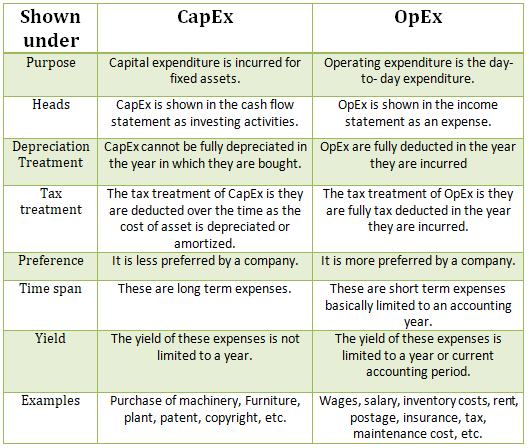
    Example 1: A company wants to lease machinery instead of buying it, in this case buying machinery would be capital expenditure, and leasing the machinery would be an Operating expense.

    Example 2: Buying machinery would cost a company for 50000 and leasing the same would cost 35000. So in this case leasing will be more preferred by a company which means operating expenditure would be preferred instead of a capital expenditure.

    From the point of view of tax treatment operating expenditure is more preferred over Capital expenditure because the expenses incurred during the year are deducted during the same year which reduces the tax levied on net income.

    Some real Examples from the Company Amazon
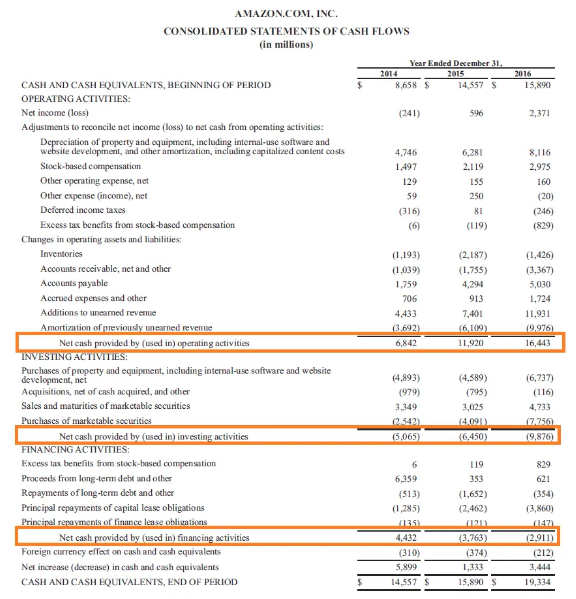
    This is the cash flow statement of Amazon, where the investing activities shows the capital expenditure incurred by the company during the years.
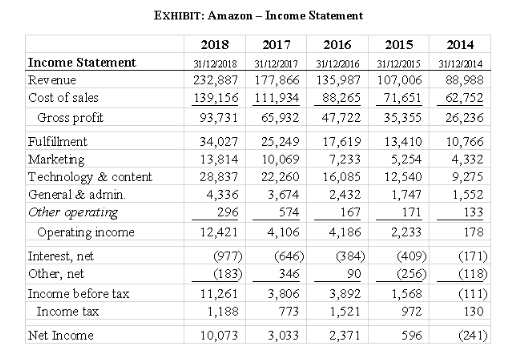
    This is the income statement of Amazon, it shows the operating expenditure incurred by the company during the year.

    See less
    • 0
    • Share
      Share
      • Share on Facebook
      • Share on Twitter
      • Share on LinkedIn
      • Share on WhatsApp
Simerpreet
SimerpreetHelpful
In: 1. Financial Accounting > Accounting Terms & Basics

What is Impairment of Assets?

Impairment
  • 1 Answer
  • 0 Followers
Answer
  1. Astha Leader Pursuing CA, BCom (Hons.)
    Added an answer on June 5, 2021 at 1:47 pm
    This answer was edited.

    What is Impairment of Assets? Impairment of assets means a decline in the value of assets due to unforeseen circumstances. Assets are impaired when the carrying value of assets increases its market value or “realizable value”. Impairment can be caused due to factors that are internal or external toRead more

    What is Impairment of Assets?

    Impairment of assets means a decline in the value of assets due to unforeseen circumstances. Assets are impaired when the carrying value of assets increases its market value or “realizable value”.

    Impairment can be caused due to factors that are internal or external to the firm. Internal factors such as physical damage, obsolescence or poor management and external factors such as a change in legal or economic circumstances, increased competition or reduction in asset’s fair value in the market result in impairment.

    Impairment Vs Depreciation

    Asset impairment is often confused with asset depreciation, which is rather a recurring and expected event, unlike impairment that reflects an abrupt decrease in the value of the asset.

    Impairment Loss

    Impairment is always treated as a loss in accounting. It is the amount by which the carrying value or the asset’s book value exceeds its fair market value.

    Before recording Impairment loss, a company must determine the recoverable value of the asset which is higher of the asset’s net realizable value or value in use. Then it is to be compared with the book value of the asset.

    If the carrying value exceeds the recoverable value then the impairment loss is to be recorded at the exceeding value i.e. difference of carrying value and realizable value.

    Example

    Suppose a company Royal Ltd. has an asset with a carrying value of 50,000, which has suffered physical damage. According to the company’s calculation, the asset has a net realizable value of 30,000 and a value in use of 25,000.

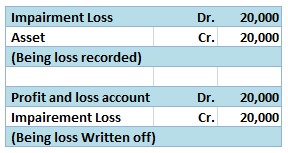
    Then, the recoverable value would be higher of the asset’s net realizable value or value in use, i.e., 30,000 which is still lower than the carrying amount of 50,000. Therefore, Royal ltd. will have to record 20,000 (50,000-30,000) as impairment loss.

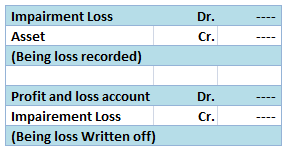
    This is will increase Royal Ltd’s expenses by 20,000 and decrease the asset’s value by the same amount.

    See less
    • 0
    • Share
      Share
      • Share on Facebook
      • Share on Twitter
      • Share on LinkedIn
      • Share on WhatsApp
Astha
AsthaLeader
In: 1. Financial Accounting > Consolidation

What is Revaluation of Assets?

Revaluation
  • 1 Answer
  • 0 Followers
Answer
  1. Simerpreet Helpful CMA Inter qualified
    Added an answer on June 5, 2021 at 2:39 pm
    This answer was edited.

    Revaluation of Assets is an adjustment made in the carrying value of the fixed asset in case the company finds there is a difference between the current price and the market value of the asset. Generally, the value of the asset decreases due to depreciation but in some cases like inflation in the ecRead more

    Revaluation of Assets is an adjustment made in the carrying value of the fixed asset in case the company finds there is a difference between the current price and the market value of the asset. Generally, the value of the asset decreases due to depreciation but in some cases like inflation in the economy, it may increase. so, in order to know the correct value of the asset Revaluation is to be done.

    Accounting standard allows two models.

    • Cost model
    • Revaluation model

    Under the cost model, the carrying value of fixed assets equals their historical cost less accumulated depreciation and accumulated impairment losses.

    For Example, Amazon ltd purchased a Plant for 5,00,000 on January 1, 2010, with a useful life of 10 years, and uses straight-line depreciation.

    Here, the journal entry would be passed as

    As the useful life of the asset is 20 years, so the yearly depreciation would be

    5,00,000/10 i.e. 50,000.

    So the accumulated depreciation at the end of December 31, 2012, would be 50,000×2= 1,00,000 and

    the carrying amount would be 5,00,000-1,00,000= 4,00,000.

    Under the Revaluation method, the assets are revalued at their current market value. If there is an increase in the value of an asset, the difference between the asset’s market value and current book value is recorded as a revaluation surplus.

    For Example, Amazon ltd purchased an asset two years ago at a cost of 2,00,000. Depreciation @ 10% under straight-line method.

    Therefore, the accumulated depreciation for two years would be 40,000,

    i.e. 20,000 for a year.

    Carrying cost of the asset = 1,60,000

    Assuming, the company revalues its assets and finds that the worth of assets is 1,85,000.

    Under this method, the company needs to record 25,000 as a surplus.

    Accounting entry for the above will be

    Depreciation calculated during the third year would be based on the new carrying value of 1,60,000.

    Therefore, Depreciation for the 3rd year= 1,60,000/3

    = 53,333.33

    Accounting entry:

    Alternatively, the incremental depreciation due to the revaluation i.e. 13,333.33 can be charged to the revaluation surplus account.

    In case, if there is a revaluation loss, the entries would be interchanged.

    In case of admission of a partner, the new partner may not agree with the value of assets as stated in the balance sheet, with time the values may have arisen or may have fallen, so in order to bring them to their correct values revaluation is done so that the new partner doesn’t suffer.

    Where the assets and liabilities are to be shown in the books at the revised (new) values after the admission of the new partner.

    The accounting entries are

    1. For Increase in the value of an asset

    2. For a decrease in the value of an asset

    3. For transfer of profit on revaluation i.e. if the total of credit side exceeds the debit side.

    4. For transfer of loss on revaluation i.e. if the total of debit side exceeds the credit side.

    Note: If the total of both sides is equal it signifies that there is no profit or loss on the revaluation of assets. Hence no entry is to be passed.

    After preparing for the journal entry, a revaluation ledger account is also prepared wherein the accounts carrying a debit balance are transferred to the debit side and the accounts carrying a credit balance are transferred to the credit side.

    In the case of retirement of a partner, the same journal entries are to be passed as in the case of Admission of a partner for revaluation of assets.

    Generally, the value of an asset decreases with time but it may increase in certain circumstances especially in inflationary economies.

    Conclusion

    An entity should do the revaluation of its assets because revaluation provides the present value of assets owned by an entity and upward revaluation is beneficial for the entity and hence the company can charge more depreciation on upward revaluation and can get tax benefits.

    See less
    • 0
    • Share
      Share
      • Share on Facebook
      • Share on Twitter
      • Share on LinkedIn
      • Share on WhatsApp
Simerpreet
SimerpreetHelpful
In: 1. Financial Accounting > Depreciation & Amortization

Is depreciation a cash flow?

Cash FlowDepreciation
  • 1 Answer
  • 1 Follower
Answer
  1. Astha Leader Pursuing CA, BCom (Hons.)
    Added an answer on June 2, 2021 at 12:43 pm
    This answer was edited.

    Depreciation refers to that portion of the value of an asset that a company uses in an accounting year to generate revenue. Assets are written off in form of depreciation over time also called the useful life of the asset. It denotes the wear and tear of an asset over time. Suppose, a company namedRead more

    Depreciation refers to that portion of the value of an asset that a company uses in an accounting year to generate revenue. Assets are written off in form of depreciation over time also called the useful life of the asset. It denotes the wear and tear of an asset over time.

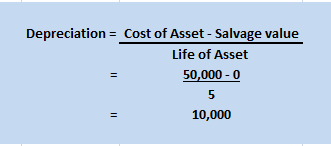
    Suppose, a company named Johnson ltd. purchases machinery for 50,000 that has a useful life of 5 years with nil salvage value. Then the yearly depreciation to be charged can be calculated as:

    Depreciation calculation with formula

    Is Depreciation a Cash Flow?

    Cash flows are inflows and outflows of cash and cash equivalents in an entity. The payments made by the entity denote the outflows whereas the revenues or incomes of the entity denote the inflows. Talking about cash flows, depreciation is a non-cash item of expense which means it neither results in inflow nor outflow of cash resources.

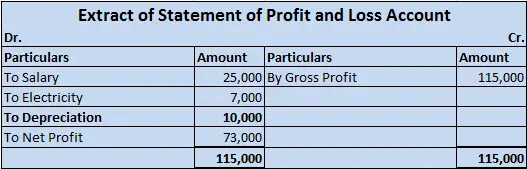
    In the adjacent Profit and Loss statement, a cash payment of 7,000 for electricity implies outflow of cash however, depreciation of 10,000 is merely an imputed cost to write off an asset or we can say, a part of profits set aside each year so that there are sufficient funds available to procure a new asset after the currently available asset is discarded.

    showing depreciation in profit and loss account

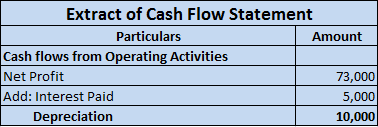
    However, cash flow statements are affected by depreciation. Depreciation is added back to the net profits while calculating cash flows from operating expenses since it is a non-cash item and has been deducted while calculating net profits in the profit and loss statement.

    Depreciation shown in cash flow statement

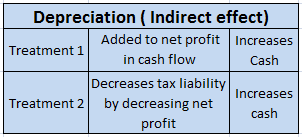
    Depreciation does not directly impact the amount of cash generated or expended by a business but it is tax-deductible and will reduce the cash outflows related to income taxes. Thus, depreciation affects cash flow by reducing the amount of cash a business has to pay for income taxes.

    depreciation effect on cash flow indirectly

    See less
    • 0
    • Share
      Share
      • Share on Facebook
      • Share on Twitter
      • Share on LinkedIn
      • Share on WhatsApp
Astha
AsthaLeader
In: 1. Financial Accounting > Ledger & Trial Balance

How to know if opening balance of an account is Debit or Credit?

CreditDebitOpening Balance
  • 1 Answer
  • 0 Followers
Answer
  1. Simerpreet Helpful CMA Inter qualified
    Added an answer on June 2, 2021 at 3:11 pm
    This answer was edited.

    Let us begin with a short explanation of what opening balance is: The opening balance is the amount of funds that are bought forward from the end of one accounting period to the beginning of a new accounting period. In a firm’s account, the first entry done is of the opening balance. It can either hRead more

    Let us begin with a short explanation of what opening balance is:

    The opening balance is the amount of funds that are bought forward from the end of one accounting period to the beginning of a new accounting period.

    In a firm’s account, the first entry done is of the opening balance. It can either have a debit balance or a credit balance depending upon whether the firm has a negative or positive balance.

    Opening balance of a ledger

    Opening balance is the first entry of the ledger account at the beginning of an accounting period.

    In the case of a newly started business, there will be no closing balances and as such there will be no balances to be carried forward. In such a case, the investment and capital of the business will be entered as an opening balance for the current accounting period.

    So the first and foremost part is to identify on which side of the ledger i.e. the debit side or the credit side the opening balance is to be entered.

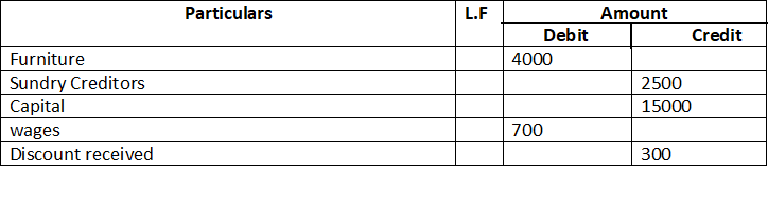
    For Example, A trial balance is given which represents the debit and credit balances, accordingly, I will prepare different ledger accounts to make it simpler.

    The trial balance shows the opening balance of various accounts. Now posting them in ledger accounts.



    As the Furniture is an Asset account, the opening balance will be on the debit side of the ledger account.

    As Sundry creditor is a credit account,  we put the opening balance on the credit side.

    As the Capital is a credit account,  we put the opening balance on the credit side.

    As Wages is a debit account,  we put the opening balance on the debit side.

    As the Discount received is a credit account,  we put the opening balance on the credit side.

    Exception

    Drawing Account.

    Drawing account is an exception to this topic. It is considered a contra account to the owner’s capital account because it reduces the value of the owner’s equity. Drawings, therefore, have no opening balance.

    Contra Entry.

    Contra entry involves transactions of cash and bank. Any entry which involves both the cash and bank is contra entry.

    For example, we deposit cash 5000 into the bank.

    Accounting entry for this transaction would be

    In this case, the ledger entry would be

    As the bank account has a debit balance, the opening balance would come on the debit side.

    As the cash account has a credit balance, the opening balance would come on the credit side.

    Alternatively, If we withdraw cash 5000 from the bank.

    Accounting entry would be

    In this case, the ledger entry would be

    As the Cash account has a debit balance, the opening balance would come on the debit side.

    As the Bank account has a credit balance, the opening balance would come on the credit side.

    See less
    • 0
    • Share
      Share
      • Share on Facebook
      • Share on Twitter
      • Share on LinkedIn
      • Share on WhatsApp
Simerpreet
SimerpreetHelpful
In: 1. Financial Accounting > Miscellaneous

What are the sources of working capital?

Working Capital
  • 1 Answer
  • 0 Followers
Answer
  1. Astha Leader Pursuing CA, BCom (Hons.)
    Added an answer on May 30, 2021 at 2:18 pm
    This answer was edited.

    Let us first understand what working capital is. Working capital means the funds available for the day-to-day operations of an enterprise. It is a measure of a company’s liquidity and short term financial health. They are cash or mere cash resources of a business concern. It also represents the exceRead more

    Let us first understand what working capital is.

    Working capital means the funds available for the day-to-day operations of an enterprise. It is a measure of a company’s liquidity and short term financial health. They are cash or mere cash resources of a business concern.

    It also represents the excess of current assets, such as cash, accounts receivable and inventories, over current liabilities, such as accounts payable and bank overdraft.

    working capital formula

    Sources of Working Capital

    Any transaction that increases the amount of working capital for a company is a source of working capital.

    Suppose, Amazon sells its goods for $1,000 when the cost is only $700. Then, the difference of $300 is the source of working capital as the increase in cash is greater than the decrease in inventory.

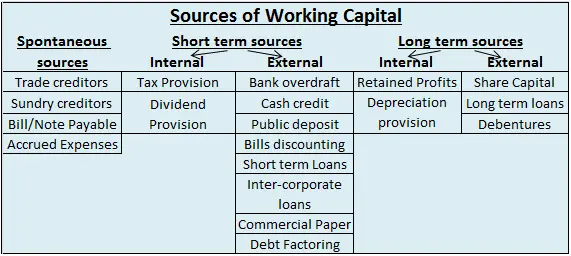
    Sources of working capital can be classified as follows:

    short term and long term sources of working capital

    Short Term Sources

    • Trade credit: Credit given by one business firm to the other arising from credit sales. It is a spontaneous source of finance representing credit extended by the supplier of goods and services.
    • Bills/Note payable: The purchaser gives a written promise to pay the amount of bill or invoice either on-demand or at a fixed future date to the seller or the bearer of the note.
    • Accrued expenses: It refers to the services availed by the firm, but the payment for which is yet to be done. It represents an interest-free source of finance.
    • Tax/Dividend provisions: It is a provision made out of current profits to meet the tax/dividend obligation. The time gap between provision made and payment of actual payment serves as a source of short-term finance during the intermediate period.
    • Cash Credit/Overdraft: Under this arrangement, the bank specifies a pre-determined limit for borrowings. The borrower can withdraw as required up to the specified limits.
    • Public deposit: These are unsecured deposits invited by the company from the public for a period of six months to 3 years.
    • Bills discounting: It refers to an activity wherein a discounted amount is released by the bank to the seller on purchase of the bill drawn by the borrower on their customers.
    • Short term loans: These loans are granted for a period of less than a year to fulfil a short term liquidity crunch.
    • Inter-corporate loans/deposits: Organizations having surplus funds invest with other organizations for up to six months at rates higher than that of banks.
    • Commercial paper: These are short term unsecured promissory notes sold at discount and redeemed at face value. These are issued for periods ranging from 7 to 360 days.
    • Debt factoring: It is an arrangement between the firm (the client) and a financial institution (the factor) whereby the factor collects dues of his client for a certain fee. In other words, the factor purchases its client’s trade debts at a discount.

    Long Term Sources

    • Retained profits: These are profits earned by a business in a financial year and set aside for further usage and investments.
    • Share Capital: It is the money invested by the shareholders in the company via purchase of shares floated by the company in the market.
    • Long term loans: These loans are disbursed for a period greater than 1 year to the borrower in his account in cash. Interest is charged on the full amount irrespective of the amount in use. These shareholders receive annual dividends against the money invested.
    • Debentures: These are issued by companies to obtain funds from the public in form of debt. They are not backed by any collateral but carry a fixed rate of interest to be paid by the company to the debenture holders.

    Another point I would like to add is that, although depreciation is recorded in expense and fixed assets accounts and does not affect working capital, it still needs to be accounted for when calculating working capital.

    See less
    • 0
    • Share
      Share
      • Share on Facebook
      • Share on Twitter
      • Share on LinkedIn
      • Share on WhatsApp
Astha
AsthaLeader
In: 1. Financial Accounting > Accounting Terms & Basics

What is capital work-in-progress?

Capital
  • 1 Answer
  • 0 Followers
Answer
  1. Simerpreet Helpful CMA Inter qualified
    Added an answer on May 30, 2021 at 3:01 pm
    This answer was edited.

    As per Wiki, it is also called construction in progress. Capital work in progress is a non-current asset of an entity. It is also known as CWIP in short. CWIP is the work which is not yet completed but the amount for which has already been paid. Suppose, at the time of preparing a balance sheet, ifRead more

    As per Wiki, it is also called construction in progress. Capital work in progress is a non-current asset of an entity. It is also known as CWIP in short.

    CWIP is the work which is not yet completed but the amount for which has already been paid.

    Suppose, at the time of preparing a balance sheet, if an asset is not completed, all the costs incurred on that asset up to the balance sheet date are to be transferred to an account called capital work in progress.

    Example 1: A machinery under installation.

    There are several expenses incurred while installing machinery, expenses such as labor charges, Initial delivery and handling costs, Assembly and installation cost, etc are included in CWIP and when the asset is completed and is ready to use, all the costs are transferred to the relevant accounts.

    To make it simpler, let me show journal entries relating to this example.

    When an expense is incurred/paid:

    Journal entry for capital work in progress when an expense is incurred

    When an asset is complete and put to use:

    Journal entry for capital work in progress when asset is complete and put to use

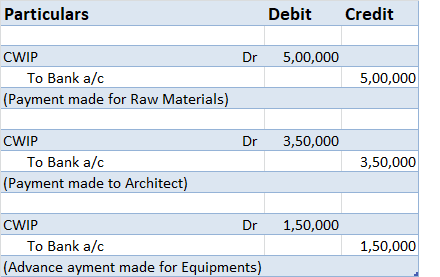
    Example 2: A Contractor is constructing a building. The following expenditures are being incurred to date:

    i) Raw materials – 5,00,000

    ii) Payment to Architect – 3,50,000

    iii) Advance for Equipments – 1,50,000

    Following accounting entries will be passed to record the expenditure on CWIP assets:

    capital work in progress journal entries example

    The following accounting entry will be passed once assets are ready to use:

    entry to show cwip when asset is complete

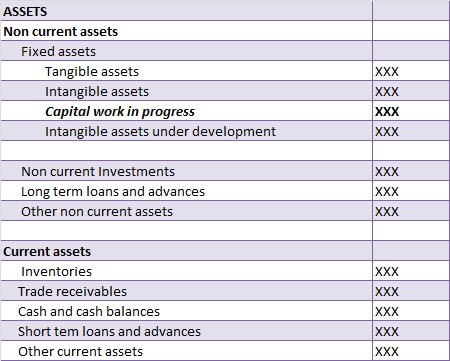
    Disclosure in the Balance sheet

    CWIP account is shown separately in the balance sheet below the fixed asset.

    we cannot depreciate capital work in progress. It can only be depreciated when the asset is put to use.

    Capital work in progress shown in balance sheet

    See less
    • 0
    • Share
      Share
      • Share on Facebook
      • Share on Twitter
      • Share on LinkedIn
      • Share on WhatsApp
Simerpreet
SimerpreetHelpful
In: 1. Financial Accounting > Miscellaneous

Is Land a Current Asset?

Current Assets
  • 2 Answers
  • 0 Followers
Answer
  1. Bonnie Curious MBA (Finance)
    Added an answer on June 27, 2021 at 5:34 am
    This answer was edited.

    Similarly, someone asked Are loose tools current assets

    Similarly, someone asked Are loose tools current assets

    See less
    • 0
    • Share
      Share
      • Share on Facebook
      • Share on Twitter
      • Share on LinkedIn
      • Share on WhatsApp
Astha
AsthaLeader
In: 1. Financial Accounting > Contingent Liabilities & Assets

When and where are Contingent Assets disclosed?

Contingent Assets
  • 1 Answer
  • 0 Followers
Answer
  1. Simerpreet Helpful CMA Inter qualified
    Added an answer on June 29, 2021 at 9:04 am
    This answer was edited.

    To begin with, let me first give you a small explanation of what Contingent assets are A contingent asset is a potential asset or economic benefit that does not exist currently but may arise in the near future. Such an asset arises from an uncertain and unpredictable event. To make it clear with anRead more

    To begin with, let me first give you a small explanation of what Contingent assets are

    A contingent asset is a potential asset or economic benefit that does not exist currently but may arise in the near future. Such an asset arises from an uncertain and unpredictable event.

    To make it clear with an example: String Co. filed a lawsuit against a competitor company Weave Tech Co. for infringing on company ABC’s patent. Even if it is probable (but not certain) that Strings Co. will win the lawsuit, it is a contingent asset.

    As such, it will not be recorded in Strings Co. general ledger accounts until the lawsuit is settled.

    At most the Strings Co. can do is, prepare a note disclosing the fact that it has filed the lawsuit the outcome of which is uncertain.

    Disclosing Contingent Assets

    • The probability of occurrence is virtually certain or probable: It will be disclosed as an asset in the balance sheet.

    For Example, The court orders for reimbursement to Strings Co. say 1,00,000 for the damages, but it has not yet received the money. Although it is virtually certain that the company will receive the money in the near future, it will be treated as an asset and can be disclosed in the balance sheet on the assets side.

    • The probability of occurrence is probable: It will be disclosed as notes to accounts below the balance sheet.

    For Example, Strings Co. filed a lawsuit against a competitor company Weave Tech for infringing on Strings Co. patent. Even if it is probable (but not certain) that Strings Co. will win the lawsuit, it is a contingent asset.

    As such, it will not be recorded in Strings company’s general ledger until the lawsuit is settled.

    At most the Strings Co. can do is, prepare a note disclosing the fact that it has filed the lawsuit the outcome of which is uncertain. 

    • The probability of occurrence is remote or not probable:  It will not be treated as a contingent asset.

    In this case, the disclosure of it is not permitted.

    See less
    • 0
    • Share
      Share
      • Share on Facebook
      • Share on Twitter
      • Share on LinkedIn
      • Share on WhatsApp

Sidebar

Question Categories

  • 1. Financial Accounting

      • Accounting Terms & Basics
      • Bank Reconciliation Statement
      • Banks & NBFCs
      • Bills of Exchange
      • Capital & Revenue Expenses
      • Consignment & Hire Purchase
      • Consolidation
      • Contingent Liabilities & Assets
      • Departments & Branches
      • Depreciation & Amortization
      • Financial Statements
      • Goodwill
      • Insurance Accounting
      • Inventory or Stock
      • Investment Accounting
      • Journal Entries
      • Ledger & Trial Balance
      • Liquidation & Amalgamation
      • Miscellaneous
      • Not for Profit Organizations
      • Partnerships
      • Ratios
      • Shares & Debentures
      • Source Documents & Vouchers
      • Subsidiary Books
  • 2. Accounting Standards

      • AS
      • IFRS
      • IndAS
  • 3. Cost & Mgmt Accounting
  • 4. Taxes & Duties

      • GST
      • Income Tax
  • 5. Audit

      • Bank Audit
      • Internal Audit
      • Miscellaneous - Audit
      • Statutory Audit
  • 6. Software & ERPs

      • Tally
  • 7. MS-Excel
  • 8. Interview & Career
  • Top Questions
  • I need 20 journal entries with ledger and trial balance?

  • Can you show 15 transactions with their journal entries, ledger, ...

  • What is furniture purchased for office use journal entry?

  • What is loose tools account and treatment in final accounts?

  • What is the Journal Entry for Closing Stock?

  • What is the journal entry for goods purchased by cheque?

  • What is commission earned but not received journal entry?

  • How to show adjustment of loose tools revalued in final ...

  • What is the journal entry for interest received from bank?

  • Following is the Receipts and Payments Account of Bharti Club ...

Hot Topics

Accounting Policies Accounting Principles Balance Sheet Bank Reconciliation Statement Bill of Exchange Branch Accounting Calls in Advance Capital Capital Expenditure Companies Act Compound Entry Consignment Creditors Current Assets Debit Balance Debtors Depreciation Difference Between Dissolution of Firm Dissolution of Partnership Drawings External Users Fictitious Assets Final Accounts Financial Statements Fixed Assets Fixed Capital Fluctuating Capital Gain Impairment Installation Interest Received in Advance Internal Users Journal Entry Ledger Loose Tools Miscellaneous Expenditure Profit Rent Rent Received in Advance Reserves Revaluation Revenue Expenditure Revenue Reserve Sacrificing Ratio Subscription Subscription Received in Advance Trial Balance Type of Account Uncalled Capital
  • Home
  • Questions
    • Most Visited
    • Most Active
    • Trending
    • Recent
  • Follow
    • Categories
    • Users
    • Tags
  • Write an Answer
  • Badges & Points
  • Request New Category
  • Send a Suggestion

Most Helping Users

Astha

Astha

  • 50,291 Points
Leader
Simerpreet

Simerpreet

  • 72 Points
Helpful
AbhishekBatabyal

AbhishekBatabyal

  • 65 Points
Helpful

Footer

  • About Us
  • Contact Us
  • Pricing
  • Refund
  • Forum Rules & FAQs
  • Terms and Conditions
  • Privacy Policy
  • Career

© 2021 All Rights Reserved
Accounting Capital.