Please briefly explain why you feel this question should be reported.

Please briefly explain why you feel this answer should be reported.

Please briefly explain why you feel this user should be reported.

Sign InSign Up

AccountingQA

AccountingQA Logo AccountingQA Logo

AccountingQA Navigation

  • Home
  • Ask Questions
  • Write Answers
  • Explore
  • FAQs
Search
Ask A Question

Mobile menu

Close
Ask a Question
  • Home
  • Questions
    • Most Visited
    • Most Active
    • Trending
    • Recent
  • Follow
    • Categories
    • Users
    • Tags
  • Write an Answer
  • Badges & Points
  • Request New Category
  • Send a Suggestion
  • Search Your Accounting Question..

  • Recent Questions
  • Most Answered
  • Answers
  • Most Visited
  • Most Voted
  • No Answers

AccountingQA Latest Questions

Astha
AsthaLeader
In: 1. Financial Accounting > Financial Statements

Why is miscellaneous expenditure shown in balance sheet?

Balance SheetMiscellaneous Expenditure
  • 1 Answer
  • 0 Followers
Answer
  1. Simerpreet Helpful CMA Inter qualified
    Added an answer on June 25, 2021 at 2:52 pm
    This answer was edited.

    Miscellaneous expenditure in the balance sheet The expenses that are written off in the current financial year are shown on the debit side of the profit and loss account. However, those that are not written off during the current financial year are shown in the balance sheet on the Assets Side as MiRead more

    Miscellaneous expenditure in the balance sheet

    The expenses that are written off in the current financial year are shown on the debit side of the profit and loss account. However, those that are not written off during the current financial year are shown in the balance sheet on the Assets Side as Miscellaneous expenditure.

    Miscellaneous expenditure are those expenses that are not categorized as Operating expenses i.e. these are not classified as manufacturing, selling, and administrative expenses.

    For example, BlackRock has spent 5,00,000 which will be written of in 5 consecutive years as an Advertisement expense. During the current financial year, only 1,00,000 will be written off and the rest will be carried to the next year and year thereafter.

    Treatment in the first year:

    • 1,00,000 which is written off during the current financial year will be shown on the debit side of the Profit and Loss account.
    • 4,00,000 which is carried forward will be shown on the assets side of the balance sheet as miscellaneous expenditure because all assets and expenses have a debit balance.

    Treatment in the second year:

    • 1,00,000 which is written off during the current financial year will be shown on the debit side of the Profit and Loss account.
    • 4,00,000 which is carried forward will be shown in the assets side of the balance sheet as a miscellaneous expenditure.

    The same will be done in the third, fourth, and fifth years.

    Conclusion

    Deferred revenue expenditure is also a long-term expenditure the benefit of which cannot be derived within the same year. So the amount that is written off during the current year is shown on the debit side of the profit and loss account and the amount which is not written off during the current financial year is shown on the assets side under the head Miscellaneous expenditure.

    See less
    • 0
    • Share
      Share
      • Share on Facebook
      • Share on Twitter
      • Share on LinkedIn
      • Share on WhatsApp
Astha
AsthaLeader
In: 1. Financial Accounting > Journal Entries

What is the journal entry for received cash?

  • 1 Answer
  • 0 Followers
Answer
  1. Ayushi Curious Pursuing CA
    Added an answer on December 9, 2021 at 5:52 pm
    This answer was edited.

    The receipt of cash is recorded by debiting the cash account to the account from which the cash is received. This source account may be the sales account, account receivable account or any other account from which cash is received. The journal entry is: An entity may receive cash in the following evRead more

    The receipt of cash is recorded by debiting the cash account to the account from which the cash is received. This source account may be the sales account, account receivable account or any other account from which cash is received.

    The journal entry is:

    An entity may receive cash in the following events:

    • Sales of goods or provision of services
    • Payment from account receivables
    • Sale of assets.
    • Withdrawal of cash from the bank
    • Introduction of additional capital in the business
    • Subscription or donation received in case of non-profit oriented concerns.
    • Other income in cash

    This list is not exhaustive. There may be many such events. However, the cash account will be always debited.

    Rules of accounting applicable on the cash account

    As per the golden rules of accounting, the cash account is a real account as represents an asset. For real accounts, the rule, “Debit the receiver and credit the giver” applies.

    Hence, when cash is received, cash is debited and the source (giver) is credited.

    As per modern rules of accounting, the cash account is an asset account. Assets accounts are debited when increased and credited when decreased.

    Hence, at receipt of cash, cash is debited as cash is increased.

    See less
    • 0
    • Share
      Share
      • Share on Facebook
      • Share on Twitter
      • Share on LinkedIn
      • Share on WhatsApp
AbhishekBatabyal
AbhishekBatabyalHelpful
In: 1. Financial Accounting > Miscellaneous

What is effective capital?

  • 1 Answer
  • 0 Followers
Answer
  1. Ayushi Curious Pursuing CA
    Added an answer on November 30, 2021 at 7:50 pm
    This answer was edited.

    Effective Capital is an amount calculated for purpose of arriving at the maximum limit of managerial remuneration as per the Companies Act, 2013 where profit is inadequate or no profit. Other than that it has no use. Computation of effective capital is given in Explanation I to Schedule II of the CoRead more

    Effective Capital is an amount calculated for purpose of arriving at the maximum limit of managerial remuneration as per the Companies Act, 2013 where profit is inadequate or no profit. Other than that it has no use.

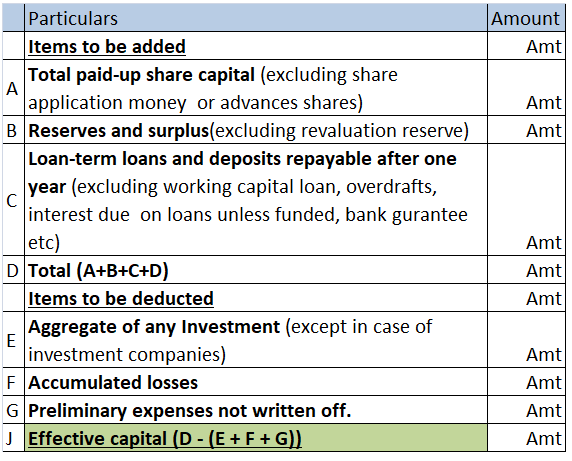
    Computation of effective capital is given in Explanation I to Schedule II of the Companies Act. Schedule II deals with remuneration payable to managers in case of no profit or inadequate profit in the following manner:

    Computation of effective capital is done in the following manner:

    Numerical example:

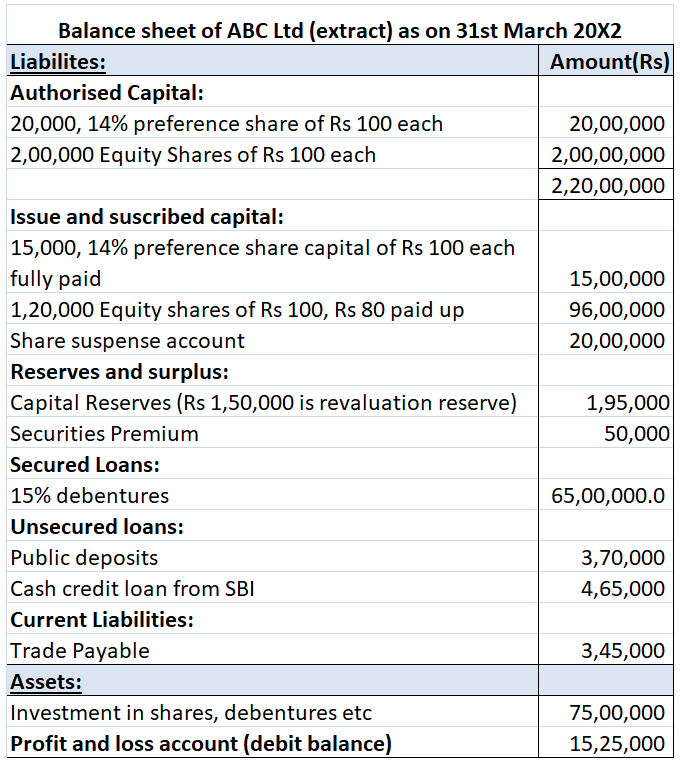
    ABC Ltd reports its balance sheet as given below:

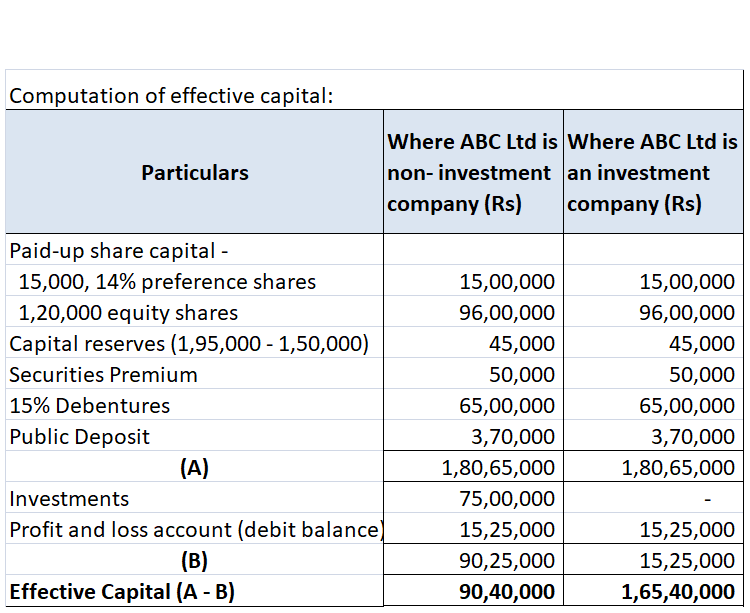
    We will compute its effective capital for both an investment company and a non-investment company.

    See less
    • 0
    • Share
      Share
      • Share on Facebook
      • Share on Twitter
      • Share on LinkedIn
      • Share on WhatsApp
A_Team
A_Team
In: 1. Financial Accounting > Depreciation & Amortization

Can you please explain these depreciation MCQs?

Depreciation is referred to as the reduction in the cost of a fixed asset in sequential order, due to wear and tear until the asset becomes obsolete. Following are some of ...

  • 1 Answer
  • 0 Followers
Answer
  1. Astha Leader Pursuing CA, BCom (Hons.)
    Added an answer on March 24, 2022 at 6:03 pm

    The main objective of depreciation is to calculate net profit. Depreciation is an expense allowed on the fixed assets of an entity to provide for the cost of benefit utilized by the entity in that particular year. Since the such assets are used for more than one financial year, profits for the furthRead more

    1. The main objective of depreciation is to calculate net profit.

    Depreciation is an expense allowed on the fixed assets of an entity to provide for the cost of benefit utilized by the entity in that particular year. Since the such assets are used for more than one financial year, profits for the further years would be misstated if such depreciation expense is not provided for.

    Further, depreciation in no way shows previous profits or satisfies the tax department and a reduction in tax is secondary since it will only be allowed if charged in the profit & loss account. Thus, B is the correct answer.

    2. Depreciation is generated due to wear and tear.

    Depreciation is provided for to compensate for the wear and tear of the asset while being used by the entity. Depreciation is not generated due to increase in the value of liability, decrease in capital or decrease in the value of assets. Rather the vice versa is true, that is an increase in liability, decrease in capital and decrease in asset is created due to depreciation.

    Thus, C is the correct answer.

    3. The purpose of making a provision for depreciation in the accounts is to charge the cost of fixed assets against profits.

    Fixed assets are long term assets with useful life of more than one accounting year and therefore the full cost of such assets are not provided for in the year of purchase rather a fixed portion is charged every year in the profit and loss account.

    Thus, A is correct and others are incorrect.

    4. According to the straight line method of depreciation, the depreciation remains constant.

    In the straight line method of depreciation, depreciation is calculated on the historical or purchase cost of the asset and the same amount is charged every year till the useful value of the asset, thus depreciation remains constant.

    Also, depreciation decreases each year in case of written down value method but depreciation can never increase. Thus, A is the correct answer.

    5. Total amount of depreciation of an asset cannot exceed its depreciable value.

    The depreciable value is the purchase cost of the asset less the scrap value. The total amount of depreciation can never exceed the depreciable value since depreciation is allowed on an asset till its useful life at a certain percentage. Even when the value of the asset becomes nil, no further depreciation would be charged and total depreciation would be equal to depreciable value but obviously cannot be more.

    Thus, A is the correct answer and other are wrong.

    6. According to fixed installment method, the depreciation is calculated on original cost.

    In the fixed installment method, also known as the straight line method, depreciation is calculated on the basis of the original or purchase cost of the asset using the formula-

    Depreciation = (Original cost – Scrap value)/Useful life of asset

    Thus, B is the correct answer.

    7. Salvage value means estimated disposal value.

    Salvage value is the value of the asset that can be realized by the entity on its sale after the useful life of the asset has been exhausted and is now obsolete for the entity.

    Salvage value is not definite but an estimation. Salvage value can be positive or nil but not negative. Thus, D is the correct option.

    8. Depreciation is calculated under diminishing balance method, based on book value.

    Under the diminishing value method, the depreciation is calculated at a certain percentage of the book value of the asset which is calculated after providing for depreciation in the previous year.

    Depreciation cannot be calculated on scrap value since it is the disposable value of the asset and depreciation on original value is calculated under straight line method. Thus, B is the correct option.

    9. Depreciation amount charged on a machinery will be debited to depreciation account.

    Depreciation is an expense and depreciation account will be debited since depreciation is a nominal account, as per traditional method, and all expenses are debited. Also, as per modern rules of accounting, increase in expenses are debited.

    When depreciation is charged there is a decrease in the value of assets therefore machinery account will be credit also depreciation cannot be classified under repair account or cash account heads. Thus, C is the correct option.

    10. In accounting, becoming out of date or obsolete is known as obsolescence.

    Amortization means decrease in the value of intangible assets of an entity. Depletion means exhaustion  of existing wasting assets such as coal mines. Physical deterioration means fall in value of asset due to physical damage to the asset. Therefore, the correct answer is Obsolescence.

    See less
    • 0
    • Share
      Share
      • Share on Facebook
      • Share on Twitter
      • Share on LinkedIn
      • Share on WhatsApp
Simerpreet
SimerpreetHelpful
In: 1. Financial Accounting > Accounting Terms & Basics

Explain the qualitative characteristics of accounting information?

  • 1 Answer
  • 0 Followers
Answer
  1. prashant06 B.com, CMA pursuing
    Added an answer on July 11, 2021 at 1:28 pm
    This answer was edited.

    QUALITATIVE CHARACTERISTICS OF ACCOUNTING INFORMATION ARE AS FOLLOWS: 1. COMPARABILITY: Comparison of financial statements is one of the most frequently used and effective tools of financial analysis. It helps the users of accounting information to compare, analyze and take decisions accordingly. CoRead more

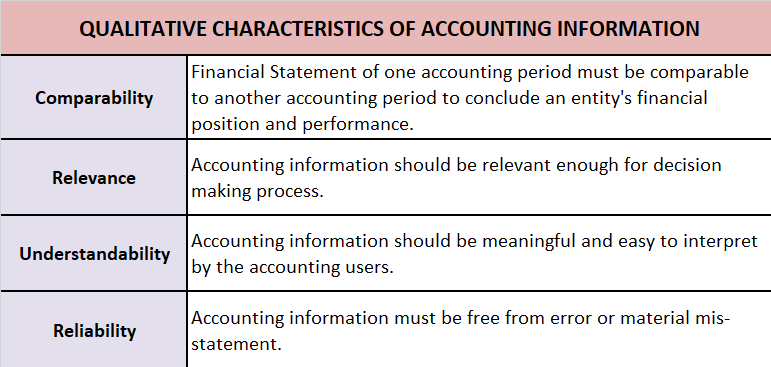
    QUALITATIVE CHARACTERISTICS OF ACCOUNTING INFORMATION ARE AS FOLLOWS:

    1. COMPARABILITY: Comparison of financial statements is one of the most frequently used and effective tools of financial analysis. It helps the users of accounting information to compare, analyze and take decisions accordingly. Comparability enables inter-firm and intra-firm comparisons. It helps to ascertain the growth and progress of the business over time and in comparison to other businesses.

    For example, managers of ITC ltd want to know which business of his is performing well and which needs progress so they would compare the financial statement of its different businesses and make the decision accordingly.

    2. RELEVANCE: It generally means that the essential information should be easily and readily available and any irrelevant information should be avoided. The user of accounting information needs relevant accounting information for a good decision-making process, planning, and predicting future circumstances.

    For example, a firm is expected to provide the total amount owed by the debtors in the balance sheet, whereas the total number of debtors is not important.

    3. UNDERSTANDIBILITY: The financial statement should be presented so that every user can interpret the information without any difficulty in a meaningful and appropriate manner. To be more precise it should be complete, concise, clear, and organized.

    For example, mentioning note number in the financial statement for any items which needs disclosure. This helps the users of accounting to interpret the financial statement without any difficulty.

    4. RELIABILITY: This means the accounting information must be free from material error and bias. All accounting information is verifiable and can be verified from the source documents basically, information should not be vague or false.

    For example, any significant matters like amount due, damages, losses, etc. which impact the financial stability shall be mentioned as disclosure since it is useful for all the users of accounting to be aware of such facts and not to be misguided by incomplete information.

    See less
    • 0
    • Share
      Share
      • Share on Facebook
      • Share on Twitter
      • Share on LinkedIn
      • Share on WhatsApp
Astha
AsthaLeader
In: 1. Financial Accounting > Consignment & Hire Purchase

Consignment account is which type of account?

ConsignmentType of Account
  • 1 Answer
  • 0 Followers
Answer
  1. Radha M.Com, NET
    Added an answer on July 17, 2021 at 7:12 am
    This answer was edited.

    A Consignment Account is a Nominal Account. It is classified as a nominal A/c because it is prepared to ascertain the profit earned or loss incurred on the consignment. The accounting rule applied to consignment A/c: Debit all Expenses & Losses and Credit all Incomes & Gains. As per the modeRead more

    A Consignment Account is a Nominal Account. It is classified as a nominal A/c because it is prepared to ascertain the profit earned or loss incurred on the consignment.

    The accounting rule applied to consignment A/c: Debit all Expenses & Losses and Credit all Incomes & Gains.

    As per the modern rules, there is no clear-cut classification of consignment A/c. It is prepared from the perspective of the consignor, hence it cannot be outrightly classified as an expense/revenue.

    In the context of accounting, consignment refers to an arrangement of goods wherein the consignor sends the goods to the consignee so that the consignee can sell/distribute the goods on behalf of the consignor.

    The relationship between the consignor and consignee is that of a principal and agent. The consignee gets a commission for his services.

    You should keep in mind that the consignee does not get ownership of the goods even though the goods are in his possession. The ownership remains with the consignor till the sale is made. On sale, the buyer will become the owner.

    A Consignment A/c is an account prepared to record the transactions happening in a consignment business. This account is maintained by the consignor. It shows the profit earned or loss incurred by the consignor on a specific consignment.

    A consignor may send goods to more than one consignee. In such a case, a separate consignment A/c is prepared for each consignment.

    The following items appear on the debit side of the consignment A/c:

    • Cost of goods sent on consignment.
    • Expenses incurred by the consignor (freight, insurance, etc.)
    • Expenses paid by the consignee (storage and warehousing, marketing expenses, packaging and selling expenses, etc.)
    • Bad debts in consignment.
    • Commission paid to consignee.


    The entries appearing on the credit side of the consignment A/c are as follows:

    • Gross sales.
    • Abnormal loss of goods.
    • Inventories on consignment (stock in transit).


    The balance in the consignment A/c represents the profit or loss made on the consignment. It is transferred to the P&L A/c and the account is closed.

    Below is the format for Consignment A/c:

    See less
    • 0
    • Share
      Share
      • Share on Facebook
      • Share on Twitter
      • Share on LinkedIn
      • Share on WhatsApp
A_Team
A_Team
In: 1. Financial Accounting > Accounting Terms & Basics

Capital account is which type of account?

I mean to ask is it real, nominal, or personal and why?

CapitalType of Account
  • 2 Answers
  • 0 Followers
Answer
  1. AbhishekBatabyal Helpful Pursuing CA, BCOM (HONS)
    Added an answer on November 7, 2021 at 4:06 pm

    The correct option is option A. Journal is the book of original entry. It is from the journal, the postings in the ledgers are made. As it is the journal first to record the transactions, it is called the book of original entry. It is from the journal, the postings in the ledgers are made. Ledgers aRead more

    The correct option is option A.

    Journal is the book of original entry. It is from the journal, the postings in the ledgers are made. As it is the journal first to record the transactions, it is called the book of original entry.

    It is from the journal, the postings in the ledgers are made. Ledgers are called the books of principal book of entry.

    Option B Duplicate is wrong as there is no such thing as the book of duplicate entry in financial accounting. Journal entries are the first-hand record of business transactions. Hence, it cannot be the book of duplicate entries.

    Option C Personal is wrong. This classification of ‘personal’ is a type of account as per traditional rules of accounting, not books of accounts

    Option D Nominal is wrong. It is also a type of account as per the traditional rules of accounting.

    See less
    • 0
    • Share
      Share
      • Share on Facebook
      • Share on Twitter
      • Share on LinkedIn
      • Share on WhatsApp
Load More Questions

Sidebar

Question Categories

  • 1. Financial Accounting

      • Accounting Terms & Basics
      • Bank Reconciliation Statement
      • Banks & NBFCs
      • Bills of Exchange
      • Capital & Revenue Expenses
      • Consignment & Hire Purchase
      • Consolidation
      • Contingent Liabilities & Assets
      • Departments & Branches
      • Depreciation & Amortization
      • Financial Statements
      • Goodwill
      • Insurance Accounting
      • Inventory or Stock
      • Investment Accounting
      • Journal Entries
      • Ledger & Trial Balance
      • Liquidation & Amalgamation
      • Miscellaneous
      • Not for Profit Organizations
      • Partnerships
      • Ratios
      • Shares & Debentures
      • Source Documents & Vouchers
      • Subsidiary Books
  • 2. Accounting Standards

      • AS
      • IFRS
      • IndAS
  • 3. Cost & Mgmt Accounting
  • 4. Taxes & Duties

      • GST
      • Income Tax
  • 5. Audit

      • Bank Audit
      • Internal Audit
      • Miscellaneous - Audit
      • Statutory Audit
  • 6. Software & ERPs

      • Tally
  • 7. MS-Excel
  • 8. Interview & Career
  • Top Questions
  • I need 20 journal entries with ledger and trial balance?

  • Can you show 15 transactions with their journal entries, ledger, ...

  • What is furniture purchased for office use journal entry?

  • What is loose tools account and treatment in final accounts?

  • What is the Journal Entry for Closing Stock?

  • What is the journal entry for goods purchased by cheque?

  • What is commission earned but not received journal entry?

  • How to show adjustment of loose tools revalued in final ...

  • What is the journal entry for interest received from bank?

  • Following is the Receipts and Payments Account of Bharti Club ...

Hot Topics

Accounting Policies Accounting Principles Balance Sheet Bank Reconciliation Statement Bill of Exchange Branch Accounting Calls in Advance Capital Capital Expenditure Companies Act Compound Entry Consignment Creditors Current Assets Debit Balance Debtors Depreciation Difference Between Dissolution of Firm Dissolution of Partnership Drawings External Users Fictitious Assets Final Accounts Financial Statements Fixed Assets Fixed Capital Fluctuating Capital Gain Impairment Installation Interest Received in Advance Internal Users Journal Entry Ledger Loose Tools Miscellaneous Expenditure Profit Rent Rent Received in Advance Reserves Revaluation Revenue Expenditure Revenue Reserve Sacrificing Ratio Subscription Subscription Received in Advance Trial Balance Type of Account Uncalled Capital
  • Home
  • Questions
    • Most Visited
    • Most Active
    • Trending
    • Recent
  • Follow
    • Categories
    • Users
    • Tags
  • Write an Answer
  • Badges & Points
  • Request New Category
  • Send a Suggestion

Most Helping Users

Astha

Astha

  • 50,291 Points
Leader
Simerpreet

Simerpreet

  • 72 Points
Helpful
AbhishekBatabyal

AbhishekBatabyal

  • 65 Points
Helpful

Footer

  • About Us
  • Contact Us
  • Pricing
  • Refund
  • Forum Rules & FAQs
  • Terms and Conditions
  • Privacy Policy
  • Career

© 2021 All Rights Reserved
Accounting Capital.