

Straight Line Depreciation Journal Entry Straight-line depreciation refers to the diminishing value of assets over the life of the asset. In other words, the cost of the asset spreads evenly over the useful life of the assets. The salvage value or Residual value of an asset means the estimated valueRead more
Straight Line Depreciation Journal Entry
Straight-line depreciation refers to the diminishing value of assets over the life of the asset. In other words, the cost of the asset spreads evenly over the useful life of the assets.
The salvage value or Residual value of an asset means the estimated value of the asset at the end of its useful life.
The depreciation can also be charged with another method like Written Down Value (WDV) Method.
Formula
Depreciation per annum = ( Cost of asset – Salvage Value) / Useful Life
The journal entry for the depreciation is:
|
JOURNAL ENTRIES |
||
| Depreciation on Asset A/C DR. | ||
| To Asset A/C | ||
| (Being depreciation charged on asset) |
Now let us understand this with an example, suppose XYZ Ltd. has an asset of value 90,000 with a useful life of 3 years. The company uses the straight-line method of depreciation to depreciate the asset in its book.
So, the depreciation per annum would be calculated as:-
= 90,000/3
= 30,000
In Year 1, the depreciation will be charged as 30,000 for this year. It will be debited to the depreciation account and credited to the asset account. Thus, the value of the asset at the end of year 1 will be 60,000 (90,000-30,000).
|
JOURNAL ENTRIES |
||||
| DR | CR | |||
| Depreciation on Asset A/C 30,000 | ||||
| To Asset A/C 30,000 | ||||
| (being depreciation charged on asset) |
In Year 2, the depreciation will be charged as 30,000. The entry would be the same as the previous year. The value of the asset at the end of year 2 will be 30,000 (60,000-30,000).
| JOURNAL ENTRIES | ||||
| DR | CR | |||
| Depreciation on Asset A/C 30,000 | ||||
| To Asset A/C 30,000 | ||||
| (being depreciation charged on asset) |
At last in Year 3, the depreciation will be charged 30,000. The entry would be the same. The value of the asset at the end of year 3 will be Nil (30,000- 30,000).
|
JOURNAL ENTRIES |
||||
| DR |
CR |
|||
| Depreciation on Asset A/C 30,000 | ||||
| To Asset A/C 30,000 | ||||
| (being depreciation charged on asset) |
The depreciation will be charged to the profit and loss account for the year as it is an expense for the company.
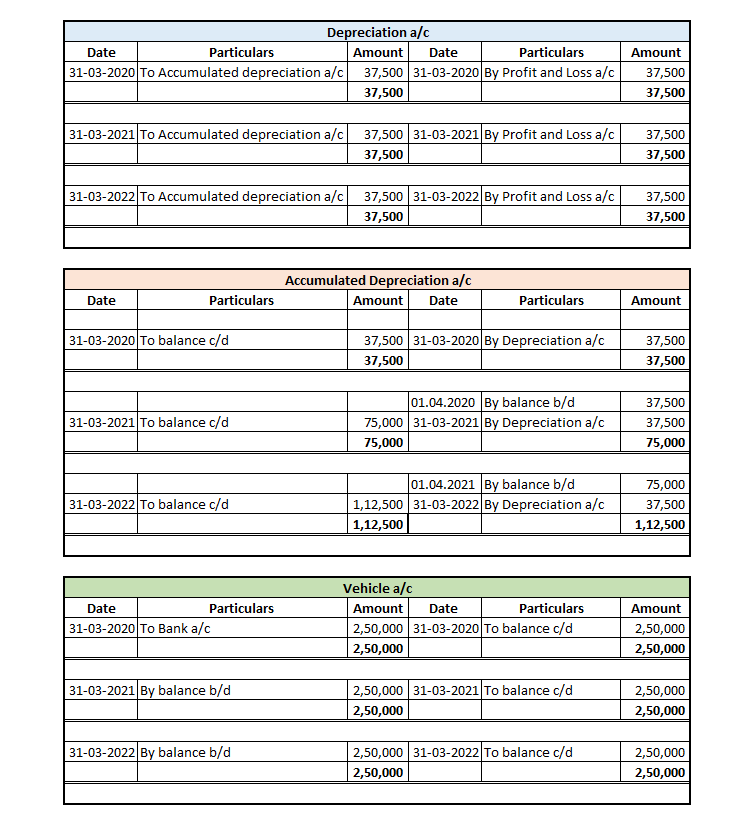
The entries will be posted into depreciation account as mentioned:
| DEPRECIATION A/C | |||||||
| Date | Particulars | Amount | Date | Particulars | Amount | ||
| Year 1 | To Asset A/C | 30,000 | By Profit and Loss A/C | 30,000 | |||
| 30,000 | 30,000 | ||||||
| Year 2 | To Asset A/C | 30,000 | By Profit and Loss A/C | 30,000 | |||
| 30,000 | 30,000 | ||||||
| Year 3 | To Asset A/C | 30,000 | By Profit and Loss A/C | 30,000 | |||
| 30,000 | 30,000 | ||||||
See less




Plant and Machinery are the equipment attached to the earth that supports the manufacturing of the company or its operations. These are tangible non-current assets to the company and as a result, have a debit balance. Depreciation is the decrease in the value of an asset that is spread over the expeRead more
Plant and Machinery are the equipment attached to the earth that supports the manufacturing of the company or its operations. These are tangible non-current assets to the company and as a result, have a debit balance.
Depreciation is the decrease in the value of an asset that is spread over the expected life of the asset. Not depreciating an asset presents a false image of the company as the asset is recorded at a higher value and profit is overstated as depreciation expense is not provided for.
There are two ways that a company provide depreciation:
For most of the depreciation methods, we need a rate to provide for depreciation every year. Now, for accounting purposes, the management can use a rate they think is suitable depending on the use and expected life of the machinery.
Depreciation is calculated on the basis of the Companies act, 2013 for the purpose of book-keeping. According to Schedule 2 of the Companies Act, depreciation on plant and machinery is calculated on the basis of either SLM or WDV.
Plant and machinery for those special rates are not assigned useful life is considered to be 15 years and depreciation is calculated @ 18.10% on WDV and @6.33% on SLM.
According to the Income Tax Act, 15% depreciation is provided every year on Plant and Machinery and, an additional 20% depreciation is provided in the first year of installation of machinery.
Depreciation on Machinery is charged on the basis of usage of such machinery. if it is used for 180 days or more then full depreciation is allowed and if it is used for less than 180 days then only 50% depreciation is allowed.
See less