
Please briefly explain why you feel this question should be reported.

Please briefly explain why you feel this answer should be reported.

Please briefly explain why you feel this user should be reported.

Sign InSign Up

AccountingQA

AccountingQA Logo AccountingQA Logo

AccountingQA Navigation

  • Home
  • Ask Questions
  • Write Answers
  • Explore
  • FAQs
Search
Ask A Question

Mobile menu

Close
Ask a Question
  • Home
  • Questions
    • Most Visited
    • Most Active
    • Trending
    • Recent
  • Follow
    • Categories
    • Users
    • Tags
  • Write an Answer
  • Badges & Points
  • Request New Category
  • Send a Suggestion
  • Search Your Accounting Question..

  • Most Visited
  • Most Voted
  • Followed Questions
  • Most Answered
  • No Answers

AccountingQA Latest Questions

AbhishekBatabyal
AbhishekBatabyalHelpful
In: 1. Financial Accounting > Financial Statements

Where is land on a balance sheet?

  • 1 Answer
  • 0 Followers
Answer
  1. ShreyaSharma none
    Added an answer on August 19, 2022 at 8:30 pm
    This answer was edited.

    Land in the balance sheet The land is an asset and hence it is shown on the asset side of the balance sheet. On the asset side of the balance sheet, the land is stated under the heading long-term assets. Balance Sheet (for the year…) Explanation The land is a fixed asset and is supposed not to be caRead more

    Land in the balance sheet

    The land is an asset and hence it is shown on the asset side of the balance sheet.

    On the asset side of the balance sheet, the land is stated under the heading long-term assets.

    Balance Sheet (for the year…)

    Explanation

    The land is a fixed asset and is supposed not to be cashed, consumed, last, sold, or written off within one accounting year and is purchased for long-term use. The fixed assets are also called non-current assets and the reason behind it is that current assets are easily converted into cash within one year and they are not.

    • The sole purpose of buying fixed assets like the land is that they are planned to be used for the long term in order to generate income.
    • Examples of fixed assets – Land, buildings, furniture, plants & equipment, etc.
    • Also called non-current assets and capital assets.


    Why is it shown on the asset side?

    The land is an asset, although it is not depreciable it is still considered to be an asset because just like other assets the business spends its own money to acquire it, and it gives them a long-term benefit while reselling it.

    Therefore, the land is shown on the asset side under the fixed asset heading.

    See less
    • 0
    • Share
      Share
      • Share on Facebook
      • Share on Twitter
      • Share on LinkedIn
      • Share on WhatsApp
Simerpreet
SimerpreetHelpful
In: 1. Financial Accounting > Financial Statements

What is debit side of trading account?

  • 1 Answer
  • 0 Followers
Answer
  1. Kajal
    Added an answer on September 20, 2023 at 4:41 pm
    This answer was edited.

    Trading A/c is a nominal account which follows the rule "Debit all expenses and losses, Credit all incomes and gains". So, all expenses relating to the purchase or manufacturing of goods are shown on the debit side of the Trading A/c. It includes Opening Stock, Purchases, Wages, Carriage Inward, ManRead more

    Trading A/c is a nominal account which follows the rule “Debit all expenses and losses, Credit all incomes and gains”.

    So, all expenses relating to the purchase or manufacturing of goods are shown on the debit side of the Trading A/c. It includes Opening Stock, Purchases, Wages, Carriage Inward, Manufacturing Expenses, Dock charges, and other direct expenses that are directly related to the manufacturing or purchase.


    TRADING ACCOUNT

    Trading A/c is prepared for calculating the Gross Profit or Gross Loss arising from the trading activities of a business.

    Trading activities are mostly related to buying and selling of goods. However, in between buying and selling, a lot of activities are involved like transportation, warehousing, etc. So, all the expenses that are directly related to manufacturing or purchase of goods are also recorded in the Trading A/c.
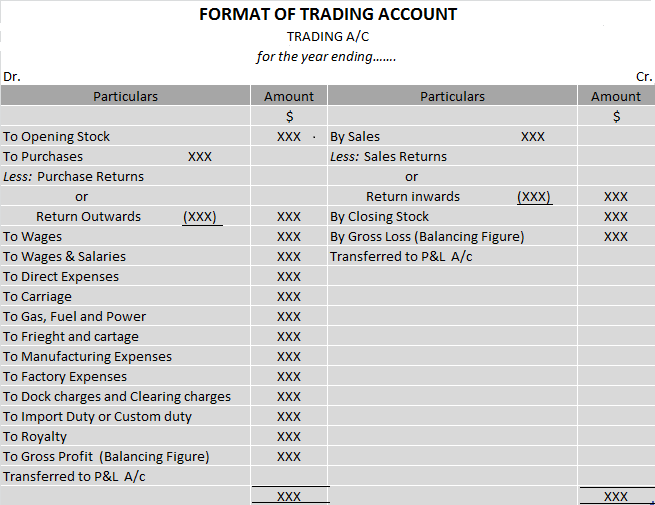


    DEBIT SIDE OF TRADING A/C

    The items shown on the Dr. side are,

    OPENING STOCK – Stock is nothing but goods that are either obtained for resale or manufactured for sale and are yet unsold on any particular date.

    The value of stock at the beginning of an accounting year is called Opening stock while the value of the stock at the end of an accounting year is called closing stock.

    The closing stock of the last year becomes the opening stock of the current year.

    Opening stock includes,

    1. Opening Stock of Raw materials
    2. Opening Stock of Semi-finished goods
    3. Opening Stock of Finished goods

    For example – Suppose you are in the business of manufacturing and trading shirts. On 31st March 2023, there was unused raw material worth $10,000 and shirts worth $50,000 remained unsold.

    So, we have Closing Stock of Raw material – $10,000

    Closing Stock of Finished Goods – $50,000

    This closing stock of last year becomes your opening stock during the current year i.e. on 1st April 2023, we have

    Opening Stock of raw material – $10,000

    Opening Stock of Finished Goods – $50,000

    PURCHASES – Goods that have been bought for resale or raw materials purchased for manufacturing the product are terms as Purchases. These goods must be related to the business you are doing.

    It includes cash as well as credit Purchases.

    Continuing with the above example, suppose you bought raw material worth $ 1,00,000 for manufacturing and shirts worth $50,000 for resale (and not for personal consumption) then both these will be termed as purchases for you. So, your purchases will be $1,50,000 ($1,00,000 + $50,000)

    PURCHASES RETURN – When goods bought are returned to the suppliers due to any reason. This is known as Purchase return. Purchase return is deducted from the Purchases.

    In the above example, you bought shirts worth $50,000 for resale. Out of which shirts worth $20,000 were defective. So, you returned them to the supplier. This return of $20,000 is your purchase return or return outwards (as goods are going out)

    WAGES – Wages are paid to the workers who are directly engaged in the loading, unloading and production of goods.

    For example – Paid $10,000 to workers for manufacturing shirts.

    However, it would be included in Trading A/c only if the wages are paid for work which is directly related to the manufacturing or purchase of goods otherwise it will be shown in P&L A/c.

    Suppose you hired a manager to take care of your business and paid him $20,000 as salary. This salary is indeed an expense for the business but is not directly related to the manufacturing of goods. Since it is an indirect expense, it can only be recorded in P&L  A/c and not in the Trading A/c.

    CARRIAGE or CARRIAGE INWARDS or FREIGHT – It refers to the cost of transporting goods from the supplier.

    Suppose, you ordered raw material in bulk which was transported to you by a van and you paid its fare. This fare is nothing but your carriage inwards.

    However, if carriage or freight is paid on bringing an asset, the amount should be added to the asset account and must not be debited to the trading account.

    MANUFACTURING EXPENSES – All expenses incurred in the manufacture of goods such as  Coal, Gas, Fuel, Water, Power, Factory rent, Factory lighting etc.

    DOCK CHARGES – These are charged by port authorities when unloading goods at a dock or wharf. Such charges paid in connection with goods purchased are considered direct expenses and are debited to Trading a/c.

    IMPORT DUTY or CUSTOM DUTY – It is a tax collected on imports and specific exports by a country’s customs authorities. If import duty is paid on the import of goods, then they are shown on the Dr. side of the Trading A/c.

    For example –  Paid $15,000 as import duty for importing shirts for resale.

    ROYALTY – Royalty refers to the amount paid for the use of assets belonging to another person. It includes royalty for the use of intangible assets, such as copyrights, trademarks, or franchisee agreements. It is also paid for the use of natural resources, such as mining leases.

    Royalty is charged to the Trading A/c as it increases the cost of production.

    GROSS PROFIT – When sales exceed the amount of purchases and the expenses directly connected with such purchases i.e. when Credit side> Debit side.


    CREDIT SIDE OF TRADING A/C

    SALES – When goods are sold to earn a profit, it is called sales. It can be cash sales or credit sales.

    SALES RETURN – When the goods sold are returned by the customer, it is known as a sales return. Sales return is deducted from the sales.

    CLOSING STOCK – The goods remaining unsold at the end of the year are termed as closing stock. It is valued at cost price or market price whichever is less.

    GROSS LOSS – If purchases and direct expenses exceed sales, then it is a Gross loss. In other words, when Debit side > Credit side.


    See less
    • 0
    • Share
      Share
      • Share on Facebook
      • Share on Twitter
      • Share on LinkedIn
      • Share on WhatsApp
Rahul_Jose
Rahul_Jose
In: 1. Financial Accounting > Financial Statements

What is the importance of financial reporting?

  • 1 Answer
  • 0 Followers
Answer
  1. Pooja_Parikh Aspiring Chartered Accountant
    Added an answer on December 12, 2021 at 7:33 am

    Financial Reporting is a common practice in accounting where the financial statements of the company are disclosed to present its financial information and performance over a particular period. It is important to know where a company’s money comes from and where it goes. Types of Financial StatementRead more

    Financial Reporting is a common practice in accounting where the financial statements of the company are disclosed to present its financial information and performance over a particular period. It is important to know where a company’s money comes from and where it goes.

    Types of Financial Statements

    There are 4 important types of financial statements such as:

    • Income Statement: This statement summarises a company’s revenue, expenses and profits. It is prepared to calculate the net profit of the company.
    • Balance Sheet: It portrays the company’s assets and liabilities in a statement. This is used to understand the financial position of the company.
    • Statement of Retained Earnings: This statement reveals a company’s changes in equity during an accounting period.
    • Cash Flow Statement: It shows the amount of cash flowing in and out of the business. It is helpful in understanding the liquidity position of the business.

    Importance of Financial Reporting

    • Understanding these financial statements is helpful in making financial decisions. One can identify certain trends and hurdles while analyzing financial statements.
    • It helps the top order management to keep a check on its outstanding debt and how to manage them effectively.
    • Financial reports are also required to be prepared by law for tax purposes. Therefore these statements have to be prepared to calculate taxable income. It also ensures that the companies are compliant with the required laws and regulations.
    • True and accurate financial reporting is also important for potential investors who need to understand the financial performance and position to come to a decision.


    See less
    • 0
    • Share
      Share
      • Share on Facebook
      • Share on Twitter
      • Share on LinkedIn
      • Share on WhatsApp

Sidebar

Question Categories

  • 1. Financial Accounting

      • Accounting Terms & Basics
      • Bank Reconciliation Statement
      • Banks & NBFCs
      • Bills of Exchange
      • Capital & Revenue Expenses
      • Consignment & Hire Purchase
      • Consolidation
      • Contingent Liabilities & Assets
      • Departments & Branches
      • Depreciation & Amortization
      • Financial Statements
      • Goodwill
      • Insurance Accounting
      • Inventory or Stock
      • Investment Accounting
      • Journal Entries
      • Ledger & Trial Balance
      • Liquidation & Amalgamation
      • Miscellaneous
      • Not for Profit Organizations
      • Partnerships
      • Ratios
      • Shares & Debentures
      • Source Documents & Vouchers
      • Subsidiary Books
  • 2. Accounting Standards

      • AS
      • IFRS
      • IndAS
  • 3. Cost & Mgmt Accounting
  • 4. Taxes & Duties

      • GST
      • Income Tax
  • 5. Audit

      • Bank Audit
      • Internal Audit
      • Miscellaneous - Audit
      • Statutory Audit
  • 6. Software & ERPs

      • Tally
  • 7. MS-Excel
  • 8. Interview & Career
  • Top Questions
  • I need 20 journal entries with ledger and trial balance?

  • Can you show 15 transactions with their journal entries, ledger, ...

  • What is furniture purchased for office use journal entry?

  • What is loose tools account and treatment in final accounts?

  • What is the Journal Entry for Closing Stock?

  • What is the journal entry for goods purchased by cheque?

  • What is commission earned but not received journal entry?

  • How to show adjustment of loose tools revalued in final ...

  • What is the journal entry for interest received from bank?

  • Following is the Receipts and Payments Account of Bharti Club ...

Hot Topics

Accounting Policies Accounting Principles Balance Sheet Bank Reconciliation Statement Bill of Exchange Branch Accounting Calls in Advance Capital Capital Expenditure Companies Act Compound Entry Consignment Creditors Current Assets Debit Balance Debtors Depreciation Difference Between Dissolution of Firm Dissolution of Partnership Drawings External Users Fictitious Assets Final Accounts Financial Statements Fixed Assets Fixed Capital Fluctuating Capital Gain Impairment Installation Interest Received in Advance Internal Users Journal Entry Ledger Loose Tools Miscellaneous Expenditure Profit Rent Rent Received in Advance Reserves Revaluation Revenue Expenditure Revenue Reserve Sacrificing Ratio Subscription Subscription Received in Advance Trial Balance Type of Account Uncalled Capital
  • Home
  • Questions
    • Most Visited
    • Most Active
    • Trending
    • Recent
  • Follow
    • Categories
    • Users
    • Tags
  • Write an Answer
  • Badges & Points
  • Request New Category
  • Send a Suggestion

Most Helping Users

Astha

Astha

  • 50,291 Points
Leader
Simerpreet

Simerpreet

  • 72 Points
Helpful
AbhishekBatabyal

AbhishekBatabyal

  • 65 Points
Helpful

Footer

  • About Us
  • Contact Us
  • Pricing
  • Refund
  • Forum Rules & FAQs
  • Terms and Conditions
  • Privacy Policy
  • Career

© 2021 All Rights Reserved
Accounting Capital.