Please briefly explain why you feel this question should be reported.

Please briefly explain why you feel this answer should be reported.

Please briefly explain why you feel this user should be reported.

Sign InSign Up

AccountingQA

AccountingQA Logo AccountingQA Logo

AccountingQA Navigation

  • Home
  • Ask Questions
  • Write Answers
  • Explore
  • FAQs
Search
Ask A Question

Mobile menu

Close
Ask a Question
  • Home
  • Questions
    • Most Visited
    • Most Active
    • Trending
    • Recent
  • Follow
    • Categories
    • Users
    • Tags
  • Write an Answer
  • Badges & Points
  • Request New Category
  • Send a Suggestion
  • Search Your Accounting Question..

  • Most Visited
  • Most Voted
  • Followed Questions
  • Most Answered
  • No Answers

AccountingQA Latest Questions

A_Team
A_Team
In: 1. Financial Accounting > Bank Reconciliation Statement

A Bank Reconciliation Statement is prepared with the help of ?

Bank statement and bank column of cash book Bank statement and cash column of cash book Bank column of cash book and cash column of cash book None of the above

Bank Reconciliation Statement
  • 1 Answer
  • 0 Followers
Answer
  1. Karan B.com and Pursuing ACCA
    Added an answer on July 13, 2021 at 6:08 am
    This answer was edited.

    The correct answer is the 1. Bank statement and bank column of the cash book, because it will help the business to verify whether amounts entered and entries recorded are correct or not. It will also help in verifying the balances of bank statements and cash books whether they tally or not. What isRead more

    The correct answer is the 1. Bank statement and bank column of the cash book, because it will help the business to verify whether amounts entered and entries recorded are correct or not. It will also help in verifying the balances of bank statements and cash books whether they tally or not.

    What is Reconciliation?

    Reconciliation is an accounting procedure that compares two sets of records to check figures are correct and in agreement. Reconciliation can also be used for personal purposes.

    What is a Bank Reconciliation Statement?

    A statement showing causes of disagreement between the balance of bank statement and bank column of the cash book at the end of a specific period is called a Bank Reconciliation Statement.

    Steps in preparation of Bank Reconciliation Statement

    Step 1: Comparing items appearing on the debit and credit sides of the bank statement and bank column of the cash book.

    Step 2: Make a list of missed entries.

    Step 3: Analyse the causes of differences.

    Step 4: Select the date for the preparation of the Bank Reconciliation Statement.

    Step 5: Choose the starting point i.e balance as per cash book or balance as per bank statement.

    Step 6: Adjust the starting point by adding or subtracting the missed entries.

    Step 7: Bank Statement must match with the cash book.

    To prepare a bank reconciliation statement a business will need a bank statement from its bank and cash book which it prepares to record entries.

    See less
    • 0
    • Share
      Share
      • Share on Facebook
      • Share on Twitter
      • Share on LinkedIn
      • Share on WhatsApp
Vijay
VijayCurious
In: 1. Financial Accounting > Miscellaneous

What is useful life of assets as per the Companies Act?

Companies Act
  • 1 Answer
  • 0 Followers
Answer
  1. Naina@123 (B.COM and CMA-Final)
    Added an answer on July 5, 2021 at 6:54 pm
    This answer was edited.

    Simply explaining the meaning of the useful life of an asset, it is nothing but the number of years the asset would remain in the business for purpose of revenue generation, making it more simple, the amount of time an asset is expected to be functional and fit for use.  It is also called economic lRead more

    Simply explaining the meaning of the useful life of an asset, it is nothing but the number of years the asset would remain in the business for purpose of revenue generation, making it more simple, the amount of time an asset is expected to be functional and fit for use.  It is also called economic life or service life

    It is a useful concept in accounting as it is used to work out depreciation. By knowing this useful life of an asset an entity can easily analyze how to allot the initial cost of an asset across the relevant accounting period rather than doing it unfairly manner.

    How do we calculate the useful life of an asset?

    The useful life of an asset is not an accounting policy, but an accounting estimate. calculating useful life is not an exact phenomenon but an estimate that is done because it directly impacts how much an asset is to expense every year.

    Factors affecting “how long an asset is expected to be useful” depends on some stated points as below:

    1. Usage, the more the assets are used, the more quickly it will deteriorate.
    2. Whether the asset is new at the time of purchase or reused model.
    3. Change in technology.

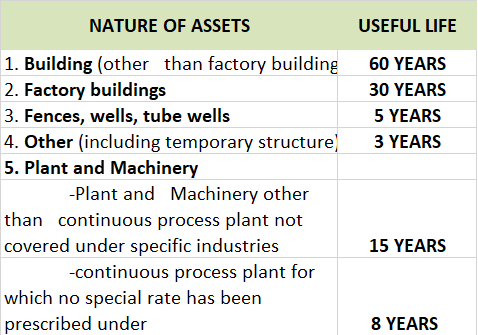
    As per the companies act 2013, some of the useful life of assets are stated below

    To know more about the different categories of assets you can follow the given link useful life of assets.

    POINT TO BE NOTED:- There lies a huge difference in the useful life v/s the physical life of an asset. It is very important to note that amount of time an asset is used in a business is not always be same as an asset’s entire life span.


    See less
    • 1
    • Share
      Share
      • Share on Facebook
      • Share on Twitter
      • Share on LinkedIn
      • Share on WhatsApp
A_Team
A_Team
In: 1. Financial Accounting > Not for Profit Organizations

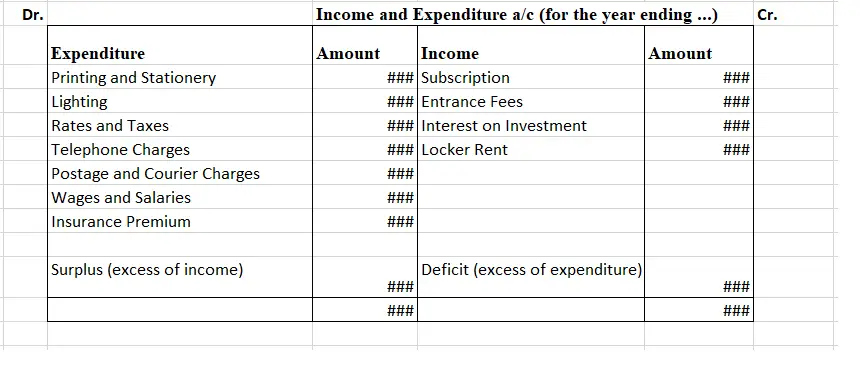
Can I get income and expenditure account of charitable trust in excel?

  • 1 Answer
  • 0 Followers
Answer
  1. GautamSaxena Curious .
    Added an answer on July 14, 2022 at 10:19 pm
    This answer was edited.

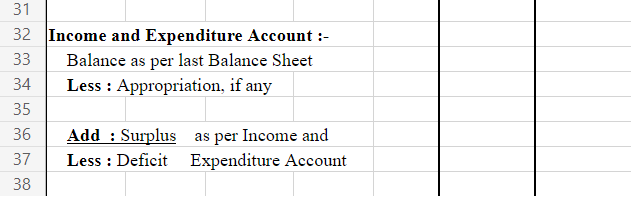
    Income and Expenditure A/c of Charitable Trust Income and Expenditure A/c is like the Profit and Loss A/c in the Balance Sheet of the Charitable Trust. All the income and expenses are, therefore, recorded in this. It is used to determine the surplus or deficit of income over expenditures over a specRead more

    Income and Expenditure A/c of Charitable Trust

    Income and Expenditure A/c is like the Profit and Loss A/c in the Balance Sheet of the Charitable Trust. All the income and expenses are, therefore, recorded in this. It is used to determine the surplus or deficit of income over expenditures over a specific accounting period.

    It shows the summary of all the income and expenditures done by the charitable trust over an accounting year. All the revenue items relating to the current period are shown in this account, the expenses and losses on the expenditure side, and incomes and gains on the income side of the account.


    • Therefore, as you can see here, how a charitable trust may use MS Excel for making their Income and Expenditure A/c, the Surplus and Deficit are the balancing figures used for balancing both the debit and credit sides.

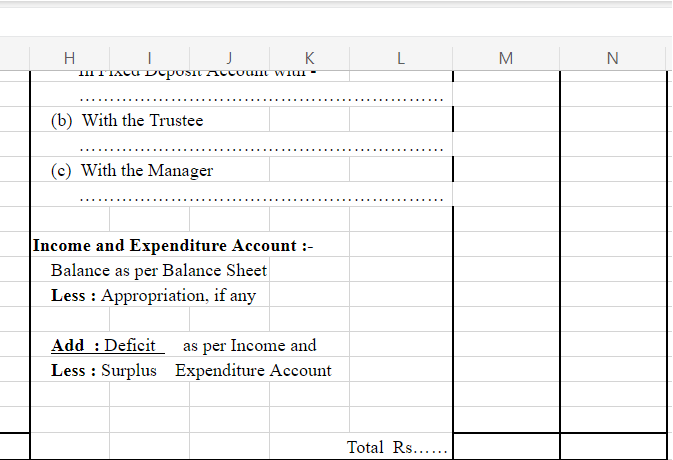
    Later on, they are even used in the Balance Sheet. As follows-

    On the Assets Side 


    On the Liability Side


    See less
    • 0
    • Share
      Share
      • Share on Facebook
      • Share on Twitter
      • Share on LinkedIn
      • Share on WhatsApp
A_Team
A_Team
In: 1. Financial Accounting > Financial Statements

Where does bad debts come in the balance sheet?

  • 6 Answers
  • 0 Followers
Answer
  1. Ishika Pandey Curious ca aspirant
    Added an answer on January 13, 2023 at 7:12 am
    This answer was edited.

    Definition Bad debts are a debt owed to an enterprise that is considered to be irrecoverable or we can say that it is owed to the business that is written off because it is irrecoverable. Bad debts will be treated in the following ways : On the debit side of the profit and loss account. In the curreRead more

    Definition

    Bad debts are a debt owed to an enterprise that is considered to be irrecoverable or we can say that it is owed to the business that is written off because it is irrecoverable.

    Bad debts will be treated in the following ways :

    On the debit side of the profit and loss account.

    In the current assets side of the balance sheet, these are deducted from sundry debtors.

    For example loans from banks are declared as bad debt, sales made on credit and amounts not received from customers, etc.

    Now I will show you an extract of the profit and loss account and balance sheet   

    Current assets are defined as cash and other assets that are expected to be converted into cash or consumed in the production of goods or the rendering of services in the ordinary course of business.

    For example,  debtors exist to convert them into cash i.e., receive the amount from them, bills receivable exist again for receiving cash against it, etc.


    Current liabilities are defined as liabilities that are payable normally within 12 months from the end of the accounting period or in other words which fall due for payment in a relatively short period.

    For example bills payable, short-term loans, etc.


    Accounting treatment

    Now let me try to explain to you the accounting treatment for bad debts which is as follows :

    • Balance sheet
      • In the balance sheet either it can be shown on the asset side under head current assets by reducing from that specific assets.
      • For example, if credit sales are made to a customer who says it’s not recoverable or is partially recoverable then the amount is bad debt. It’s a loss for the business and credited to the personal account of debtors or we can say reduced from debtor those are current assets of the balance sheet.


    • Profit and loss account
      • Bad debts are treated as an expense and debited to the profit and loss account.
      • For example, as I have explained above, but before transferring to the balance sheet, bad debt will be debited to the profit and loss account as an expense.


    Reasons for bad debts

    There are several reasons why businesses may have bad debts some of them are as follows:-

    • Offered credit to customers who were unable to pay them back, or they may have been the victim of fraud.


    • When there is conflicts or dispute arise with respect to product size, color, quality, delivery, credit term, price, etc therefore debts becomes bad.


    • Debtors have poor financial management or they are not able to pay debts on time.


    • Debtors’ unwillingness to pay is also a reason for debts to become bad.


    • Or there can be more cases where debtors are unable to collect debts and debts turns out to be bad.


    Accounting methods

    There are two methods for accounting for bad debts which are mentioned below:-

    • First, is the direct written-off method which states that bad debts will be directly treated as expenses and expensed to the income statement, which is called the profit and loss account.


    • Second, is the allowance method which means we create provisions for doubtful debts accounts and the debtor’s account remains as it is since the debtor’s account and provision for doubtful debts account are two separate accounts.


      • Debts that are doubtful of recovery are provided estimating the debts that may not be recovered .amount debited to the profit and loss account reduces the current year’s profit and the amount of provision is carried forward to the next year.
      • Next year, when debts actually become bad debts and are written off, the amount of bad debts is transferred ( debited ) to the provision for doubtful debts account.
      • The amount of bad debts is not debited to the profit and loss account since it was already debited in earlier years.
      • Provision for doubtful debts is shown in the debit side of the profit and loss account as well as shown as a deduction from sundry debtors in the assets side of the balance sheet. 


    Related terms

    So there are a few related terms whose meanings you should know

    • Further bad debts :
      • It means the amount of sundry debtors in the trial balance is before the deduction of bad debts. in this situation, entry for further bad debts is also passed into the books of account.
      • That is bad debts are debited and the debtor’s account is credited. And the accounting treatment for them is the same as bad debts which I have shown you above.


    • Bad debts recovered :
      • It may happen that the amount written off as bad debts is recovered fully or partially.
      • In that case, the amount is not credited to the debtor’s (personal) account but is credited to the bad debts recovered account because the amount recovered had been earlier written off as a loss.
      • Thus amount recovered is a ‘gain’  and is credited to the profit and loss account.


    See less
    • 0
    • Share
      Share
      • Share on Facebook
      • Share on Twitter
      • Share on LinkedIn
      • Share on WhatsApp
Manvi
Manvi
In: 1. Financial Accounting > Accounting Terms & Basics

Who are external users of accounting information?

External Users
  • 1 Answer
  • 0 Followers
Answer
  1. Karan B.com and Pursuing ACCA
    Added an answer on July 8, 2021 at 2:33 pm
    This answer was edited.

    External users are people outside the business or entity who use accounting information. They do not have a direct link with the organization but can influence or can be influenced by the organization's activities. For example - Tax Authorities, Banks, Customers, Trade Unions, Government, Investors,Read more

    External users are people outside the business or entity who use accounting information. They do not have a direct link with the organization but can influence or can be influenced by the organization’s activities.

    For example – Tax Authorities, Banks, Customers, Trade Unions, Government, Investors, or Creditors.

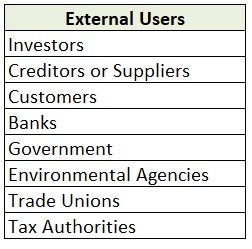
    External Users:

    • Investors – Investors are interested in the past performance and future earnings of the business. They want to track the performance of their business whether it is giving them any benefit or not. A business’s past information helps investors in assessing their investments.
    • Creditors or Suppliers – Some suppliers provide goods and services on credit, and before providing any credit they check the company’s ability to pay. Creditors are interested in the company’s liquidity i.e to see if a company can fulfill short-term obligations.
    • Customers – Customers are more interested in a company’s financial statement as they rely on them for goods and services. They check the ability of the company whether it is providing them good quality goods and will continue to provide them in future.
    • Banks – Banks are most likely interested in the liquidity and profitability of the company. They keep track of whether the company can pay the debt when it is due along with interest.
    • Government – The company’s activities are central to the economy and must be met by them. The government controls a company’s actions if they break a law or damage the environment.
    • Environmental agencies – They keep an eye on organizations whether their activities are harming the environment or not.
    • Trade unions – They take an active part in the decision-making process. They want to see the financial statements of the company and want to decide the compensation of the employees they represent.
    • Tax authorities – They determine whether the business has declared the correct amount of tax in its tax returns. They conduct audits of the tax returns to verify them with the accounting records disclosed.

    Here is a summary of external users

    See less
    • 0
    • Share
      Share
      • Share on Facebook
      • Share on Twitter
      • Share on LinkedIn
      • Share on WhatsApp
Nistha
Nistha
In: 1. Financial Accounting > Journal Entries

What is dividend paid journal entry?

Journal Entry
  • 1 Answer
  • 0 Followers
Answer
  1. Radhika
    Added an answer on November 18, 2021 at 7:48 am
    This answer was edited.

    When a company earns profit, it distributes a proportion of its income to its shareholders, and such distribution is called the dividend. The dividend is allocated as a fixed amount per share and shareholders receive dividends proportional to their shareholdings. However, a company can only pay diviRead more

    When a company earns profit, it distributes a proportion of its income to its shareholders, and such distribution is called the dividend. The dividend is allocated as a fixed amount per share and shareholders receive dividends proportional to their shareholdings.

    However, a company can only pay dividends out of its current year profits or retained earnings (profits of the company that are not distributed as dividend and retained in the business is called retained earnings) of previous years but not out of capital.

    Dividends can be paid to shareholders in the form of

    • Cash
    • dividend re-investing plan of the company
    • future shares
    • share repurchase.

    For companies, payment of regular dividends boosts the morale of the shareholders, investors trust the companies more and it reflects positively on the share price of the company.

    For example, Nestle in India paid an interim dividend of 1100.00% to its shareholders in 2021.

    The journal entry for dividend paid is

    Particulars Debit Credit
    Retained Earnings A/c                                                          Dr. Amt  
    To Cash A/c   Amt


    According to the golden rules of accounting-

    • Retained earnings is a credit account by nature and since dividends are paid from retained earnings resulting in a deduction of the account, we debit
    • Cash is credited because the account is debit in nature and since dividends are paid in cash it’s credited to present the deduction in the account.

    According to modern rules of accounting-

    • Since cash is decreasing, we credit
    • Since retained earnings are decreasing and it is a part of capital it should be

    For example-

    A company paid a dividend of 25 crores to its shareholders in cash, the journal entry according to golden rules will be-

    Particulars Debit

    (in crores)

    Credit

    (in crores)

    Retained Earnings A/c  (Dr.) 25  
    To Cash A/c   25


    See less
    • 0
    • Share
      Share
      • Share on Facebook
      • Share on Twitter
      • Share on LinkedIn
      • Share on WhatsApp
Simerpreet
SimerpreetHelpful
In: 1. Financial Accounting > Bills of Exchange

Bill of exchange format 12th commerce?

Bill of Exchange
  • 1 Answer
  • 0 Followers
Answer
  1. Sandy CMA Final
    Added an answer on July 13, 2021 at 2:17 pm
    This answer was edited.

    Specimen of Bill of Exchange Important points of Bill of Exchange: Date: When a bill of exchange is drawn, the drawer has to specify the date in the top right corner. The date is important for the purpose of calculating the due date of the bill. Generally, the drawee is given three days as a grace pRead more

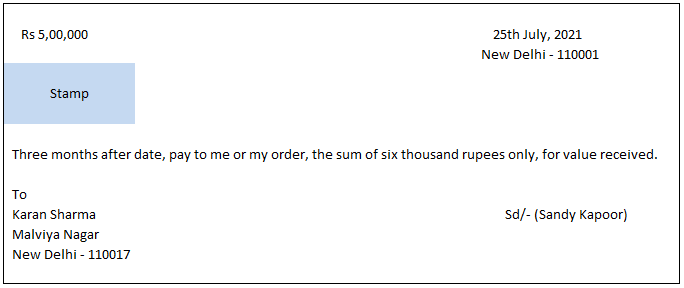
    Specimen of Bill of Exchange

    Important points of Bill of Exchange:

    Date: When a bill of exchange is drawn, the drawer has to specify the date in the top right corner. The date is important for the purpose of calculating the due date of the bill. Generally, the drawee is given three days as a grace period over and above the due date of maturity.

    In the above specimen, the date mentioned is 25th July 2021, so the due date will be three months + 3 days( grace period) i.e. to say  28th October 2021.

    Term: In the above, the term as agreed by the drawer and drawee is 3 months. So the maturity date will be after 3 months.

    Stamp: The Stamp is affixed in the left corner in every bill of exchange, the value of which depends upon the amount specified in the bill.

    Parties involved in Bill of Exchange:

    1. Drawer: The one who makes the bill, i.e. the creditor.
    2. Drawee: The one on whom the bill is drawn, i.e. the debtor.
    3. Payee: The one to whom the amount is to be paid is the payee.

    Sometimes, the drawer and the payee are the same people.

    For Example,

    i) A bill of exchange for Rs 10,000 is drawn by Sandy on Karan which is due after three months. Karan accepted the bill which is met at maturity and hence becomes the acceptor of the bill by putting his signature.

    Here, Sandy is the drawer and Karan is the drawee. As the payment on maturity is received by Sandy so the payee will be Sandy.

    ii) A bill of exchange for Rs 10,000 is drawn by Sandy on Karan which is due after three months. Karan accepted the bill. Thereafter Sandy endorsed the bill in favor of his creditor, Vikash. The bill is met at maturity.

    So in this case, Sandy is the drawer, Karan is the drawee and Vikash is the payee as he received the amount at maturity.

    Acceptance: Acceptance by the drawee is given on the face of the bill as-

    Meaning of BOE:

    In a business, in the case of credit sales, the payment is received after a certain period of time. In such a case the seller i.e. the creditor makes a credit note and the purchaser i.e. the debtor accepts the same by giving his acceptance by signing the instrument, to pay the amount of money mentioned to a certain person or the bearer of the instrument.

    It is generally a negotiable instrument i.e. can be transferred from one person to another.

    Features of Bill of Exchange.

    1. It is a written document.
    2. It is an unconditional order to pay.
    3. It must be signed by the maker of the bill i.e. the drawer.
    4. It must be properly stamped.
    5. The amount is payable either to a specified person or to his order or to the bearer.
    6. It contains an order to pay the amount mentioned in the instrument both in figures and words.
    7. The amount is to be paid either on the expiry of a fixed period from the date of the bill or on-demand.


    See less
    • 0
    • Share
      Share
      • Share on Facebook
      • Share on Twitter
      • Share on LinkedIn
      • Share on WhatsApp
Radha
Radha
In: 1. Financial Accounting > Financial Statements

Internal analysis of financial statements is done by?

(a) Potential investors (b) The owners or managers of the concern (c) Creditors and Lenders (d) Government​

  • 1 Answer
  • 0 Followers
Answer
  1. Simerpreet Helpful CMA Inter qualified
    Added an answer on July 27, 2021 at 4:12 pm

    The correct option is (b) and (d) As the internal analysis is done for the internal assessment of the firm, only those persons can carry out the assessment who has access to the internal accounting records of a business firm. As the owners or managers are the members of the top-level management execRead more

    The correct option is (b) and (d)

    As the internal analysis is done for the internal assessment of the firm, only those persons can carry out the assessment who has access to the internal accounting records of a business firm. As the owners or managers are the members of the top-level management executives they can carry out the work of internal analysis. Also, the government agencies can carry out internal analysis as they have been given the statutory powers of doing such works.

    To make it clear, let me explain a little about internal analysis-

    To determine the profitability of various activities and operations or to know the performance of the business concern, the top-level executives along with the management accountant carry out an internal assessment of the financial statements within the concern, this process is known as internal analysis.


    See less
    • 0
    • Share
      Share
      • Share on Facebook
      • Share on Twitter
      • Share on LinkedIn
      • Share on WhatsApp
Simerpreet
SimerpreetHelpful
In: 1. Financial Accounting > Accounting Terms & Basics

What is Impairment of Assets?

Impairment
  • 1 Answer
  • 0 Followers
Answer
  1. Astha Leader Pursuing CA, BCom (Hons.)
    Added an answer on June 5, 2021 at 1:47 pm
    This answer was edited.

    What is Impairment of Assets? Impairment of assets means a decline in the value of assets due to unforeseen circumstances. Assets are impaired when the carrying value of assets increases its market value or “realizable value”. Impairment can be caused due to factors that are internal or external toRead more

    What is Impairment of Assets?

    Impairment of assets means a decline in the value of assets due to unforeseen circumstances. Assets are impaired when the carrying value of assets increases its market value or “realizable value”.

    Impairment can be caused due to factors that are internal or external to the firm. Internal factors such as physical damage, obsolescence or poor management and external factors such as a change in legal or economic circumstances, increased competition or reduction in asset’s fair value in the market result in impairment.

    Impairment Vs Depreciation

    Asset impairment is often confused with asset depreciation, which is rather a recurring and expected event, unlike impairment that reflects an abrupt decrease in the value of the asset.

    Impairment Loss

    Impairment is always treated as a loss in accounting. It is the amount by which the carrying value or the asset’s book value exceeds its fair market value.

    Before recording Impairment loss, a company must determine the recoverable value of the asset which is higher of the asset’s net realizable value or value in use. Then it is to be compared with the book value of the asset.

    If the carrying value exceeds the recoverable value then the impairment loss is to be recorded at the exceeding value i.e. difference of carrying value and realizable value.

    Example

    Suppose a company Royal Ltd. has an asset with a carrying value of 50,000, which has suffered physical damage. According to the company’s calculation, the asset has a net realizable value of 30,000 and a value in use of 25,000.

    Then, the recoverable value would be higher of the asset’s net realizable value or value in use, i.e., 30,000 which is still lower than the carrying amount of 50,000. Therefore, Royal ltd. will have to record 20,000 (50,000-30,000) as impairment loss.

    This is will increase Royal Ltd’s expenses by 20,000 and decrease the asset’s value by the same amount.

    See less
    • 0
    • Share
      Share
      • Share on Facebook
      • Share on Twitter
      • Share on LinkedIn
      • Share on WhatsApp
Karan
Karan
In: 1. Financial Accounting > Goodwill

Is goodwill fictitious asset?

  • 1 Answer
  • 0 Followers
Answer
  1. Pooja_Parikh Aspiring Chartered Accountant
    Added an answer on December 8, 2021 at 7:10 pm

    No, Goodwill cannot be called a fictitious asset. A fictitious asset does not have any physical existence or realizable value. Although it is recorded in the assets column, it is not really an asset, rather it is an expense that is incurred during the accounting period. Its benefit, however, is realRead more

    No, Goodwill cannot be called a fictitious asset.

    A fictitious asset does not have any physical existence or realizable value. Although it is recorded in the assets column, it is not really an asset, rather it is an expense that is incurred during the accounting period. Its benefit, however, is realized for extended periods. This is why they are recorded as assets. They are recorded in a single year and are amortized over the years. A fictitious asset is neither tangible nor intangible.

    Examples of Fictitious Assets

    • Preliminary expenses
    • Promotional expenses
    • Discount on issue of shares/debentures etc.

    Now, goodwill is an intangible asset that relates to the purchase of a company. It is the amount that a company pays over the net worth of the company being purchased. This can be because of its brand value, good customer base, etc. As a company’s reputation improves, its goodwill increases accordingly. Therefore, It does not have a tangible existence but it does have a monetary value. They are also recorded on the asset side of the balance sheet under the head “Intangible assets”.

    Reason for not being a fictitious asset

    Since goodwill is an asset and not an expense, it cannot be called a fictitious asset. Moreover, goodwill has a realizable value. Unlike fictitious assets, goodwill can be purchased or sold. Therefore, goodwill is termed as an intangible asset but not a fictitious asset. The major difference between an intangible asset and a fictitious asset is:

    See less
    • 0
    • Share
      Share
      • Share on Facebook
      • Share on Twitter
      • Share on LinkedIn
      • Share on WhatsApp

Sidebar

Question Categories

  • 1. Financial Accounting

      • Accounting Terms & Basics
      • Bank Reconciliation Statement
      • Banks & NBFCs
      • Bills of Exchange
      • Capital & Revenue Expenses
      • Consignment & Hire Purchase
      • Consolidation
      • Contingent Liabilities & Assets
      • Departments & Branches
      • Depreciation & Amortization
      • Financial Statements
      • Goodwill
      • Insurance Accounting
      • Inventory or Stock
      • Investment Accounting
      • Journal Entries
      • Ledger & Trial Balance
      • Liquidation & Amalgamation
      • Miscellaneous
      • Not for Profit Organizations
      • Partnerships
      • Ratios
      • Shares & Debentures
      • Source Documents & Vouchers
      • Subsidiary Books
  • 2. Accounting Standards

      • AS
      • IFRS
      • IndAS
  • 3. Cost & Mgmt Accounting
  • 4. Taxes & Duties

      • GST
      • Income Tax
  • 5. Audit

      • Bank Audit
      • Internal Audit
      • Miscellaneous - Audit
      • Statutory Audit
  • 6. Software & ERPs

      • Tally
  • 7. MS-Excel
  • 8. Interview & Career
  • Top Questions
  • I need 20 journal entries with ledger and trial balance?

  • Can you show 15 transactions with their journal entries, ledger, ...

  • What is furniture purchased for office use journal entry?

  • What is loose tools account and treatment in final accounts?

  • What is the Journal Entry for Closing Stock?

  • What is the journal entry for goods purchased by cheque?

  • What is commission earned but not received journal entry?

  • How to show adjustment of loose tools revalued in final ...

  • What is the journal entry for interest received from bank?

  • Following is the Receipts and Payments Account of Bharti Club ...

Hot Topics

Accounting Policies Accounting Principles Balance Sheet Bank Reconciliation Statement Bill of Exchange Branch Accounting Calls in Advance Capital Capital Expenditure Companies Act Compound Entry Consignment Creditors Current Assets Debit Balance Debtors Depreciation Difference Between Dissolution of Firm Dissolution of Partnership Drawings External Users Fictitious Assets Final Accounts Financial Statements Fixed Assets Fixed Capital Fluctuating Capital Gain Impairment Installation Interest Received in Advance Internal Users Journal Entry Ledger Loose Tools Miscellaneous Expenditure Profit Rent Rent Received in Advance Reserves Revaluation Revenue Expenditure Revenue Reserve Sacrificing Ratio Subscription Subscription Received in Advance Trial Balance Type of Account Uncalled Capital
  • Home
  • Questions
    • Most Visited
    • Most Active
    • Trending
    • Recent
  • Follow
    • Categories
    • Users
    • Tags
  • Write an Answer
  • Badges & Points
  • Request New Category
  • Send a Suggestion

Most Helping Users

Astha

Astha

  • 50,291 Points
Leader
Simerpreet

Simerpreet

  • 72 Points
Helpful
AbhishekBatabyal

AbhishekBatabyal

  • 65 Points
Helpful

Footer

  • About Us
  • Contact Us
  • Pricing
  • Refund
  • Forum Rules & FAQs
  • Terms and Conditions
  • Privacy Policy
  • Career

© 2021 All Rights Reserved
Accounting Capital.