


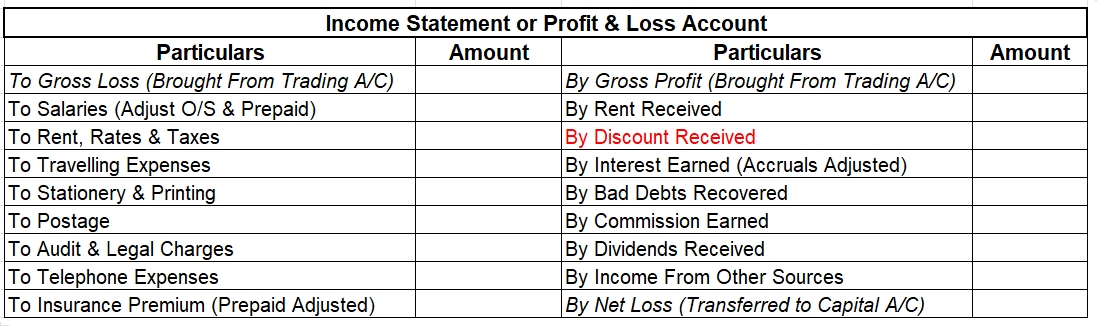
Discount received is the reduction in the price of the goods and services which is received by the buyer from the seller. It is an income for the buyer and is credited to the discount received account and credited to the seller/supplier’s account. Journal entry for discount received as per modern ruRead more
Discount received is the reduction in the price of the goods and services which is received by the buyer from the seller. It is an income for the buyer and is credited to the discount received account and credited to the seller/supplier’s account.
Journal entry for discount received as per modern rules:
| Creditor’s A/c | Debit | Decrease in liability |
| To Cash A/c | Credit | Decrease in asset |
| To Discount Received A/c | Credit | Increase in income |
| (Being goods purchased and discount received) |
Discount allowed is the reduction in the price of the goods which is granted by the seller to the buyer on prompt payment of their account. It is an expense for the seller and is debited to the discount allowed account and credited to the buyer’s account.
Journal entry for discount allowed as per modern rules:
| Cash A/c | Debit | Increase in asset |
| Discount Allowed A/c | Debit | Increase in expense |
| To Debtor’s A/c | Credit | Decrease in asset |
| (Being goods sold and discount allowed) |
For example, A Ltd. offers a 10% discount to the customers who settle their debts within two weeks. Mr.B a customer purchased goods worth Rs.20,000.
According to modern rules, A Ltd will record this sale as:
| Particulars | Amt | Amt |
| Cash A/c Dr. | 8,000 | |
| Discount Allowed A/c Dr. | 2,000 | |
| To Mr.B’s A/c | 10,000 |
Mr.B will record this purchase as:
| Particulars | Amt | Amt |
| A Ltd A/c Dr. | 10,000 | |
| To Cash A/c | 8,000 | |
| To Discount Received A/c | 2,000 |
For a business, the discount received is an income, and the discount allowed is an expense. In the above example, A Ltd has granted a discount and B is the receiver of the discount. Hence, for A Ltd discount allowed is an expense and for B discount received is an income.
See less








Provisional financial statements are prepared on the basis of past data i.e. for the period which is already over. For example, the bank requested for Q4 financial statement but there were still 15 days left for the quarter to get over. In this case, the business/company will prepare a provisional fRead more
Provisional financial statements are prepared on the basis of past data i.e. for the period which is already over. For example, the bank requested for Q4 financial statement but there were still 15 days left for the quarter to get over. In this case, the business/company will prepare a provisional financial statement.
Provisional financial statements can be requested by banks, investors, and large vendors while making decisions regarding business and want current financial statements which can be obtained easily.
It is prepared with the help of past actual figures on a particular date or before the end of a financial statement. The main purpose of preparing is to show the company’s financial position on a particular date. Items of the provisional financial statement are assets, liabilities, and equity/capital.
See less