


When the Accumulated depreciation account is not maintained, the journal entry for vehicle depreciation shall be Particulars Debit Credit Depreciation a/c Dr. (xxx) To Vehicle a/c (xxx) (Being DepreciationRead more
When the Accumulated depreciation account is not maintained, the journal entry for vehicle depreciation shall be
| Particulars | Debit | Credit |
| Depreciation a/c Dr. | (xxx) | |
| To Vehicle a/c | (xxx) | |
| (Being Depreciation charge on Vehicle made) |
For example, let us assume that a vehicle (Bike) was purchased on 1st April 2019 with INR. 2,50,000, the rate of depreciation is 15% and also the Company follows the straight-line method of calculating depreciation.
Then the journal entries shall be,
The depreciation charge for the 1st Year
| Date | Particulars | Debit | Credit |
| 31-03-2020 | Depreciation a/c Dr. | 37,500 | |
| To Vehicle a/c | 37,500 | ||
| (Being Depreciation made on Vehicle) |
The depreciation charge for the 2nd Year
| Date | Particulars | Debit | Credit |
| 31-03-2021 | Depreciation a/c Dr. | 37,500 | |
| To Vehicle a/c | 37,500 | ||
| (Being Depreciation made on Vehicle) |
The depreciation charge for the 3rd Year
| Date | Particulars | Debit | Credit |
| 31-03-2022 | Depreciation a/c Dr. | 37,500 | |
| To Vehicle a/c | 37,500 | ||
| (Being Depreciation made on Vehicle) |
The respective ledger accounts for all three years are given below:
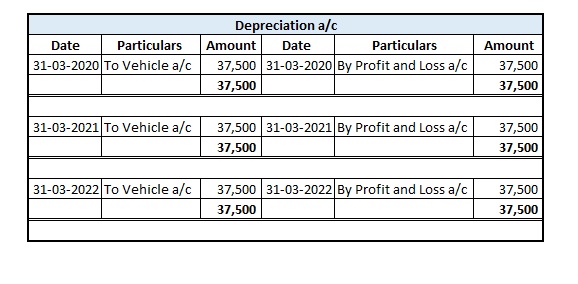
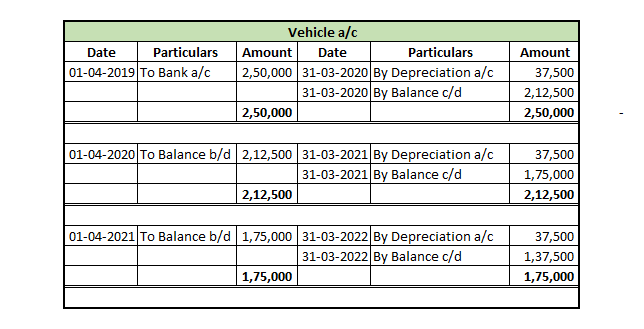
When the Accumulated depreciation account is maintained, the journal entry for vehicle depreciation shall be
| Particulars | Debit | Credit |
| Depreciation a/c Dr. | (xxx) | |
| To Accumulated depreciation a/c | (xxx) | |
| (Being Depreciation charge on Vehicle made) |
Taking the above said example,
The depreciation charge for the 1st Year
| Date | Particulars | Debit | Credit |
| 31-03-2020 | Depreciation a/c Dr. | 37,500 | |
| To accumulated depreciation a/c | 37,500 | ||
| (Being Depreciation made on Vehicle) |
The depreciation charge for the 2nd Year
| Date | Particulars | Debit | Credit |
| 31-03-2021 | Depreciation a/c Dr. | 37,500 | |
| To accumulated depreciation a/c | 37,500 | ||
| (Being Depreciation made on Vehicle) |
The depreciation charge for the 3rd Year
| Date | Particulars | Debit | Credit |
| 31-03-2021 | Depreciation a/c Dr. | 37,500 | |
| To accumulated depreciation a/c | 37,500 | ||
| (Being Depreciation made on Vehicle) |
The respective ledger accounts for all three years are given below:
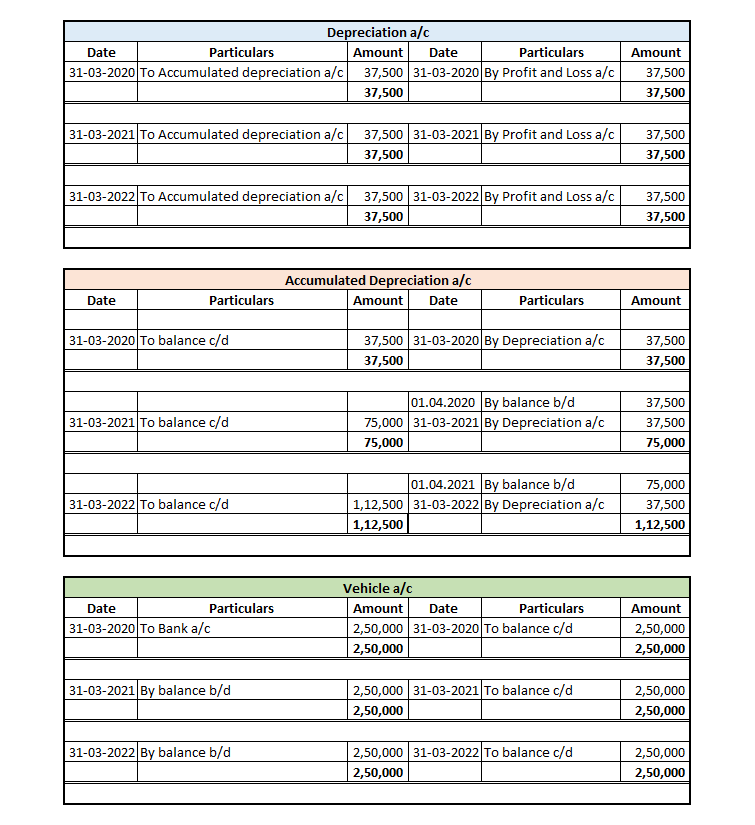
See less







The word, “deferred” means delayed or postponed and “revenue” in layman’s terms means income. Therefore deferred revenue means the revenue which is yet to be recognised as income. It is actually unearned income. In accrual accounting, income is recognised only when it is accrued or earned. DeferredRead more
The word, “deferred” means delayed or postponed and “revenue” in layman’s terms means income. Therefore deferred revenue means the revenue which is yet to be recognised as income. It is actually unearned income.
In accrual accounting, income is recognised only when it is accrued or earned. Deferred revenue is the income received before the performance of the economic activity to earn it.
Example: A shoe shop owner gives an order to a shoe manufacturer of 1000 pair of shoes which is to be delivered after 4 months. He also gives him a cheque of ₹15,000 in advance, the rest ₹5000 is to be given at the time of delivery.
So, in this case, the ₹15,000 is actually is unearned revenue i.e. deferred revenue. It will be recognised as revenue when the shoe manufacture completes the order and deliver it.
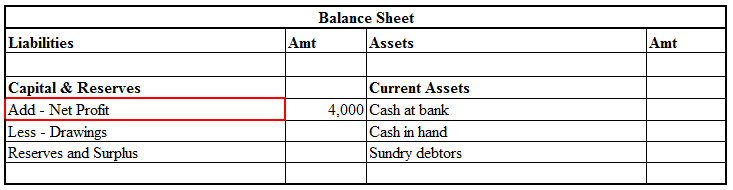
Till then, the deferred revenue is reported as a liability in the balance sheet. Like this:
After recognition as revenue, it will be reported in the statement of profit or loss:
Hence, to summarise, deferred revenue is:
Some examples of deferred revenue are as follows:
Now the question arises why deferred revenue is recognised as a liability. It is due to the fact that the business may not be able to perform the economic activity successfully to earn that revenue.
Taking the above example, suppose the shoe manufacturer is not able to honour its commitment and the shoe shop owner can wait no more, then the advanced money of ₹ 15,000 is to be refunded. That’s why deferred revenue is recognised as a liability because it is a liability if we consider the principle of conservatism (GAAP).

See less