


When a company issues shares to shareholders at a price over the face value (at a premium), that amount is termed as securities premium. This amount is transferred to what we call the securities premium reserve. The company is required to maintain a separate reserve for securities premium. UtilizatiRead more
When a company issues shares to shareholders at a price over the face value (at a premium), that amount is termed as securities premium. This amount is transferred to what we call the securities premium reserve. The company is required to maintain a separate reserve for securities premium.
Utilization
Securities premium reserve can be used for the following reasons:
- Issue of fully paid Bonus share capital.
- To cover preliminary expenses of a company.
- For funding the buy-back of securities.
Since it is not a free reserve, it can only be used for a few specific purposes. The amount received as securities premium cannot be used to transfer dividends to shareholders
Treatment
When a company issues shares at a premium, the securities premium reserve account is credited along with share capital as an increase in capital is credited according to the modern rule of accounting.
For example,
Sonly Ltd. issues 1,000 shares of $10 face value at $15. Here, the amount of premium would be $5 (15 – 10) per share. Therefore, the journal entry would show:
Bank a/c (15 x 1,000) Dr 15,000
To Share Capital (10 x 10,000) 10,000
To Securities Premium Reserve a/c (5 x 10,000) 5,000
From the above example, we can see that the company receives $15,000, but transfers $10,000 to share capital and the excess $5,000 to securities premium reserve.
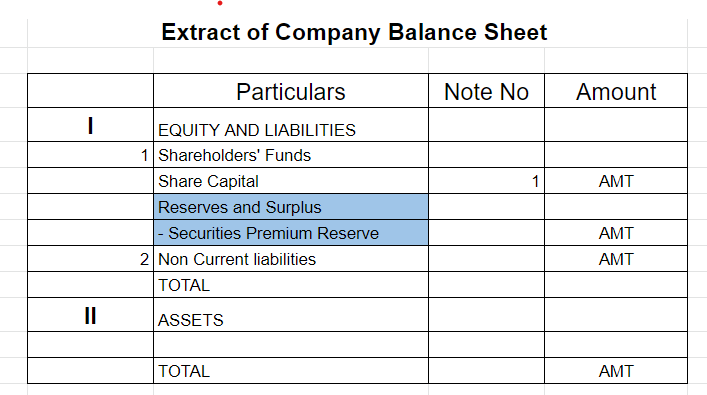
In the balance sheet, this securities premium reserve is shown under the title “Equity and Liabilities” under the head ‘‘Reserves and Surplus”.




















Receipts and payment account is a summary of cash transactions prepared at the end of the accounting period from the cash book where the transactions are recorded in chronological order. It is an Asset/ Real Account that records both revenue and capital receipts and payments. It is mainly prepared fRead more
Receipts and payment account is a summary of cash transactions prepared at the end of the accounting period from the cash book where the transactions are recorded in chronological order. It is an Asset/ Real Account that records both revenue and capital receipts and payments. It is mainly prepared for non-profit organizations and helps in the preparation of final accounts.
Proforma
Income and Expenditure Account is an account prepared by not-for-profit organizations to see whether the income of a particular period is sufficient to cover the expenses of that period. If the revenue is more than the expenses, it is known as “Surplus” or “Excess of Income over Expenditure” and if the expenses are more than Income, it is known as “Deficit” or “Excess of Expenditure over Income”. The account is prepared on the accrual basis of accounting i.e. all revenue incomes whether received or not and all revenue expenditures of the period whether paid or not are taken into account. However, in case of surplus, the money is not distributed among the members. Similarly, if there is a deficit it is not borne by the members.
Proforma

See less