


Financial analysis of a company means analyzing the previous data of the company and giving recommendations based on that whether the company will improve in the future on not. It is the process of evaluating the financial performance and stability of the company. There are various types of financiaRead more
Financial analysis of a company means analyzing the previous data of the company and giving recommendations based on that whether the company will improve in the future on not.
It is the process of evaluating the financial performance and stability of the company.
There are various types of financial analysis. They are leverage, growth, cash flow, liquidity, profitability, etc.
The main objectives of Financial analysis are
1.Reviewing the current position: In order to know if the company is doing well, past analysis of data is required to be carried out. Regular recording of the transactions helps to understand the financial position of the company.
For example, A company wants to generate a revenue of 2000 crores in the next 5 years. The last four years’ data shows revenue as 1100, 1300,1600, 1800 crores respectively.
So from the above, we can say that the company is performing well and looks like it will reach the desired target in the fifth year or may perform better than the target desired.
However, if the revenue declines, it will cause concern for the team but the team will get time to gear up and work efficiently to achieve the desired target.
2. Ease in decision making: For Future decision-making, quarterly financials play an important role. Subsidiary books and accounts like the sales book, purchase orders, manufacturing a/c, etc. help in giving more reliable information.
For example, If sales are increasing inconsistently in a quarter, and in the next quarter the level of sales decrease due to any reason then the management can analyze and change the strategy.
3. Performance Comparison: It helps in comparing the performance of the business every month, quarterly, half-yearly, and yearly. Analyzing the data can help the management to compare if the company is proceeding in the right direction.
4. Assessing the profitability: Financial statements are used to assess the profitability of the firm. The analysis is made through the accounting ratios, trend line, etc. Accounting ratios calculated for a number of years shows the trend of change of position i.e. positive, negative or static. The assessing of the trend helps the management to analyze if the company is making profits or not.
5. Measure the solvency of the firm: Financial analysis helps to measure the short-term and long-term efficiency of the firm for the benefit of the Stakeholders.
6. Helps the end-users: The owners are the end-users for whom the financial statements are prepared. Financial statements are the summaries that are prepared for providing various disclosures to the owners which helps them understand the statements in a better way. If the end-users arrive at the right decision with the help of financial statements that means the objective is achieved.
7. Other objectives:
- It helps to settle disputes among the parties.
- It helps in the expansion decision of the firm.
- It helps in analyzing the amount of tax to be paid.
- It reduces the chances of fraud.
- It provides information about resources.
- It provides a true and fair view of financial position.







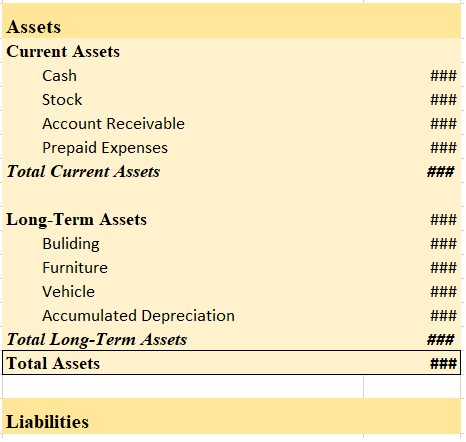





Any person, company, or organization that owes us money is a debtor. The amount that is owed to us is called debt. When you are unsure if a debtor is going to pay back the amount owed to you, then a provision for doubtful debts is created. Here, the debtor may or may not pay back the amount owed. WhRead more
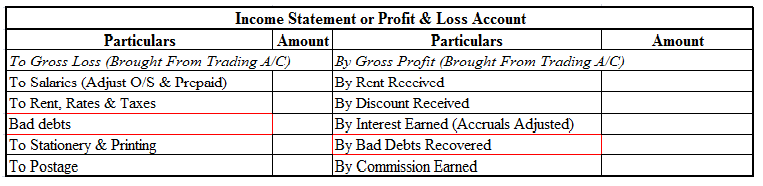
Any person, company, or organization that owes us money is a debtor. The amount that is owed to us is called debt. When you are unsure if a debtor is going to pay back the amount owed to you, then a provision for doubtful debts is created. Here, the debtor may or may not pay back the amount owed. When the debts owed to us is irrecoverable, it is termed as bad debts.
Provision for doubtful debts may become a bad debt at some point. Usually, companies keep a small portion of their debtors as a provision for doubtful debts in accordance with the prudence concept that tells us to account for all possible losses. Provision for doubtful debts is a liability whereas bad debts are recorded as an expense.
Journal entries for Doubtful debts and bad debts are as follows:
EXAMPLE
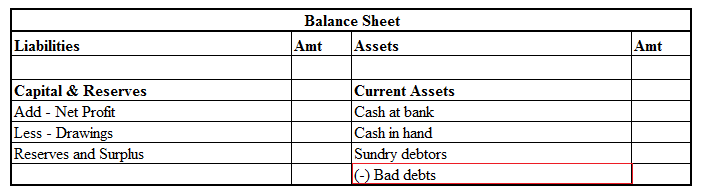
If the balance in the debtors’ account shows an amount of Rs 20,000 and 5% of debtors are treated as doubtful, then Rs 1,000 is recorded as a provision for doubtful debts. This amount is deducted from debtors in the balance sheet.
Now if Rs 400 was recorded as actual bad debts, then it is deducted from the provision for doubtful debts instead of debtors. Further another 400 is added back to provision for doubtful debts to maintain the percentage.
See less