Please briefly explain why you feel this question should be reported.

Please briefly explain why you feel this answer should be reported.

Please briefly explain why you feel this user should be reported.

Sign InSign Up

AccountingQA

AccountingQA Logo AccountingQA Logo

AccountingQA Navigation

  • Home
  • Ask Questions
  • Write Answers
  • Explore
  • FAQs
Search
Ask A Question

Mobile menu

Close
Ask a Question
  • Home
  • Questions
    • Most Visited
    • Most Active
    • Trending
    • Recent
  • Follow
    • Categories
    • Users
    • Tags
  • Write an Answer
  • Badges & Points
  • Request New Category
  • Send a Suggestion
  • Search Your Accounting Question..

  • Most Visited
  • Most Voted
  • Followed Questions
  • Most Answered
  • No Answers

AccountingQA Latest Questions

Anushka Lalwani
Anushka Lalwani
In: 1. Financial Accounting > Miscellaneous

What is revenue reserve?

ReservesRevenue Reserve
  • 1 Answer
  • 0 Followers
Answer
  1. PriyanshiGupta Graduated, B.Com
    Added an answer on November 15, 2021 at 1:31 pm
    This answer was edited.

    Profits earned by a firm are not completely distributed to its owners, some of the profits are retained for various purposes. Reserves are profits that are apportioned or set aside to use in the future for a specific or general purpose. Reserves follow the Conservative Principle of accounting.  ReveRead more

    Profits earned by a firm are not completely distributed to its owners, some of the profits are retained for various purposes. Reserves are profits that are apportioned or set aside to use in the future for a specific or general purpose. Reserves follow the Conservative Principle of accounting. 

    Revenue reserve is created from the net profits of a company during a financial year. Revenue reserve is created from revenue profit that a company earns from the daily operations of the business.

    Various types of reserves are:

    • Capital Redemption Reserve: It is created to issue fully paid bonus shares or reduction of capital in accordance with Article 3 of the Companies Act, 2013.
    • General Reserve: It is a reserve created to provide for various requirements of the company from time to time.
    • Debenture Redemption Reserve: It is required by the Companies Act, 2013 to transfer the amount of debentures that are going to be redeemed in the following year to minimize the risk of default.
    • Securities Premium Reserve: When shares and debentures are issued at a price higher than the book value, then such higher amount is transferred to Securities Premium Reserve
    • Revaluation Reserve: It is created to revalue the assets and liabilities and provide for gain or loss.

    Different parts of profit are apportioned to create a different reserve and those reserves can only be used for purposes as defined.

    While accounting for Revenue Reserve, the profit decided to transfer to Revenue Reserve are first transferred to Profit and Loss Appropriation Account and then to Revenue Reserve Account. In the balance sheet, Revenue Account is shown under the Capital and Reserves head.

    Liabilities Amount Amount
    Share Capital
    Reserve and Surplus
    General Reserve
    Capital Redemption Reserve
    Securities Premium Account
    Profit and Loss Account

    Uses of Revenue Reserve:

    • Revenue Reserves are created to expand business or for meeting contingencies that may arise in the future.
    • It can also be used to distribute dividends or bonus shares to its shareholders.

    Example:

    Given that Revenue Reserve Account stands at Rs 1,00,000 and the company wants to distribute Rs. 40,000 as dividend to its shareholders. The treatment of this transaction in the financial statements will be-

    Particulars                                                                                                                           Amount (Rs.)

    Revenue Reserve Account                                                                                                    1,00,000

    (less) Dividend distributed                                                                                                    (40,000)

    The amount shown in Balance Sheet                                                                                    60,000


    See less
    • 0
    • Share
      Share
      • Share on Facebook
      • Share on Twitter
      • Share on LinkedIn
      • Share on WhatsApp
Radha
Radha
In: 1. Financial Accounting > Miscellaneous

Is capital work in progress a tangible asset?

  • 1 Answer
  • 0 Followers
Answer
  1. PriyanshiGupta Graduated, B.Com
    Added an answer on December 7, 2021 at 4:37 pm
    This answer was edited.

    Yes, Capital Work in Progress is Tangible Asset. To attain an understanding of the same, we first need to understand what are tangible assets. Assets that have a physical existence, that is they can be seen, touched are called Tangible Assets. Capital work in progress is the cost incurred on fixed aRead more

    Yes, Capital Work in Progress is Tangible Asset.

    To attain an understanding of the same, we first need to understand what are tangible assets. Assets that have a physical existence, that is they can be seen, touched are called Tangible Assets.

    Capital work in progress is the cost incurred on fixed assets that are under construction as on the balance sheet date. Since the asset cannot be used for operation it cannot be classified as a Fixed Asset.

    For example:

    If an asset takes 1.5 years to be constructed as on 1.4.2020 then on the balance sheet date 31.3.2021, the cost incurred on the asset will be classified as Capital Work in Progress.

    Common examples of Capital Work in Progress include immovable assets like Plant and Machinery, Buildings.

    It is shown under the head Non-Current Assets in the balance sheet. Examples of cost included in Capital Work in Progress can be:

    • Advance payment to the contractor
    • Material used/purchased
    • Cost of labor incurred, etc.

    Since the assets under the head Capital Work in Progress are in the process of completion and not completed, hence they are not depreciable until completed. Once the asset is completed it is moved under the head Fixed Assets.

    Capital Work in Progress is shown in the Balance Sheet as:


    See less
    • 0
    • Share
      Share
      • Share on Facebook
      • Share on Twitter
      • Share on LinkedIn
      • Share on WhatsApp
Astha
AsthaLeader
In: 1. Financial Accounting > Consignment & Hire Purchase

In accounting Consignment means?

Consignment
  • 1 Answer
  • 0 Followers
Answer
  1. Naina@123 (B.COM and CMA-Final)
    Added an answer on July 17, 2021 at 4:45 am
    This answer was edited.

    Consignment is "goods sent by its owners to his agent for the purpose of sale". In simple language, the word consignment means to send goods to another person for sale on his behalf without transfer of ownership. In accounting terms, consignment is the process where the owner (consignor) transfers tRead more

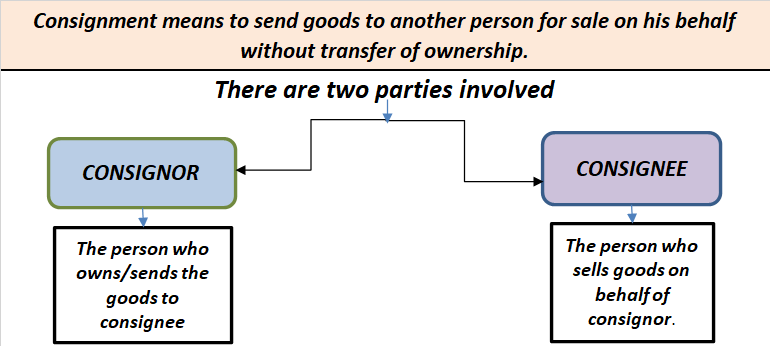
    Consignment is “goods sent by its owners to his agent for the purpose of sale”. In simple language, the word consignment means to send goods to another person for sale on his behalf without transfer of ownership.

    In accounting terms, consignment is the process where the owner (consignor) transfers the possession of the goods to the agent (consignee) to make a sale on his behalf while the ownership of goods remains with the owner until the sale is made by the agent. In return, the agent receives an agreed percentage of the sum in the form of commission. 

    Generally, there are two parties involved in consignment, those are as follows:

    1. CONSIGNOR: the person who is the owner and sender of goods.
    2. CONSIGNEE: the person who receives goods for sale/resale from the consignor in exchange for a percentage of the sale or on an agreed sum known as commission.

    The relationship between consignor and consignee is that of principal and agent.

    Let me give you a simple example of how consignment works.

    Mr. John (consignor) sends goods to Mr. Jeh (consignee) worth Rs 20,000 to sell these goods at a cost plus 10%. Mr. Jeh agrees to sell these goods on his behalf for a commission of 1% on the sale. Therefore Mr. Jeh sold these goods at the agreed amount i.e Rs 22,000 [20,000+ 10% of 20,000] and charges Rs 220 [1% of Rs 22,000] as commission made on such sale and remit the remaining balance to the owner Mr. John.

    There is a lot of confusion regarding “is consignment the same as the sale of goods?“. The answer is NO.

    The reason what makes it different from the sale is

    a) In sale the ownership gets transferred from seller to buyer but in case of consignment the ownership remains with the consignor until the sale is made by the agent.

    b) In sale the risk gets transferred with the transfer of goods, whereas in consignment the risk remains with the owner till the sale is made.

    c) Also goods once sold cannot be returned on damages /defaults, but in case of consignment goods that come to be faulty can be returned to the consignor.

    See less
    • 0
    • Share
      Share
      • Share on Facebook
      • Share on Twitter
      • Share on LinkedIn
      • Share on WhatsApp
Simerpreet
SimerpreetHelpful
In: 1. Financial Accounting > Partnerships

What is recorded in the Realisation account?

  • 1 Answer
  • 0 Followers
Answer
  1. Kajal
    Added an answer on September 29, 2023 at 1:29 pm
    This answer was edited.

    The Realisation account is prepared at the time of dissolution of the Partnership firm to ascertain profit or loss from the sale of assets and payment of liabilities of the firm. All assets that can be converted into cash (i.e. from which any value can be realised) and all external liabilities thatRead more

    The Realisation account is prepared at the time of dissolution of the Partnership firm to ascertain profit or loss from the sale of assets and payment of liabilities of the firm. All assets that can be converted into cash (i.e. from which any value can be realised) and all external liabilities that are to be paid are recorded in the Realisation A/c.


    DISSOLUTION OF PARTNERSHIP FIRM

    It means the firm closes down its business and comes to an end. Simply, it means the firm will cease to exist in the future. As the firm is closing down, it will sell all its assets to realise all the value blocked in the assets, it is liable to pay off all of its liabilities whether due now or on some future date, and the remaining amount (if any) is distributed among the partners.


    REALISATION ACCOUNT

    This account is prepared only once, at the time of dissolution of the Partnership firm. It is opened to dispose of all the assets of the firm and make payments to all the external creditors of the firm.

    It ascertains the profit earned or loss incurred on the realisation of assets and payment of liabilities.

    The Realisation account is a NOMINAL ACCOUNT (Debit all expenses and losses, Credit all incomes and gains)


    ITEMS RECORDED IN THE REALISATION ACCOUNT

    DEBIT SIDE OF REALISATION ACCOUNT

    1. TRANSFER OF ASSETS

    Assets are any property or the possession of the business enterprise that allows it to get cash or any other benefit in the future.

    Since all assets are sold at the time of the dissolution, all assets that can be converted into cash are transferred to the  Debit side of the Realisation A/c at their book values.

    Such as Plant & Machinery, Building, Debtors, etc.

    EXCEPTIONS

    • Cash and Bank balances (as already in the most liquid form)
    • Fictitious assets ( Don’t have any realisable value)


    NOTE – If there is any provision against any asset, such as ‘Provisions for Bad debts’ or ‘Provision for Depreciation, then such assets are transferred to the Debit side of the Realisation A/c at its gross value and the Provision is transferred to the Credit side of the Realisation A/c.

    For example – Suppose there are Debtors of $50,000 and the Provision for Doubtful Debts is $2,000.

    Then, Debtors will be recorded on the Debit side with a value of $50,000 and the Provision for Doubtful Debt on the Credit side with the amount of $2,000.


    2. PAYMENT OF LIABILITIES

    All liabilities are either paid in cash or the Partner agrees to pay for some liabilities. Since they are expenses, they are recorded on the debit side of the Realisation A/c as “Debit all expenses and Losses”


    3. PROFIT ON REALISATION

    There is profit when Cr. side > Dr. side, as it means incomes are more than the payments made. This profit is distributed among the partners.


    CREDIT SIDE OF THE REALISATION ACCOUNT


    1. TRANSFER OF LIABILITIES

    Liabilities refer to the amount owed by the firm to outsiders. All liabilities must be paid off before accounts are closed. So, all external liabilities are transferred to the Credit side of the Realisation account, to make their payment.

    Such as creditors, bills payable, loans, outstanding expenses, partner’s wife’s loan, etc.

    EXCEPTION (not included)

    • Partner’s loan (internal liability and a separate account is created for it)
    • Undistributed Profits (like General reserve, Credit balance of P&L A/c, etc. because they belong to partners and are distributed among them. Also, they can’t be sold)


    2. SALE OF ASSETS

    Assets can be sold for cash or taken by the Partner. The amount received from the sale of assets is recorded on the credit side of the Realisation account as “Credit all incomes and gains”.

    Also, if any asset is given to the creditors in part or full payment of his dues, then the agreed amount is deducted from the creditor’s claim and no other entry is passed.


    3. LOSS ON REALISATION:

    There is a loss, if the Dr. side> Cr. side, which means Expenses > Incomes. This loss is also distributed among the Partners.

    See less
    • 0
    • Share
      Share
      • Share on Facebook
      • Share on Twitter
      • Share on LinkedIn
      • Share on WhatsApp
Simerpreet
SimerpreetHelpful
In: 1. Financial Accounting > Capital & Revenue Expenses

How to know which expense is capital and which is revenue?

Capital ExpenditureRevenue Expenditure
  • 1 Answer
  • 0 Followers
Answer
  1. Astha Leader Pursuing CA, BCom (Hons.)
    Added an answer on June 8, 2021 at 2:42 pm
    This answer was edited.

    Capital Expense Capital expenses are incurred for acquiring assets including incidental expenses. Such expenses increase the revenue earning capacity of the business. These are incurred to acquire, upgrade and maintain long term assets such as buildings, machines, etc and are non-recurring in natureRead more

    Capital Expense

    Capital expenses are incurred for acquiring assets including incidental expenses. Such expenses increase the revenue earning capacity of the business. These are incurred to acquire, upgrade and maintain long term assets such as buildings, machines, etc and are non-recurring in nature.

    Revenue Expenses

    Revenue expenses are incurred to carry on operations of an entity during an accounting period. Such expenses help in maintaining the revenue earning capacity of the business and are recurring in nature.

    These include ordinary repair and maintenance costs necessary to keep an asset working without any substantial improvement that leads to an increase in the useful life of the asset.

    Suppose, company Takeaway ltd. purchases machinery for 50,000 and pays installation charges of 10,000. Salary of 15,000 is paid to the employees and existing machinery is painted costing 8,000. Here, the cost of machinery 50,000 and installation charges of 10,000 are treated as capital expenditure and the salary of 15,000 and painting cost of 8,000 is treated as revenue expenditure.

    Identification

    Points to categorize an expenditure as Capital or Revenue are as follows:

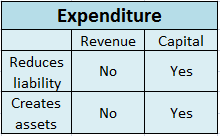
    • An expenditure that neither creates assets nor reduces liability is categorized as revenue expenditure. If it creates an asset or reduces a liability, it is categorized as capital expenditure.

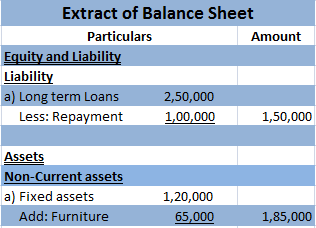
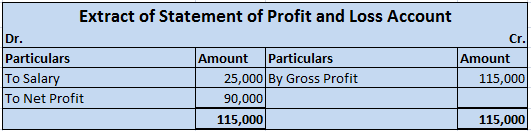
    For example, a company Motors ltd. purchases furniture for 65,000, repays loans amounting to 1,00,000 and pays salary of 25,000.

    Here the company creates an asset of 65,000 and reduces liability by 1,00,000 as shown below and therefore is considered as capital expenditure.

    However, payment of salaries neither creates assets nor reduces liability. It only reduces profits and therefore is considered as revenue expenditure.

    • Usually, the amount of capital expenditure is larger than that of revenue expenditure. But it is not necessary that if the amount is small it is revenue expenditure and if the amount is large, it is a capital expenditure.

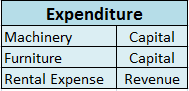
    For example, a company Stars ltd purchases machinery for 1,20,000, furniture for 35,000 and has a rental expense of 80,000.

    Here, the purchase of machinery is capital expenditure since it results in higher expense. However, the purchase of furniture cannot be regarded as a revenue expense and payment of rent cannot be regarded as a capital expense only because the rental expense is higher than the amount expended for the purchase of furniture.

    • Usually, capital expenditure is not frequent and is made at a time, in lump sum. On the other hand, revenue expenditure is paid periodically. However, it is possible that capital expenditure is paid in installments.

    For example, a company Caps ltd. purchases land for 1,00,00,000 on an equal monthly installment basis. Then such payments cannot be considered as revenue expense only because the payments are recurring. Since the installments are paid in lieu of the purchase of land which is a long term asset, the payments will be considered as capital expenditure.

    • Mostly capital expenditures are met out of capital whereas revenue expenditures are met out of revenue receipts. However, payments can be made vice-versa.
    • If an expenditure is incurred by the payer as a capital expenditure, it will remain a capital expenditure even if the amount may be revenue receipt in the hands of the payee.

    For example, a company Marks Ltd. purchases machinery directly from the manufacturer for 50,000. For the manufacturer, the proceeds from the sale of machine are revenue in nature but the amount expended by Marks Ltd. will be categorized as capital expenditure.

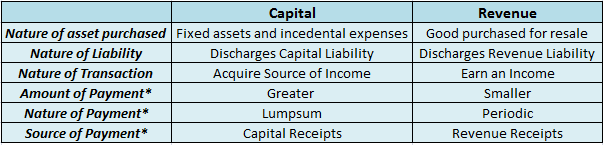
    Following conclusion can be inferred from the above explanation:

    *Such transactions may or may not hold true as explained above.

    See less
    • 0
    • Share
      Share
      • Share on Facebook
      • Share on Twitter
      • Share on LinkedIn
      • Share on WhatsApp
Karan
Karan
In: 1. Financial Accounting > Accounting Terms & Basics

What are sales returns and allowances?

  • 1 Answer
  • 0 Followers
Answer
  1. PriyanshiGupta Graduated, B.Com
    Added an answer on December 9, 2021 at 9:52 am
    This answer was edited.

    Sales return shows the sale price of goods returned by customers. It is deducted from sales or gross sales in the income statement. It is a contra revenue account that represents returns from the customers and deductions to the original selling price, in case of any defective product received by theRead more

    Sales return shows the sale price of goods returned by customers. It is deducted from sales or gross sales in the income statement.

    It is a contra revenue account that represents returns from the customers and deductions to the original selling price, in case of any defective product received by the customer or any other manufacturing default.

    Sales allowances arise when any customer accepts the product at a lower price than the original price or, in other words, a reduction in the price charged by a seller, due to any problem related to the sold product like a quality issue, an incorrect price charged or shipment issue.

    Sales allowances are created before the final billing is paid by the buyer.

    Journal entry for sales return and allowances:

    Dr. Sales return and allowances Amt  
    Cr. Accounts receivable   Amt
    • Sales Return Account is debited because it is reverse of Sales Account which is credited at the time of sale.
    • Account Receivable Account is credited to reverse the debtors debited at the time of sale.
    • Hence Sales Return entry is just reverse of the entry recorded at the time of sale.


    See less
    • 0
    • Share
      Share
      • Share on Facebook
      • Share on Twitter
      • Share on LinkedIn
      • Share on WhatsApp
Simerpreet
SimerpreetHelpful
In: 1. Financial Accounting > Partnerships

What is gain ratio formula?

  • 1 Answer
  • 0 Followers
Answer
  1. Ayushi Curious Pursuing CA
    Added an answer on August 6, 2022 at 6:33 pm
    This answer was edited.

    Introduction The term 'gain ratio' is related to partnership accounting. Gain ratio refers to the ratio in which existing partners of a partnership firm, divide among themselves, the share of profit and loss of the outgoing partners. There is a method of calculating this gain ratio. The method alongRead more

    Introduction

    The term ‘gain ratio’ is related to partnership accounting. Gain ratio refers to the ratio in which existing partners of a partnership firm, divide among themselves, the share of profit and loss of the outgoing partners.

    There is a method of calculating this gain ratio. The method along with the concept behind gain ration is discussed below.

    Concept behind gain ratio

    A partnership firm is a form of business organisation which is conducted and carried on by members known as partners. It requires at least two partners to start a firm and the maximum limit is 50.

    The partners share the profit and loss of a business in a ratio known as Profit and loss sharing ratio.

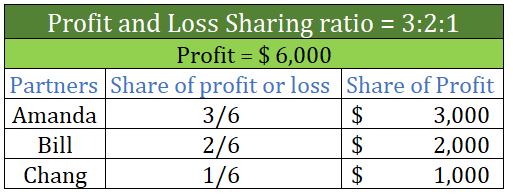
    For example, Amanda, Bill and Chang are partners, having a P/L sharing ratio of 3:2:1 i.e. Amanda is getting 3/6, Bill is getting  2/6 of the same and Chang is getting ⅓ of the profit and loss

    If the profit is $6,000 , then Amanda will get $3,000 (3/6 of $6,000) and Bill will get $2,000 (2/6 of $6,000) and Chang will get $1,000 (1/6 of $6,000).


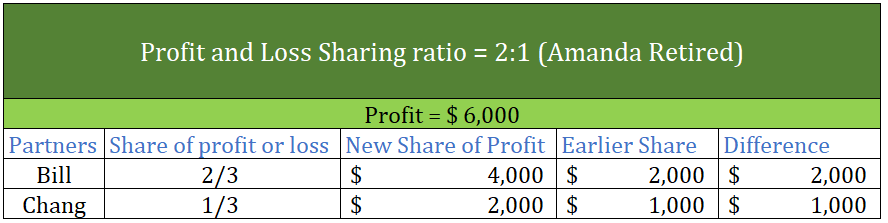
    Now if Amanda retires from the firm, then naturally, Bill and Chang’s share of profit will increase.

    The profit and loss sharing ratio will now be 2:1 (earlier it was 3:2:1) and the share of profit of Bill will be $4,000 and of Chang will be $2,000.


    Calculation of gain ratio

    The formula for calculating gain ratio = New ratio – Old Ratio

    As per the  above case:

    • Gain ratio of Bill = 2/3 – 2/6 = 2/6
    • Gain ratio of Chang = 1/3 – 1/6 = 1/6


    Therefore the gain ratio in which Bill and Chang gained the share of profit of Amanda is 2/6 : 1/6 or simply 2:1

    This is how we can calculate the gain ratio. But one thing to notice is that the gain ratio is equal to the P/L sharing ratio of the partnership between Bill and Chang.

    Hence, whenever a partner retires and the existing partner keep the P/L sharing ratio unchanged among themselves then, the gain ratio will be equal to their P/L sharing ratio. In that case, there is no need to calculate the gain ratio from the formula given above.

    But, when the remaining partners change the P/L sharing ratio among themselves after a partner retires, then the gain ratio is to be calculated using the formula given above.

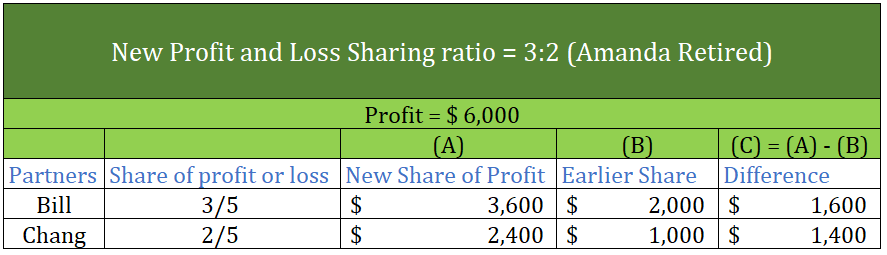
    Suppose, upon retirement of Amanda, Bill and Chang change the P/L sharing between them to from 2:1 to 3:2

     In that case,

    • The gain ratio of Bill = 3/5 – 2/6 = 8/30
    • The gain ratio of Chang = 2/5 – 1/6 = 7/30


     Therefore the gain ratio in which Bill and Chang will gain the share of profit of Amanda is 8/30 : 7/30 or simply 8:7

    See less
    • 0
    • Share
      Share
      • Share on Facebook
      • Share on Twitter
      • Share on LinkedIn
      • Share on WhatsApp
Astha
AsthaLeader
In: 1. Financial Accounting > Capital & Revenue Expenses

What is Capital Expenditure and revenue Expenditure?

Capital ExpenditureRevenue Expenditure
  • 1 Answer
  • 0 Followers
Answer
  1. GautamSaxena Curious .
    Added an answer on August 3, 2022 at 4:46 pm
    This answer was edited.

    Capital Expenditure Capital expenditure refers to the money a business spends to buy, maintain, or improve the quality of its assets. Capital expenditures are the expenses incurred by an organization for long-term benefits, i.e on the long-term assets which help in improving the efficiency or capaciRead more

    Capital Expenditure

    Capital expenditure refers to the money a business spends to buy, maintain, or improve the quality of its assets. Capital expenditures are the expenses incurred by an organization for long-term benefits, i.e on the long-term assets which help in improving the efficiency or capacity of the company. These expenses are borne by the company to boost its earning capacity.

    The investment done by the companies on assets is capital in nature and through capital expenditure, the company may use it for acquiring new assets or may use it in the maintenance of previous ones. These expenditures are added to the asset side of the balance sheet.

    Example: Purchase of machinery, patents, copyrights, installation of equipment, etc.

    Revenue Expenditure

    Revenue expenditure refers to the routine expenditures incurred by the business to manage day-to-day expenses. They are incurred for a shorter duration and are mostly limited to an accounting year. These expenses are borne by a company to sustain its profitability. These expenditures are shown in the income statement.

    These expenditures do not increase the revenue but stay maintained. These expenses are not capitalized.

    They are divided into two sub-categories:

    1. Expenditures for generating revenue for a business- Those expenditures essential for meeting the operational cost of the business are further classified as operating expenses.
    2. Expenditures for maintaining revenue-generating assets- Those expenses incurred by the business for repairing and maintenance of the assets of an organization to keep them in a working state.


    Example: Wages, salary, insurance, rent, electricity, taxes, etc.

    See less
    • 0
    • Share
      Share
      • Share on Facebook
      • Share on Twitter
      • Share on LinkedIn
      • Share on WhatsApp
Simerpreet
SimerpreetHelpful
In: 1. Financial Accounting > Ledger & Trial Balance

What is a ledger posting example?

  • 1 Answer
  • 0 Followers
Answer
  1. GautamSaxena Curious .
    Added an answer on August 10, 2022 at 8:15 pm
    This answer was edited.

    Ledger posting The process of entering all transactions from journal to ledger is called ledger posting. Each ledger account contains an individual asset, person, revenue, or expense. As we're aware the journal records all the transactions of the business. Posting to the ledger account not only helpRead more

    Ledger posting

    The process of entering all transactions from journal to ledger is called ledger posting. Each ledger account contains an individual asset, person, revenue, or expense. As we’re aware the journal records all the transactions of the business.

    Posting to the ledger account not only helps the proper maintenance of the ledger book but also helps in reflecting a permanent summary of all the journal accounts. In the end, all the accounts that are entered and operated in the ledger are closed, totaled, and balanced.

    Balancing the ledger means finding the difference between the debit and credit amounts of a particular account, it’s done on the day of closing of the accounting year. Sometimes journal entries are made and maintained monthly. Therefore, the balancing of the ledger’s date depends on the business’ closing date and the way a business maintains its books of accounts.

    Example

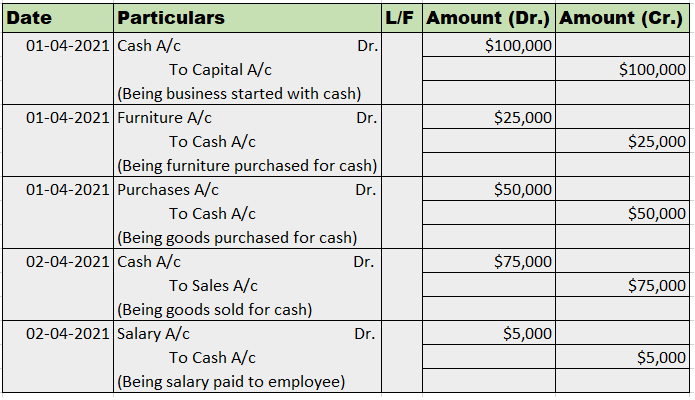
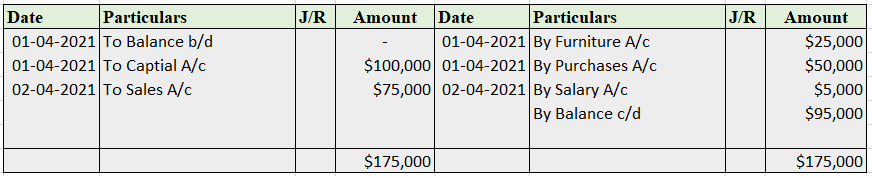
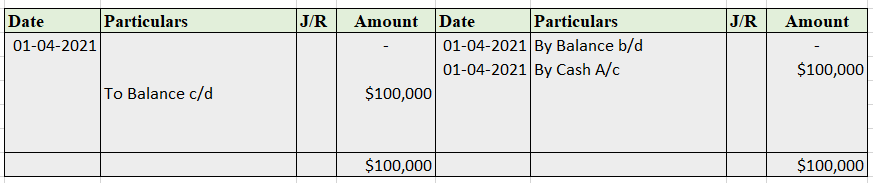
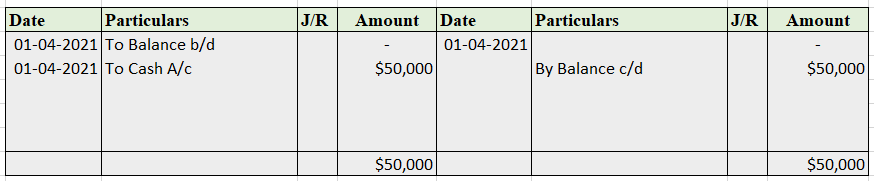
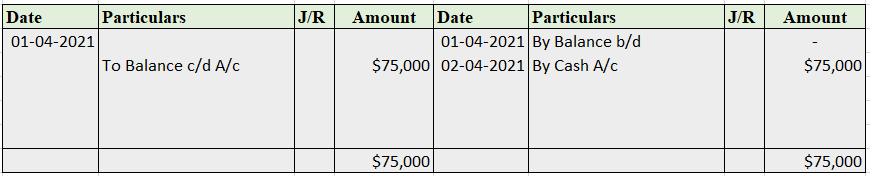
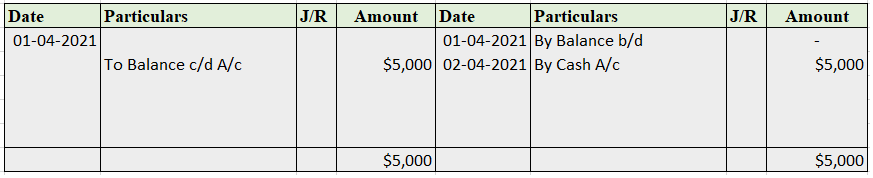
    Mr. Jack Sparrow decided to start a new clothing business. On 1st April 2021, He started the business with a total sum of $100,000 cash. He purchased furniture, including desks and shelves for $25,000. Mr. Sparrow then decided to start with women’s clothing and purchased a complete range of clothes from the wholesale market for $50,000. On the next day, he sold all the stock for $75,000. He also hired a worker for $5,000.

    We need to journalize these transactions and post them into the ledger account.


    Journal Entries


    Ledger Accounts

    Cash A/c


    Capital A/c


    Purchases A/c


    Sales A/c


    Salary A/c

    See less
    • 0
    • Share
      Share
      • Share on Facebook
      • Share on Twitter
      • Share on LinkedIn
      • Share on WhatsApp
Jasmeet_Sethi
Jasmeet_SethiCurious
In: 1. Financial Accounting > Accounting Terms & Basics

What are sundry debtors and sundry creditors?

  • 1 Answer
  • 0 Followers
Answer
  1. Simerpreet Helpful CMA Inter qualified
    Added an answer on August 12, 2021 at 3:19 pm

    Sundry Debtors Sundry Debtors are those persons or firms to whom goods have been sold or services rendered on credit and the payment has not been received from them. In other words, Debtors are the persons or firms from whom the payment is to be received by the business. For Example, Ramen Sold goodRead more

    Sundry Debtors

    Sundry Debtors are those persons or firms to whom goods have been sold or services rendered on credit and the payment has not been received from them. In other words, Debtors are the persons or firms from whom the payment is to be received by the business.

    For Example, Ramen Sold goods to Sam on credit, Sam did not pay for the goods immediately, so here Sam is the debtor for Ramen because he owes the amount to Ramen.

    Another Example, If goods worth Rs 7000 have been sold to Sid on credit, he will continue to remain as debtor of the business so long as he does not make the full payment.

    Treatment:

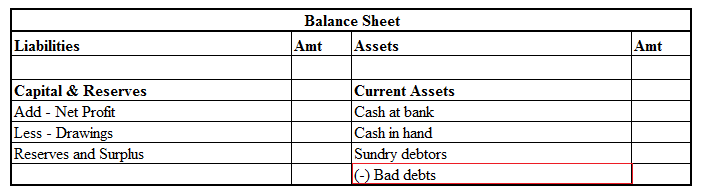
    Sundry Debtor is considered as a current asset and hence it is shown on the assets side of the balance sheet under the Current Assets heading.

    Sundry Debtors are not considered as an item of profit and loss because it is not considered as an item of income or expense. However, the items associated with sundry debtors such as bad debts or provision for doubtful debts or bad debts recovered are shown in profit and loss accounts in the debit and credit sides respectively.

    Sundry Creditors

    Sundry creditors are those persons or firms from whom goods have been purchased or services rendered on credit and for which payment has not been made. In other words, Creditors are the person or firms to whom some money has to be paid by the business.

    For Example, Ramen purchased goods from Sam on credit, Ramen did not pay for the goods immediately, so here Ramen is the creditor for Sam because he owes money to Sam.

    Another Example, If Mr. Johnson purchased goods worth Rs 3000 from M/s. Rick & Co. on credit, Mr. Johnson will continue to remain as a creditor of M/s. Rick & Co. as long as the full payment is made by Mr. Johnson.

    Treatment:

    Sundry Creditor is shown in the liabilities side of the balance sheet under the heading Current Liabilities.

    See less
    • 0
    • Share
      Share
      • Share on Facebook
      • Share on Twitter
      • Share on LinkedIn
      • Share on WhatsApp

Sidebar

Question Categories

  • 1. Financial Accounting

      • Accounting Terms & Basics
      • Bank Reconciliation Statement
      • Banks & NBFCs
      • Bills of Exchange
      • Capital & Revenue Expenses
      • Consignment & Hire Purchase
      • Consolidation
      • Contingent Liabilities & Assets
      • Departments & Branches
      • Depreciation & Amortization
      • Financial Statements
      • Goodwill
      • Insurance Accounting
      • Inventory or Stock
      • Investment Accounting
      • Journal Entries
      • Ledger & Trial Balance
      • Liquidation & Amalgamation
      • Miscellaneous
      • Not for Profit Organizations
      • Partnerships
      • Ratios
      • Shares & Debentures
      • Source Documents & Vouchers
      • Subsidiary Books
  • 2. Accounting Standards

      • AS
      • IFRS
      • IndAS
  • 3. Cost & Mgmt Accounting
  • 4. Taxes & Duties

      • GST
      • Income Tax
  • 5. Audit

      • Bank Audit
      • Internal Audit
      • Miscellaneous - Audit
      • Statutory Audit
  • 6. Software & ERPs

      • Tally
  • 7. MS-Excel
  • 8. Interview & Career
  • Top Questions
  • I need 20 journal entries with ledger and trial balance?

  • Can you show 15 transactions with their journal entries, ledger, ...

  • What is furniture purchased for office use journal entry?

  • What is loose tools account and treatment in final accounts?

  • What is the Journal Entry for Closing Stock?

  • What is the journal entry for goods purchased by cheque?

  • What is commission earned but not received journal entry?

  • How to show adjustment of loose tools revalued in final ...

  • What is the journal entry for interest received from bank?

  • Following is the Receipts and Payments Account of Bharti Club ...

Hot Topics

Accounting Policies Accounting Principles Balance Sheet Bank Reconciliation Statement Bill of Exchange Branch Accounting Calls in Advance Capital Capital Expenditure Companies Act Compound Entry Consignment Creditors Current Assets Debit Balance Debtors Depreciation Difference Between Dissolution of Firm Dissolution of Partnership Drawings External Users Fictitious Assets Final Accounts Financial Statements Fixed Assets Fixed Capital Fluctuating Capital Gain Impairment Installation Interest Received in Advance Internal Users Journal Entry Ledger Loose Tools Miscellaneous Expenditure Profit Rent Rent Received in Advance Reserves Revaluation Revenue Expenditure Revenue Reserve Sacrificing Ratio Subscription Subscription Received in Advance Trial Balance Type of Account Uncalled Capital
  • Home
  • Questions
    • Most Visited
    • Most Active
    • Trending
    • Recent
  • Follow
    • Categories
    • Users
    • Tags
  • Write an Answer
  • Badges & Points
  • Request New Category
  • Send a Suggestion

Most Helping Users

Astha

Astha

  • 50,291 Points
Leader
Simerpreet

Simerpreet

  • 72 Points
Helpful
AbhishekBatabyal

AbhishekBatabyal

  • 65 Points
Helpful

Footer

  • About Us
  • Contact Us
  • Pricing
  • Refund
  • Forum Rules & FAQs
  • Terms and Conditions
  • Privacy Policy
  • Career

© 2021 All Rights Reserved
Accounting Capital.