Please briefly explain why you feel this question should be reported.

Please briefly explain why you feel this answer should be reported.

Please briefly explain why you feel this user should be reported.

Sign InSign Up

AccountingQA

AccountingQA Logo AccountingQA Logo

AccountingQA Navigation

  • Home
  • Ask Questions
  • Write Answers
  • Explore
  • FAQs
Search
Ask A Question

Mobile menu

Close
Ask a Question
  • Home
  • Questions
    • Most Visited
    • Most Active
    • Trending
    • Recent
  • Follow
    • Categories
    • Users
    • Tags
  • Write an Answer
  • Badges & Points
  • Request New Category
  • Send a Suggestion
  • Search Your Accounting Question..

  • Most Visited
  • Most Voted
  • Followed Questions
  • Most Answered
  • No Answers

AccountingQA Latest Questions

AbhishekBatabyal
AbhishekBatabyalHelpful
In: 1. Financial Accounting > Miscellaneous

What account is land?

  • 1 Answer
  • 0 Followers
Answer
  1. GautamSaxena Curious .
    Added an answer on August 19, 2022 at 10:18 am
    This answer was edited.

    The land is a fixed asset and is treated as a long-term asset account.  Explanation The land is a fixed asset which is also referred to as a long-term asset. The fixed assets are those assets that are not expected to be cashed, consumed, last, sold, or written off within one accounting year and areRead more

    The land is a fixed asset and is treated as a long-term asset account. 

    Explanation

    The land is a fixed asset which is also referred to as a long-term asset.

    The fixed assets are those assets that are not expected to be cashed, consumed, last, sold, or written off within one accounting year and are purchased for long-term use. The fixed assets are also called non-current assets and the reason behind it is that current assets are easily converted into cash within one year and they are not.

    Fixed assets are planned by the company to be used for the long term in order to generate income.

    Example- Land, building, furniture, plants & equipment, etc.


    Why is land an asset?

    Although the land is not depreciated, it is still considered to be an asset because just like other assets the business spends its own money to acquire it.

    It can also be used by the business for different operations and it doesn’t create any liability for the business. Instead, reselling the land after a few years can help the company earn a huge margin of profit.


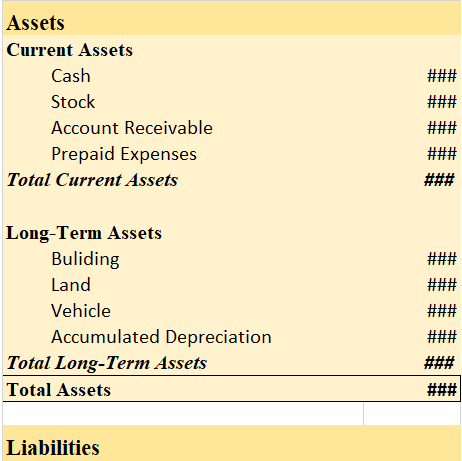
    Land in the balance sheet

    On the asset side of the balance sheet, the land is stated under the heading long-term assets.

    Balance Sheet (for the year…)


    Therefore, the land is a fixed asset and is treated as a long-term asset account.

    See less
    • 0
    • Share
      Share
      • Share on Facebook
      • Share on Twitter
      • Share on LinkedIn
      • Share on WhatsApp
A_Team
A_Team
In: 1. Financial Accounting > Miscellaneous

Is bad debt an asset?

  • 1 Answer
  • 0 Followers
Answer
  1. Ishika Pandey Curious ca aspirant
    Added an answer on January 13, 2023 at 7:12 am
    This answer was edited.

    Definition Bad debts are a debt owed to an enterprise that is considered to be irrecoverable or we can say that it is owed to the business that is written off because it is irrecoverable. Sometimes debtors are unable to pay the amount due either partially or fully. the amount that is not receivableRead more

    Definition

    Bad debts are a debt owed to an enterprise that is considered to be irrecoverable or we can say that it is owed to the business that is written off because it is irrecoverable.

    Sometimes debtors are unable to pay the amount due either partially or fully. the amount that is not receivable is a loss and is called bad debt.

    Bad debts are neither assets nor liabilities they are expenses that are debited to the profit and loss account and reduced from debtors in the balance sheet.

    For example loans from banks are declared as bad debt, sales made on credit and amounts not received from customers, etc.


    Related terms

    So there are a few related terms whose meanings you should know

    • Further bad debts :
      • It means the amount of sundry debtors in the trial balance is before the deduction of bad debts. in this situation, entry for further bad debts is also passed into the books of account.
      • That is bad debts are debited and the debtor’s account is credited. And the accounting treatment for them is the same as bad debts which I have shown you above.


    • Bad debts recovered :
      • It may happen that the amount written off as bad debts are recovered fully or partially.
      • In that case, the amount is not credited to the debtor’s (personal) account but is credited to the bad debts recovered account because the amount recovered had been earlier written off as a loss.
      • Thus amount recovered is a ‘gain’  and is credited to the profit and loss account.


    Accounting methods

    There are two methods for accounting for bad debts which are mentioned below:-

    • First, is the direct written-off method which states that bad debts will be directly treated as expenses and expensed to the income statement, which is called the profit and loss account.


    • Second, is the allowance method which means we create provisions for doubtful debts accounts and the debtor’s account remains as it is since the debtor’s account and provision for doubtful debts account are two separate accounts.


      • Debts that are doubtful of recovery are provided estimating the debts that may not be recovered .amount debited to the profit and loss account reduces the current year’s profit and the amount of provision is carried forward to the next year.
      • Next year, when debts actually become bad debts and are written off, the amount of bad debts is transferred ( debited ) to the provision for doubtful debts account.
      • The amount of bad debts is not debited to the profit and loss account since it was already debited in earlier years.
      • Provision for doubtful debts is shown in the debit side of the profit and loss account as well as shown as a deduction from sundry debtors in the assets side of the balance sheet. 


    Accounting treatment

    Now let me try to explain to you the accounting treatment for bad debts which is as follows :

    • Balance sheet


      • In the balance sheet either it can be shown on the asset side under the head, current assets by reducing from that specific assets.
      • For example, if credit sales are made to a customer who says it’s not recoverable or is partially recoverable then the amount is bad debt. It’s a loss for the business and credited to the personal account of debtors or we can say reduced from debtor those are current assets of the balance sheet.


    • Profit and loss account


      • Bad debts are treated as expenses and debited to the profit and loss account.
      • For example, as I have explained above, before transferring to the balance sheet, bad debt will be debited to the profit and loss account as an expense.

    Now let me show you the extract of the profit and loss account and balance sheet showing bad debts and bad debts recovered which are as follows:-

    See less
    • 0
    • Share
      Share
      • Share on Facebook
      • Share on Twitter
      • Share on LinkedIn
      • Share on WhatsApp
Jayesh Gupta
Jayesh GuptaCurious
In: 1. Financial Accounting > Financial Statements

What is credit side of trading account?

  • 1 Answer
  • 0 Followers
Answer
  1. Kajal
    Added an answer on September 22, 2023 at 4:44 pm
    This answer was edited.

    Trading A/c is a Nominal A/c which follows the rule “Debit the expenses and losses, Credit the incomes and gains” So, the Credit side of Trading A/c shows income from the sale of goods. It includes Sales, Closing stock (if adjustment for it has not been made yet) and Gross Loss (if any).   TRADRead more

    Trading A/c is a Nominal A/c which follows the rule “Debit the expenses and losses, Credit the incomes and gains”

    So, the Credit side of Trading A/c shows income from the sale of goods. It includes Sales, Closing stock (if adjustment for it has not been made yet) and Gross Loss (if any).


    TRADING ACCOUNT

    Trading A/c is prepared for calculating the Gross Profit or Gross Loss arising from the trading activities of a business.

    Trading activities are mostly related to buying and selling of goods. However, in between buying and selling, a lot of activities are involved like transportation, warehousing, etc. So, all the expenses that are directly related to manufacturing or purchase of goods are also recorded in the Trading A/c.


    CREDIT SIDE OF TRADING ACCOUNT

    It includes,

    SALES – When goods are sold to earn a profit, it is called sales. It can be cash sales or credit sales.

    Suppose you are in the business of manufacturing and trading shirts. You sold shirts worth $ 20,000 during the year. This $20,000 is your sales.

    SALES RETURN – When the goods sold by you are returned by the customer, it is known as sales return. Sales return is deducted from the sales.

    Continuing with the above example, the customers returned shirts of $1,000 because they didn’t like them. This return is known as sales return or return inward (as goods are coming back i.e. in)

    CLOSING STOCK – Stock is nothing but goods that are either obtained for resale or manufactured for sale and are yet unsold on any particular date.

    The value of stock at the beginning of an accounting year is called Opening stock while the value of the stock at the end of an accounting year is called Closing stock.

    Closing stock is valued at cost price or market price whichever is less.

    It includes,

    1. Closing stock of raw materials
    2. Closing stock of semi-finished goods
    3. Closing stock of finished goods

    For example – On 31st March 2023, there was unused raw material worth $1,000 and shirts worth $5,000 remained unsold.

    So, we have Closing Stock of Raw material – $1,000

    Closing Stock of Finished Goods – $5,000

    Normally, the closing stock is given outside the Trial Balance because its valuation is made after accounts have been closed. It is incorporated in the books by transferring it to the Trading A/c. So, it is shown on the credit side of Trading A/c as well as on the assets side of the Balance sheet.

    However, if the closing stock is given inside the Trail Balance, it means that the closing stock must have already been deducted from the Purchases account. So, closing stock will only be shown on the assets side of the Balance sheet.

    GROSS LOSS – If purchases and direct expenses exceed sales, then it is a Gross loss. In other words, when Debit side > credit side.


    DEBIT SIDE OF TRADING ACCOUNT

    It includes

    OPENING STOCK – The value of the stock at the beginning of an accounting year is called Opening stock.

    The closing stock of the last year becomes the opening stock of the current year.

    PURCHASES – Goods that have been bought for resale or raw materials purchased for the manufacturing of the product are terms as Purchases. These goods must be related to the business you are doing. It includes cash as well as credit Purchases.

    PURCHASES RETURN – When goods bought are returned to the suppliers due to any reason. This is known as Purchase return. Purchase return is deducted from the Purchases.

    WAGES – Wages are paid to the workers who are directly engaged in the loading, unloading and production of goods.

    CARRIAGE or CARRIAGE INWARDS or FREIGHT – It refers to the cost of transporting goods from the supplier.

    MANUFACTURING EXPENSES – All expenses incurred in the manufacture of goods such as Coal, Gas, Fuel, Water, Power, Factory rent, Factory lighting etc.

    DOCK CHARGES – These are charged by port authorities when unloading goods at a dock or wharf. Such charges paid in connection with goods purchased are considered direct expenses and are debited to Trading a/c.

    IMPORT DUTY or CUSTOM DUTY – It is a tax collected on imports and specific exports by a country’s customs authorities.

    If import duty is paid on the import of goods, then they are shown on the Dr. side of the Trading A/c.

    ROYALTY – Royalty refers to the amount paid for the use of assets belonging to another person. It includes royalty for the use of intangible assets, such as copyrights, trademarks, or franchisee agreements. It is also paid for the use of natural resources, such as mining leases.

    Royalty is charged to the Trading A/c as it increases the cost of production.

    GROSS PROFIT – When sales exceed the amount of purchases and the expenses directly connected with such purchases i.e. when Credit side> Debit side.

    See less
    • 0
    • Share
      Share
      • Share on Facebook
      • Share on Twitter
      • Share on LinkedIn
      • Share on WhatsApp
Astha
AsthaLeader
In: 1. Financial Accounting > Ledger & Trial Balance

How to know if opening balance of an account is Debit or Credit?

CreditDebitOpening Balance
  • 1 Answer
  • 0 Followers
Answer
  1. Simerpreet Helpful CMA Inter qualified
    Added an answer on June 2, 2021 at 3:11 pm
    This answer was edited.

    Let us begin with a short explanation of what opening balance is: The opening balance is the amount of funds that are bought forward from the end of one accounting period to the beginning of a new accounting period. In a firm’s account, the first entry done is of the opening balance. It can either hRead more

    Let us begin with a short explanation of what opening balance is:

    The opening balance is the amount of funds that are bought forward from the end of one accounting period to the beginning of a new accounting period.

    In a firm’s account, the first entry done is of the opening balance. It can either have a debit balance or a credit balance depending upon whether the firm has a negative or positive balance.

    Opening balance of a ledger

    Opening balance is the first entry of the ledger account at the beginning of an accounting period.

    In the case of a newly started business, there will be no closing balances and as such there will be no balances to be carried forward. In such a case, the investment and capital of the business will be entered as an opening balance for the current accounting period.

    So the first and foremost part is to identify on which side of the ledger i.e. the debit side or the credit side the opening balance is to be entered.

    For Example, A trial balance is given which represents the debit and credit balances, accordingly, I will prepare different ledger accounts to make it simpler.

    The trial balance shows the opening balance of various accounts. Now posting them in ledger accounts.

    As the Furniture is an Asset account, the opening balance will be on the debit side of the ledger account.

    As Sundry creditor is a credit account,  we put the opening balance on the credit side.

    As the Capital is a credit account,  we put the opening balance on the credit side.

    As Wages is a debit account,  we put the opening balance on the debit side.

    As the Discount received is a credit account,  we put the opening balance on the credit side.

    Exception

    Drawing Account.

    Drawing account is an exception to this topic. It is considered a contra account to the owner’s capital account because it reduces the value of the owner’s equity. Drawings, therefore, have no opening balance.

    Contra Entry.

    Contra entry involves transactions of cash and bank. Any entry which involves both the cash and bank is contra entry.

    For example, we deposit cash 5000 into the bank.

    Accounting entry for this transaction would be

    In this case, the ledger entry would be

    As the bank account has a debit balance, the opening balance would come on the debit side.

    As the cash account has a credit balance, the opening balance would come on the credit side.

    Alternatively, If we withdraw cash 5000 from the bank.

    Accounting entry would be

    In this case, the ledger entry would be

    As the Cash account has a debit balance, the opening balance would come on the debit side.

    As the Bank account has a credit balance, the opening balance would come on the credit side.

    See less
    • 0
    • Share
      Share
      • Share on Facebook
      • Share on Twitter
      • Share on LinkedIn
      • Share on WhatsApp
A_Team
A_Team
In: 1. Financial Accounting > Bank Reconciliation Statement

A Bank Reconciliation Statement is prepared with the help of ?

Bank statement and bank column of cash book Bank statement and cash column of cash book Bank column of cash book and cash column of cash book None of the above

Bank Reconciliation Statement
  • 1 Answer
  • 0 Followers
Answer
  1. Karan B.com and Pursuing ACCA
    Added an answer on July 13, 2021 at 6:08 am
    This answer was edited.

    The correct answer is the 1. Bank statement and bank column of the cash book, because it will help the business to verify whether amounts entered and entries recorded are correct or not. It will also help in verifying the balances of bank statements and cash books whether they tally or not. What isRead more

    The correct answer is the 1. Bank statement and bank column of the cash book, because it will help the business to verify whether amounts entered and entries recorded are correct or not. It will also help in verifying the balances of bank statements and cash books whether they tally or not.

    What is Reconciliation?

    Reconciliation is an accounting procedure that compares two sets of records to check figures are correct and in agreement. Reconciliation can also be used for personal purposes.

    What is a Bank Reconciliation Statement?

    A statement showing causes of disagreement between the balance of bank statement and bank column of the cash book at the end of a specific period is called a Bank Reconciliation Statement.

    Steps in preparation of Bank Reconciliation Statement

    Step 1: Comparing items appearing on the debit and credit sides of the bank statement and bank column of the cash book.

    Step 2: Make a list of missed entries.

    Step 3: Analyse the causes of differences.

    Step 4: Select the date for the preparation of the Bank Reconciliation Statement.

    Step 5: Choose the starting point i.e balance as per cash book or balance as per bank statement.

    Step 6: Adjust the starting point by adding or subtracting the missed entries.

    Step 7: Bank Statement must match with the cash book.

    To prepare a bank reconciliation statement a business will need a bank statement from its bank and cash book which it prepares to record entries.

    See less
    • 0
    • Share
      Share
      • Share on Facebook
      • Share on Twitter
      • Share on LinkedIn
      • Share on WhatsApp
Bonnie
BonnieCurious
In: 1. Financial Accounting > Not for Profit Organizations

Can you please explain income and expenditure account?

  • 1 Answer
  • 0 Followers
Answer
  1. prashant06 B.com, CMA pursuing
    Added an answer on July 30, 2021 at 4:13 pm
    This answer was edited.

    The "Income and Expenditure" account lists all the income and expenses incurred by the entity throughout the year. This account is very identical to the profit and loss account and is generally prepared on an accrual basis irrespective of whether the amount is received or paid. Non-profit organizatiRead more

    The “Income and Expenditure” account lists all the income and expenses incurred by the entity throughout the year. This account is very identical to the profit and loss account and is generally prepared on an accrual basis irrespective of whether the amount is received or paid. Non-profit organizations (NPO) prepare this type of account to ascertain surplus earned or deficit incurred by them during the period.

    Talking about the format of income and expenditure accounts we generally see that all the expenses are recorded on the debit side while all incomes are recorded on the credit side. One important thing to note is that items so recorded are revenue items while capital nature items are generally ignored because only current period items are recorded in this statement.

    Since it is a Nominal account, we follow the golden rules to prepare this, stating “debit all expenses and losses and credit all incomes and gains”. The closing balance at the end shows the surplus or deficit for the year. If the balancing figure appears on the debit side it is surplus and if the balancing figure appears on the credit side it is a deficit for the entity.

    Following is the format of income and expenditure account


    See less
    • 0
    • Share
      Share
      • Share on Facebook
      • Share on Twitter
      • Share on LinkedIn
      • Share on WhatsApp
Jayesh Gupta
Jayesh GuptaCurious
In: 1. Financial Accounting > Miscellaneous

How to treat cheque issued but not presented for payment?

  • 1 Answer
  • 0 Followers
Answer
  1. Naina@123 (B.COM and CMA-Final)
    Added an answer on August 22, 2021 at 6:01 am
    This answer was edited.

    A cheque that has been issued but yet not presented to the bank for payment is known as an unpresented cheque Generally what happens is when a cheque is issued to a party or say, creditor, the business immediately records them in the bank column of the cash book but the creditor might not present thRead more

    A cheque that has been issued but yet not presented to the bank for payment is known as an unpresented cheque

    Generally what happens is when a cheque is issued to a party or say, creditor, the business immediately records them in the bank column of the cash book but the creditor might not present them immediately to the bank for payment on the same date. The bank will only debit the account when it will be presented to it, therefore as long as the cheque remains unpresented there will be a difference in both the books i.e cash book and passbook.

    Let me give you a short example of the above treatment

    Suppose on 27th January, in the books of Mr. Shyam, the balance of the bank column as per the cash book is Rs 10,000. He received a cheque of Rs 5,000 from Mr. Hari, one of his debtors, which was sent to the bank for collection. The amount of the cheque was not collected by the bank until 31st January. Due to this, there arises a difference of Rs 5,000 in the cash book and pass book of Mr. Shyam.

    Following will be the entry in Mr. Shyam cash book and passbook

    In the books of Mr. Shaym

    Cash book (bank column only)

    Date Particulars Bank (Rs) Date Particulars Bank (Rs)
    27th Jan To balance b/d 10,000
    27th Jan To Hari 5,000
    31st Jan By balance c/d 15,000
    15000 15000

      Mr. Shyam

       Bank Statement

    Date Particulars Debit (Withdraw) Credit (Deposite) Debit or Credit Balance
    31st Jan To balance b/d credit 10,000

    How it is treated in the bank reconciliation statement?

    There lies a temporary difference in both the books as the represented cheques will eventually be presented. Therefore we will not alter the cash book. The bank statement shows the greater amount of Rs 5,000 as compared to the cashbook, therefore we will debit the amount of unpresented cheque which will eventually make it balance to the level of bank statement.


    See less
    • 0
    • Share
      Share
      • Share on Facebook
      • Share on Twitter
      • Share on LinkedIn
      • Share on WhatsApp
Simerpreet
SimerpreetHelpful
In: 1. Financial Accounting > Subsidiary Books

When a petty cash book is kept there will be

A) No entries made at all in the general ledger for items paid by petty cash B) The same number of entries in the general ledger. C) Fewer entries made in the ...

  • 1 Answer
  • 0 Followers
Answer
  1. AbhishekBatabyal Helpful Pursuing CA, BCOM (HONS)
    Added an answer on November 1, 2021 at 12:02 pm
    This answer was edited.

    The correct option is D) Fewer entries in the general ledger To understand why option D is correct, we need to understand the concept. Petty cashbook is a special cashbook prepared for recording petty or small cash expenses. The benefit is that the chief cashier can focus on large cash and bank tranRead more

    The correct option is D) Fewer entries in the general ledger

    To understand why option D is correct, we need to understand the concept.

    • Petty cashbook is a special cashbook prepared for recording petty or small cash expenses.
    • The benefit is that the chief cashier can focus on large cash and bank transactions and there are fewer transactions in the main cashbook.
    • The petty cashier is provided with a fixed amount for a month or week and is reimbursed the amount spent at the end of the period after he sends the details of expenses to the chief cashier.
    • There are entries for the transfer of cash to the petty cashier in the main cashbook only.

    Option A ‘No entries made at all in the general ledger for items paid by petty cash ‘ is wrong. It is not possible to omit entries of petty expense just because there is a petty cashbook. There will be entries related to:

    • The cash is given to the petty cashier in a fixed amount or the amount spent as petty expenses during the month or week.

    Petty cash A/c  Dr.        Amt

        To Cash A/c                   Amt

     Option (B) ‘The same number of entries in the general ledger is wrong because there can never be the same number of entries as all the petty expenses are recorded in the petty cashbook and only the entries for transfer of cash to the petty cashier is recorded in the main cash book.

    Option D ‘More entries made in the general ledger​’ is wrong because the number of entries actually reduce as only petty cash transfer entries are recorded in the main cashbook instead of numerous entries of petty cash transactions.

    See less
    • 0
    • Share
      Share
      • Share on Facebook
      • Share on Twitter
      • Share on LinkedIn
      • Share on WhatsApp
Bonnie
BonnieCurious
In: 1. Financial Accounting > Financial Statements

What is the primary objective of cash flow statement?

  • 1 Answer
  • 0 Followers
Answer
  1. Radhika
    Added an answer on December 1, 2021 at 2:09 pm
    This answer was edited.

    A cash flow statement is a statement showing the inflow and outflow of cash and cash equivalents during a financial year. Cash Flow Statements along with Income statements and Balance Sheet are the most important financial statements for a company. The Cash Flow Statement provides a picture to the sRead more

    A cash flow statement is a statement showing the inflow and outflow of cash and cash equivalents during a financial year. Cash Flow Statements along with Income statements and Balance Sheet are the most important financial statements for a company.

    The Cash Flow Statement provides a picture to the shareholders, government, and the public of how the company manages its obligations and fund its operations. It is a crucial measure to determine the financial health of a company.

    The Cash Flow Statement is created from the Income Statement and the Balance Sheet. While Income Statement shows money engaged in various transactions during the year, the Balance Sheet presents information about the opening and closing balances.

    The primary objective of a Cash Flow Statement is to present a record of inflow and outflow of cash, cash equivalents, and marketable securities through various activities of a company.

    Various activities in a company can be broadly classified into three parts or heads:

    • Cash Flow from Operating Activities: it represents how money from regular business activities is derived and spent. It includes Net Profit from Income Statement after adjusting for tax and extra-ordinary activities. Items included in Operating Activities are adjustments in Working Capital. If current liabilities are paid or current assets are bought it means outflow of cash, hence it is deducted and if liabilities are increased or assets are sold it means the inflow of cash, hence it is added. Operating Activities take into account taxation, dividend, depreciation, and other adjustments.
    • Cash Flow from Investing Activities: it represents aggregate inflow or outflow of cash due to various investments activities that the company was engaged in. Purchase and sale of non-current assets like fixed assets and long-term investments are considered under this head. If there is an investment made, it means outflow of cash, hence it is deducted and if there is an investment sold it means the inflow of cash, and hence it is added.
    • Cash Flow from Financing Activities: it represents the activities that are used to finance a company’s operations, like, issue of cash or debentures, paying dividends and interest, long-term borrowing taken by a company, etc. If these are paid, it means outflow of cash and is hence deducted and if they are acquired, it means the inflow of cash and hence ae added.

    Cash Flow Statements also present a picture of the liquidity of the company and are therefore used by the management of a company to take decisions with the help of the right information.

    Cash Flow Statements are a great source of comparison between a company’s last year’s performance to its current year or with other companies in the same industry and hence, helps shareholders and potential investors to make the right decisions.

    It also helps to differentiate between non-cash and cash items; incomes and expenditures are divided into separate heads.


    See less
    • 0
    • Share
      Share
      • Share on Facebook
      • Share on Twitter
      • Share on LinkedIn
      • Share on WhatsApp
Anushka Lalwani
Anushka Lalwani
In: 1. Financial Accounting > Financial Statements

How to show interest on capital in profit and loss account?

  • 1 Answer
  • 0 Followers
Answer
  1. AbhishekBatabyal Helpful Pursuing CA, BCOM (HONS)
    Added an answer on December 16, 2021 at 8:33 am

    Interest on capital is the interest provided on the capital invested in the business. It is calculated as a percentage on the capital invested. Interest on capital is provided if there is any rule established by the owner of the capital. Otherwise, it is not provided. We generally encounter ‘InteresRead more

    Interest on capital is the interest provided on the capital invested in the business. It is calculated as a percentage on the capital invested. Interest on capital is provided if there is any rule established by the owner of the capital. Otherwise, it is not provided.

    We generally encounter ‘Interest on capital’ in partnership accounting but a sole proprietorship can also provide interest on capital.

    Interest on capital is charged or appropriated from the profits of the firm. Hence, it appears on the debit side of the profit and loss account.

    The journal entry is as follows:

    The partners, in case the firm makes profit, are provided interest on their capital balance apart from their share of profit if provision of interest on capital is mentioned in the partnership deed.

    Hence, interest on capital is an appropriation of profit in partnership accounting. The journal in case of partnership account is as follows:

    The Interest on capital is credited to the capital/ partners’ capital account thereby increasing the capital balance.  The journal is as follows:

    In the balance sheet it is shown as an addition to the capital account.

    Numerical example

    P, Q and R are partners. Their firm reported a net profit of ₹ 20,000. Their capitals are ₹30,000, ₹45,000 and ₹60,000. It is in their partnership deed to provide the partners 4% interest on capital and a salary of ₹5,000 per annum for Q. Calculate the interest on capital.

    Solution:

    Interest on capital to be provided to the partners:

    P – ₹30,000 x 6% = ₹1,800

    Q – ₹45,000 x 6% = ₹2,700

    R – ₹60,000 x 6% = ₹3,600

    This interest will be credited to the partners’ capital. The journals are as follows:

    See less
    • 0
    • Share
      Share
      • Share on Facebook
      • Share on Twitter
      • Share on LinkedIn
      • Share on WhatsApp

Sidebar

Question Categories

  • 1. Financial Accounting

      • Accounting Terms & Basics
      • Bank Reconciliation Statement
      • Banks & NBFCs
      • Bills of Exchange
      • Capital & Revenue Expenses
      • Consignment & Hire Purchase
      • Consolidation
      • Contingent Liabilities & Assets
      • Departments & Branches
      • Depreciation & Amortization
      • Financial Statements
      • Goodwill
      • Insurance Accounting
      • Inventory or Stock
      • Investment Accounting
      • Journal Entries
      • Ledger & Trial Balance
      • Liquidation & Amalgamation
      • Miscellaneous
      • Not for Profit Organizations
      • Partnerships
      • Ratios
      • Shares & Debentures
      • Source Documents & Vouchers
      • Subsidiary Books
  • 2. Accounting Standards

      • AS
      • IFRS
      • IndAS
  • 3. Cost & Mgmt Accounting
  • 4. Taxes & Duties

      • GST
      • Income Tax
  • 5. Audit

      • Bank Audit
      • Internal Audit
      • Miscellaneous - Audit
      • Statutory Audit
  • 6. Software & ERPs

      • Tally
  • 7. MS-Excel
  • 8. Interview & Career
  • Top Questions
  • I need 20 journal entries with ledger and trial balance?

  • Can you show 15 transactions with their journal entries, ledger, ...

  • What is furniture purchased for office use journal entry?

  • What is loose tools account and treatment in final accounts?

  • What is the Journal Entry for Closing Stock?

  • What is the journal entry for goods purchased by cheque?

  • What is commission earned but not received journal entry?

  • How to show adjustment of loose tools revalued in final ...

  • What is the journal entry for interest received from bank?

  • Following is the Receipts and Payments Account of Bharti Club ...

Hot Topics

Accounting Policies Accounting Principles Balance Sheet Bank Reconciliation Statement Bill of Exchange Branch Accounting Calls in Advance Capital Capital Expenditure Companies Act Compound Entry Consignment Creditors Current Assets Debit Balance Debtors Depreciation Difference Between Dissolution of Firm Dissolution of Partnership Drawings External Users Fictitious Assets Final Accounts Financial Statements Fixed Assets Fixed Capital Fluctuating Capital Gain Impairment Installation Interest Received in Advance Internal Users Journal Entry Ledger Loose Tools Miscellaneous Expenditure Profit Rent Rent Received in Advance Reserves Revaluation Revenue Expenditure Revenue Reserve Sacrificing Ratio Subscription Subscription Received in Advance Trial Balance Type of Account Uncalled Capital
  • Home
  • Questions
    • Most Visited
    • Most Active
    • Trending
    • Recent
  • Follow
    • Categories
    • Users
    • Tags
  • Write an Answer
  • Badges & Points
  • Request New Category
  • Send a Suggestion

Most Helping Users

Astha

Astha

  • 50,291 Points
Leader
Simerpreet

Simerpreet

  • 72 Points
Helpful
AbhishekBatabyal

AbhishekBatabyal

  • 65 Points
Helpful

Footer

  • About Us
  • Contact Us
  • Pricing
  • Refund
  • Forum Rules & FAQs
  • Terms and Conditions
  • Privacy Policy
  • Career

© 2021 All Rights Reserved
Accounting Capital.