


Let us begin with a short explanation of what opening balance is: The opening balance is the amount of funds that are bought forward from the end of one accounting period to the beginning of a new accounting period. In a firm’s account, the first entry done is of the opening balance. It can either hRead more
Let us begin with a short explanation of what opening balance is:
The opening balance is the amount of funds that are bought forward from the end of one accounting period to the beginning of a new accounting period.
In a firm’s account, the first entry done is of the opening balance. It can either have a debit balance or a credit balance depending upon whether the firm has a negative or positive balance.
Opening balance of a ledger
Opening balance is the first entry of the ledger account at the beginning of an accounting period.
In the case of a newly started business, there will be no closing balances and as such there will be no balances to be carried forward. In such a case, the investment and capital of the business will be entered as an opening balance for the current accounting period.
So the first and foremost part is to identify on which side of the ledger i.e. the debit side or the credit side the opening balance is to be entered.

For Example, A trial balance is given which represents the debit and credit balances, accordingly, I will prepare different ledger accounts to make it simpler.
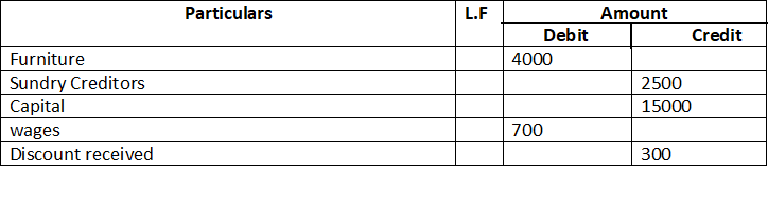 The trial balance shows the opening balance of various accounts. Now posting them in ledger accounts.

As the Furniture is an Asset account, the opening balance will be on the debit side of the ledger account.

As Sundry creditor is a credit account, we put the opening balance on the credit side.

As the Capital is a credit account, we put the opening balance on the credit side.

As Wages is a debit account, we put the opening balance on the debit side.

As the Discount received is a credit account, we put the opening balance on the credit side.
Exception
Drawing Account.
Drawing account is an exception to this topic. It is considered a contra account to the owner’s capital account because it reduces the value of the owner’s equity. Drawings, therefore, have no opening balance.
Contra Entry.
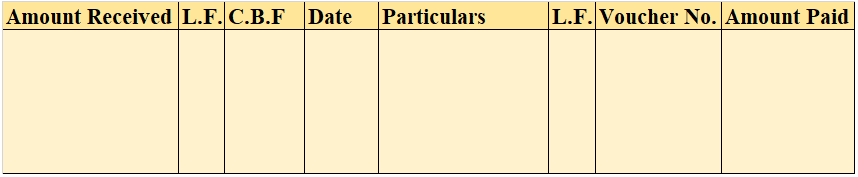
Contra entry involves transactions of cash and bank. Any entry which involves both the cash and bank is contra entry.
For example, we deposit cash 5000 into the bank.
Accounting entry for this transaction would be

In this case, the ledger entry would be

As the bank account has a debit balance, the opening balance would come on the debit side.

As the cash account has a credit balance, the opening balance would come on the credit side.
Alternatively, If we withdraw cash 5000 from the bank.
Accounting entry would be

In this case, the ledger entry would be

As the Cash account has a debit balance, the opening balance would come on the debit side.

As the Bank account has a credit balance, the opening balance would come on the credit side.
See less

















QUALITATIVE CHARACTERISTICS OF ACCOUNTING INFORMATION ARE AS FOLLOWS: 1. COMPARABILITY: Comparison of financial statements is one of the most frequently used and effective tools of financial analysis. It helps the users of accounting information to compare, analyze and take decisions accordingly. CoRead more
QUALITATIVE CHARACTERISTICS OF ACCOUNTING INFORMATION ARE AS FOLLOWS:
1. COMPARABILITY: Comparison of financial statements is one of the most frequently used and effective tools of financial analysis. It helps the users of accounting information to compare, analyze and take decisions accordingly. Comparability enables inter-firm and intra-firm comparisons. It helps to ascertain the growth and progress of the business over time and in comparison to other businesses.
For example, managers of ITC ltd want to know which business of his is performing well and which needs progress so they would compare the financial statement of its different businesses and make the decision accordingly.
2. RELEVANCE: It generally means that the essential information should be easily and readily available and any irrelevant information should be avoided. The user of accounting information needs relevant accounting information for a good decision-making process, planning, and predicting future circumstances.
For example, a firm is expected to provide the total amount owed by the debtors in the balance sheet, whereas the total number of debtors is not important.
3. UNDERSTANDIBILITY: The financial statement should be presented so that every user can interpret the information without any difficulty in a meaningful and appropriate manner. To be more precise it should be complete, concise, clear, and organized.
For example, mentioning note number in the financial statement for any items which needs disclosure. This helps the users of accounting to interpret the financial statement without any difficulty.
4. RELIABILITY: This means the accounting information must be free from material error and bias. All accounting information is verifiable and can be verified from the source documents basically, information should not be vague or false.
For example, any significant matters like amount due, damages, losses, etc. which impact the financial stability shall be mentioned as disclosure since it is useful for all the users of accounting to be aware of such facts and not to be misguided by incomplete information.

See less