


Firstly, let’s understand the meaning of both terms. Revenue receipts: The term 'revenue' suggests these are the amounts received by a business due to its operating activities. These receipts arise in a recurring manner in a business. Such receipts don’t affect the balance sheet. They are shown inRead more
Firstly, let’s understand the meaning of both terms.
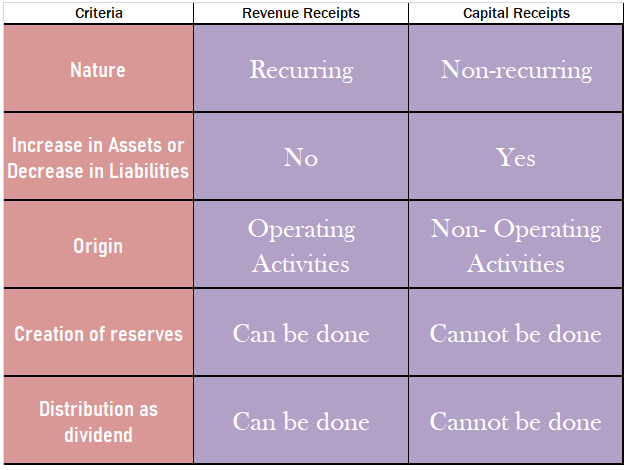
Revenue receipts: The term ‘revenue‘ suggests these are the amounts received by a business due to its operating activities. These receipts arise in a recurring manner in a business. Such receipts don’t affect the balance sheet. They are shown in the statement of profit or loss. Such receipts are essential for the survival of the business.
Examples of revenue receipts are as follows:
- Proceeds from the sale of goods.
- Proceeds from the provision of services
- Rent received
- Interest received from deposits in banks or financial institutions
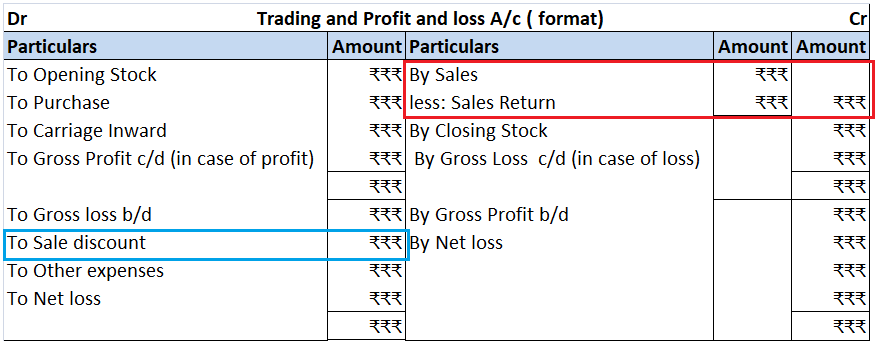
- Discount received from creditors (shown in the debit side of P/L A/c)
Capital receipts: The term ‘capital’ that such receipts are do not arise due to operating activities, hence not shown in the Profit and loss statement. These are the money received by a business when they sell any asset or undertake any liability. These receipts do not arise in a recurring manner in a business. They don’t affect the profit or loss of the business. They are not essential for the survival of the business.
Examples of capital receipts are as follows:
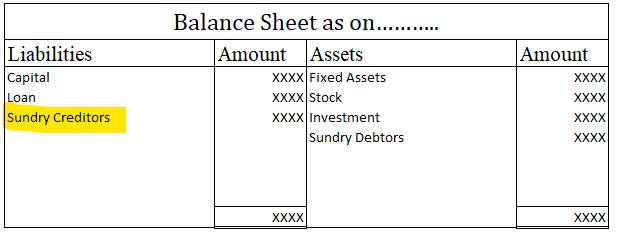
- Loan from a bank or financial institution. (Increase in liabilities)
- Proceeds from the sale of an asset. (decrease in assets)
- Proceeds from sale of investments. (decrease in assets)
- Proceeds from the issue of equity shares. (Increase in liabilities)
- Proceeds from issue of debentures. (Increase in liabilities)
I have given a table below for more understanding:
















The journal entry for asset purchase is- Particulars Amount Amount Asset A/c Dr $$$ To Bank A/c $$$ According to the Modern Approach for Assets Account: When there is an increase in the Asset, it is ‘Debited’. When there is a decreaseRead more
The journal entry for asset purchase is-
According to the Modern Approach for Assets Account:
So the journal entry here is about the purchase of an asset and since there is an increase in Asset, the assets account will be debited as per the modern rule and due to the decrease of cash in the bank account, it will be credited.
For Example, Richard purchased furniture worth Rs 6,000 for his business.
I will try to explain it with the help of steps.
Step 1: To identify the account heads.
In this transaction, two accounts are involved, i.e. Furniture A/c and Bank A/c as Richard has acquired the furniture paying a certain amount.
Step 2: To Classify the account heads.
According to the modern approach: Furniture A/c is an Asset account and Bank A/c is also an Asset account.
According to the traditional approach: Furniture A/c is a Real account and Bank A/c is also a Real account.
Step 3: Application of Rules for Debit and Credit:
According to the modern approach: As asset increases because Furniture has been bought, ‘Furniture A/c’ will be debited. (Rule – increase in Asset is debited).
Bank account is also an Asset account. As the asset is in the form of cash decreases because the amount has been paid by cash or cheque, Bank account will be credited. (Rule – decrease in Asset is credited).
According to the traditional approach: Furniture A/c is a Real account and Bank is also a Real account, for which the rule to be applied is ‘Debit what comes in and Credit what goes out’. Furniture being asset comes in the business, so Furniture A/c will be debited and as cash goes out Bank A/c will be credited.
So from the above explanation, the Journal Entry will be-
See less