


Interest on capital is the interest provided on the capital invested in the business. It is calculated as a percentage on the capital invested. Interest on capital is provided if there is any rule established by the owner of the capital. Otherwise, it is not provided. We generally encounter ‘InteresRead more
Interest on capital is the interest provided on the capital invested in the business. It is calculated as a percentage on the capital invested. Interest on capital is provided if there is any rule established by the owner of the capital. Otherwise, it is not provided.
We generally encounter ‘Interest on capital’ in partnership accounting but a sole proprietorship can also provide interest on capital.
Interest on capital is charged or appropriated from the profits of the firm. Hence, it appears on the debit side of the profit and loss account.
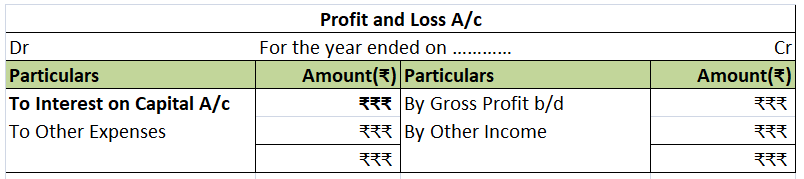
The journal entry is as follows:

The partners, in case the firm makes profit, are provided interest on their capital balance apart from their share of profit if provision of interest on capital is mentioned in the partnership deed.
Hence, interest on capital is an appropriation of profit in partnership accounting. The journal in case of partnership account is as follows:

The Interest on capital is credited to the capital/ partners’ capital account thereby increasing the capital balance. The journal is as follows:

In the balance sheet it is shown as an addition to the capital account.
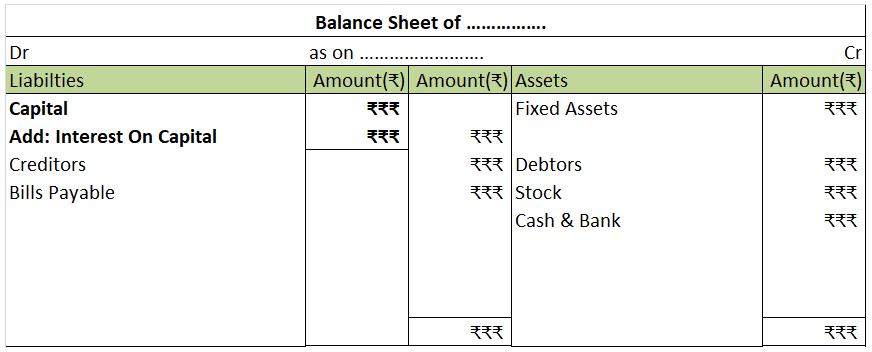
Numerical example
P, Q and R are partners. Their firm reported a net profit of ₹ 20,000. Their capitals are ₹30,000, ₹45,000 and ₹60,000. It is in their partnership deed to provide the partners 4% interest on capital and a salary of ₹5,000 per annum for Q. Calculate the interest on capital.
Solution:
Interest on capital to be provided to the partners:
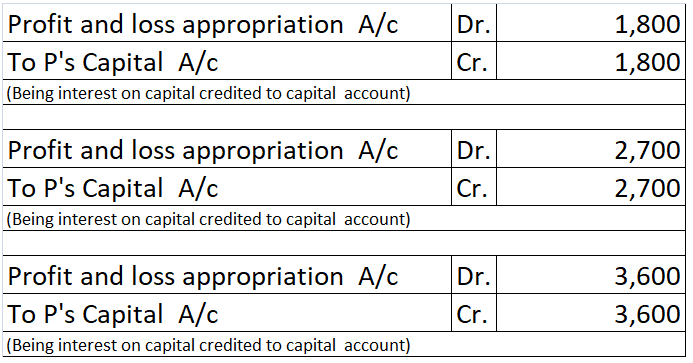
P – ₹30,000 x 6% = ₹1,800
Q – ₹45,000 x 6% = ₹2,700
R – ₹60,000 x 6% = ₹3,600
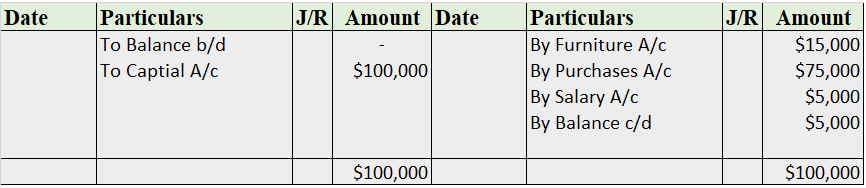
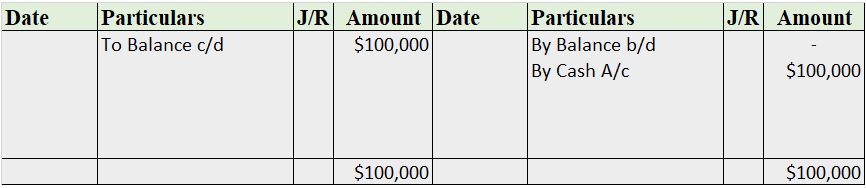
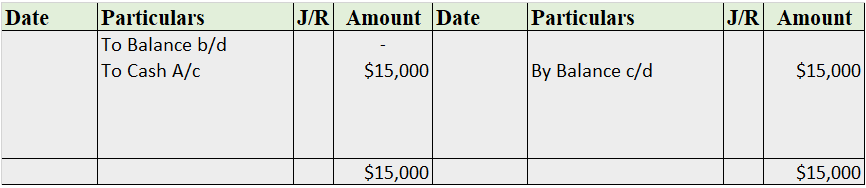
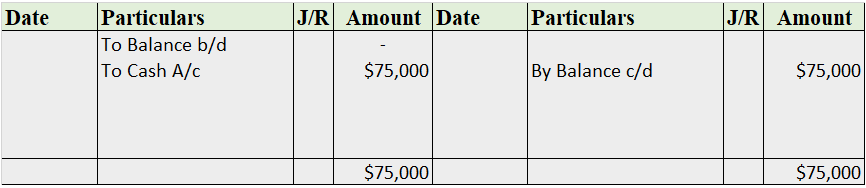
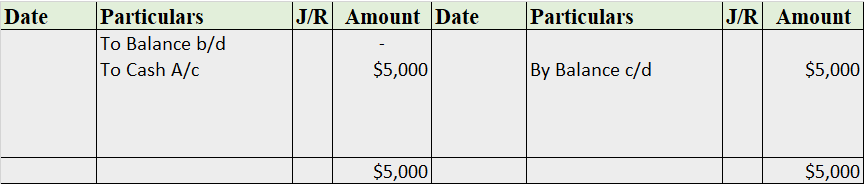
This interest will be credited to the partners’ capital. The journals are as follows:









Meaning New profit-sharing ratio is the profit-sharing ratio after the new partner is admitted in the partnership. At the time of such admission there is change in old/existing partners’ ratio too. The share of new partner’s profit is acquired from old/existing partners’ share of profit. Thus, New pRead more
Meaning
New profit-sharing ratio is the profit-sharing ratio after the new partner is admitted in the partnership. At the time of such admission there is change in old/existing partners’ ratio too. The share of new partner’s profit is acquired from old/existing partners’ share of profit.
Thus, New profit-sharing ratio can be stated as ratio in which all the partners, Old and New will share profits and losses of the partnership in future. The new profit-sharing ratio can be calculated as follows.
Formula
Sacrifice ratio is the ratio in which old/existing partners agrees to give away their share in profits for the new partner.
For better understanding let’s see how calculation of New profit-sharing ratio can be done:
Example : There are two partners in a partnership firm, Mr. Anil & Mr. Mukesh. Their profit-sharing ratio is 2:3. They wants to admit Mr. Nikhil as their third partner for 1/3rd share.
In such case, Calculation of New profit-sharing ratio would be as follows:
Total profit = 1
Mr. Nikhil’s Share = 1/3
Remaining Profit = 1 – 1/3 = 2/3
So, this remaining share of 2/3 is shared among the old partners in their old ratio of 2:3.
Mr. Anil’s Share = 2/3 x 2/5 = 4/15
Mr. Mukesh’s Share = 2/3 x 3/5 = 6/15
Mr. Nikhil’s Share = 1/3 x 5/5 =5/15
So, New ratio would be 4/15: 6/15: 5/15 i.e., 6:4:5
See less